Guinea Airways'
p. 45 · Read in the full issue
Earnings
Future of Co. in Mandated Territory
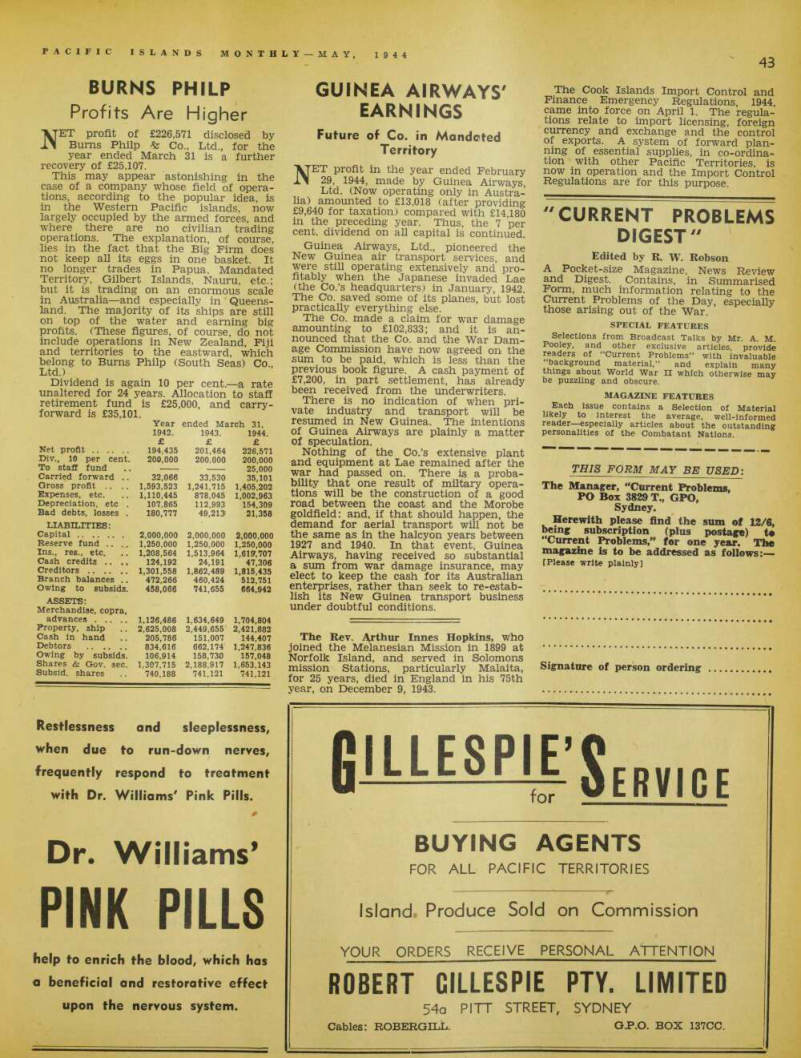
NET profit in the year ended February 29, 1944, made by Guinea Airways, Ltd. (Now operating only in Austra lia) amounted to £13,018 (after providing £9,640 for taxation) compared with £14,180 in the preceding year. Thus, the 7 per cent, dividend on all capital is continued.
Guinea Airways, Ltd., pioneered the New Guinea air transport services, and were still operating extensively and pro fitably when the Japanese invaded Lae (the Co.’s headquarters) in January, 1942, The Co. saved some of its planes, but lost practically everything else.
The Co. made a claim for war damage amounting to £102,833; and it is an nounced that the Co. and the War Dam age Commission have now agreed on the sum to be paid, which is less than the previous book figure. A cash payment of £7,200, in part settlement, has already been received from the underwriters.
There is no indication of when pri vate industry and transport will be resumed in New Guinea. The intentions of Guinea Airways are plainly a matter of speculation.
Nothing of the Co.’s extensive plant and equipment at Lae remained after the war had passed on. There is a proba bility that one result of miltary opera tions will be the construction of a good road between the coast and the Morobe goldfield: and, if that should happen, the demand for aerial transport will not be the same as in the halcyon years between 1927 and 1940. In that event, Guinea Airways, having received so substantial a sum from war damage insurance, may elect to keep the cash for its Australian enterprises, rather than seek to re-estab lish its New Guinea transport business under doubtful conditions.
The Rev. Arthur Innes Hopkins, who joined the Melanesian Mission in 1899 at Norfolk Island, and served in Solomons mission Stations, particularly Malaita, for 25 years, died in England in his 75th year, on December 9, 1943.
The Cook Islands Import Control and Finance Emergency Regulations, 1944, came into force on April 1. The regula tions relate to import licensing, foreign currency and exchange and the control of exports. A system of forward plan ning of essential supplies, in co-ordina tion with other Pacific Territories, is now in operation and the Import Control Regulations are for this purpose.