Culture Clashes In The Pacific
pp. 43-44 · Read in the full issue
Another "Brown Versus White" Study by the Rev. J. W. Burton
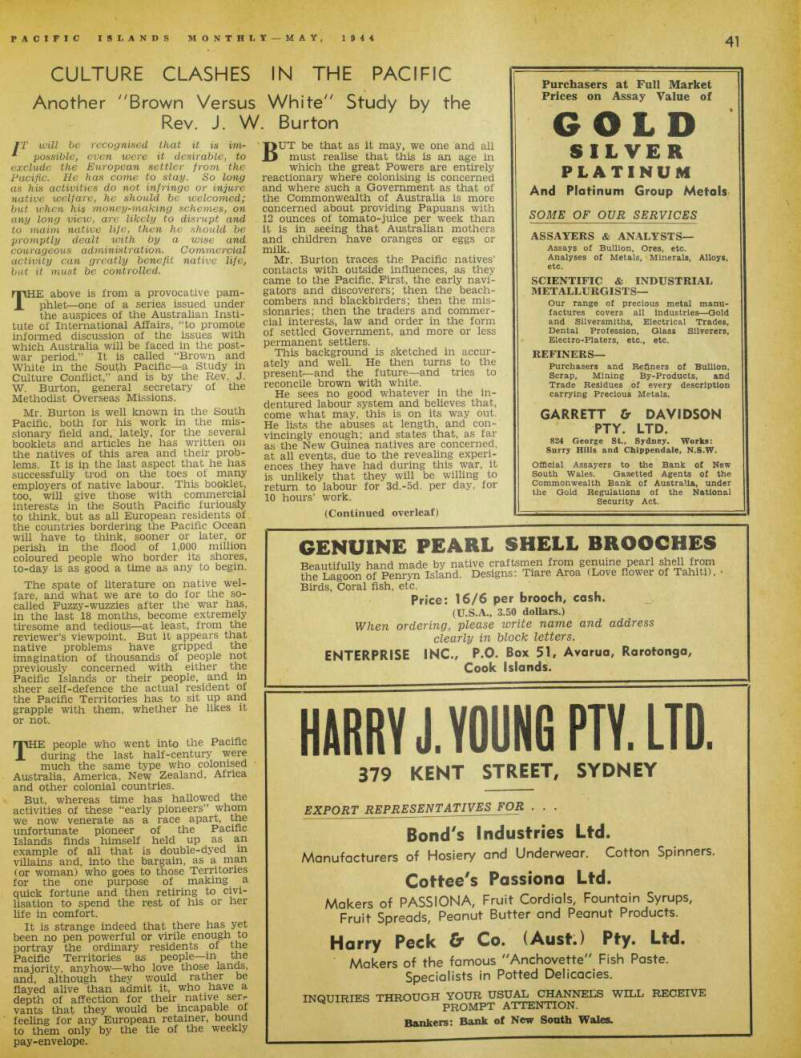
IT will he recognised that it is im * possible, even were it desirable, to exclude the European settler from the Pacific. He has come to stay. So long as his activities do not infringe or injure native welfare, he should be welcomed; but when his money-making schemes, on any long view, are likely to disrupt and to maim native life, then he should be promptly dealt with by a wise and courageous administration. Commercial activity can greatly benefit native life, but it must be controlled. rE above is from a provocative pam phlet—one of a series issued under the auspices of the Australian Insti tute of International Affairs, “to pronupte informed discussion of the issues with which Australia will be faced in the post war period.” It is called “Brown and White in the South Pacific—a Study in Culture Conflict,” and is by the Rev v J.
W. Burton, general secretary of the Methodist Overseas Missions.
Mr. Burton is well known in the South Pacific, both for his work in the mis sionary field and, lately, for the several booklets and articles he has written on the natives of this area and their prob lems. It is in the last aspect that he has successfully trod on the toes of many employers of native labour. This booklet, too, will give those with commercial interests in the South Pacific furiously to think, but as all European residents of the countries bordering the Pacific Ocean will have to think, sooner or later, or perish in the flood of 1,000 million coloured people who border its shores, to-day is as good a time as any to begin.
The spate of literature on native wel fare, and what we are to do for the so called Fuzzy-wuzzies after the war has, in the last 18 months, become extremely tiresome and tedious —at least, from the reviewer’s viewpoint. But it appears that native problems have gripped the imagination of thousands of people not previously concerned with either the Pacific Islands or their people, and in sheer self-defence the actual resident of the Pacific Territories has to sit up and grapple with them, whether he likes it or not. rE people who went into the Pacific during the last half-century were much the same type who colonised Australia, America, New Zealand, Africa and other colonial countries.
But, whereas time has hallowed the activities of these “early pioneers” whom we now venerate as a race apart, the unfortunate pioneer of the Pacific Islands finds himself held up as an example of all that is double-dyed in villains and, into the bargain, as a man (or woman) who goes to those Territories for the one purpose of making a quick fortune and then retiring to civi lisation to spend the rest of his or her life in comfort.
It is strange indeed that there has yet been no pen powerful or virile enough to portray the ordinary residents of the Pacific Territories as people—in the majority, anyhow—who love those lands, and, although they would rather be flayed alive than admit it, who have a depth of affection for their native serr vants that they would be incapable of feeling for any European retainer, bound to them only by the tie of the weekly
pay-envelope.
BUT be that as it may, we one and all must realise that this is an age in which the great Powers are entirely reactionary where colonising is concerned and where such a Government as that of the Commonwealth of Australia is more concerned about providing Papuans with 12 ounces of tomato-juice per week than it is in seeing that Australian mothers and children have oranges or eggs or milk.
Mr. Burton traces the Pacific natives’ contacts with outside influences, as they came to the Pacific. First, the early navi gators and discoverers; then the beach combers and blackbirders; then the mis sionaries; then the traders and commer cial interests, law and order in the form of settled Government, and more or less permanent settlers.
This background is sketched in accur ately and well. He then turns to the present—and the future —and tries to reconcile brown with white.
He sees no good whatever in the in dentured labour system and believes that, come what may, this is on its way out.
He lists the abuses at length, and con vincingly enough; and states that, as far as the New Guinea natives are concerned, at all events, due to the revealing experi ences they have had during this war, it is unlikely that they will be willing to return to labour for 3d.-sd. per day, for 10 hours’ work.
(Continued overleaf)
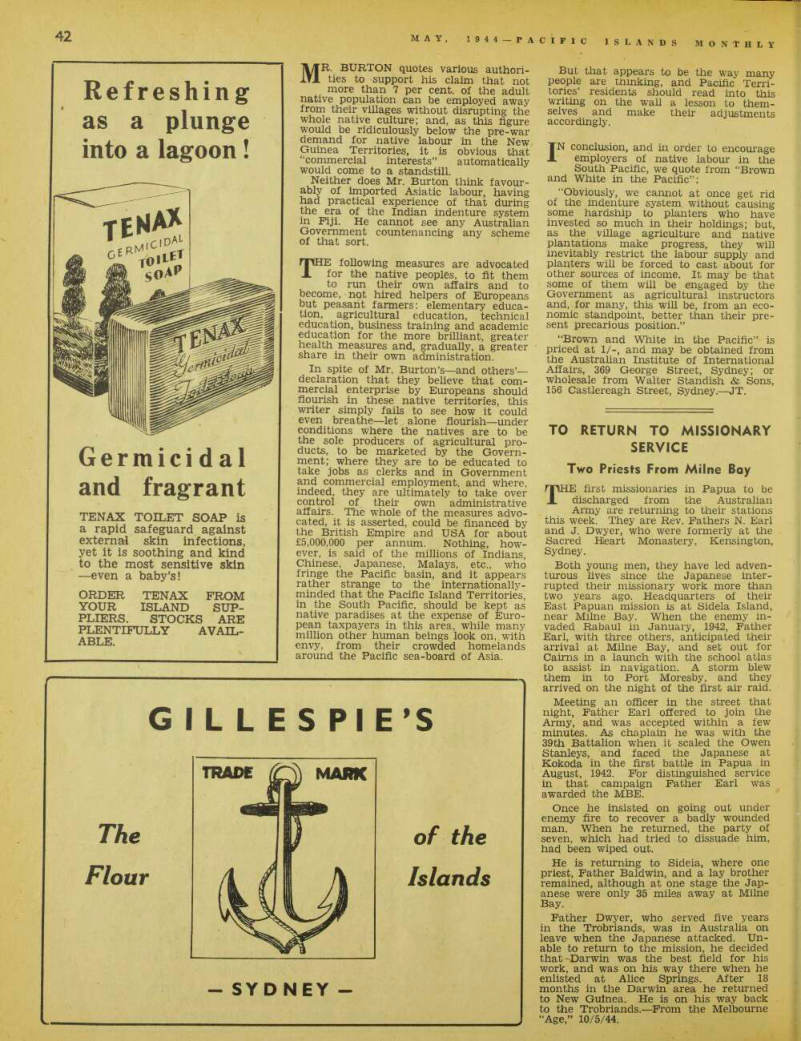
MR. BURTON quotes various authori ties to support his claim that not more than 7 per cent, of the adult native population can be employed away from their villages without disrupting the whole native culture; and, as this figure would be ridiculously below the pre-war demand for native labour in the New Guinea Territories, it is obvious that “commercial interests” automatically would come to a standstill.
Neither does Mr. Burton think favour ably of imported Asiatic labour, having had practical experience of that during the era of the Indian indenture system in Fiji. He cannot see any Australian Government countenancing any scheme of that sort. rpHE following measures are advocated X for the native peoples, to fit them to run their own affairs and to become, not hired helpers of Europeans but peasant farmers: elementary educa tion, agricultural education, technical education, business training and academic education for the more brilliant, greater health measures and, gradually, a greater share in their own administration.
In spite of Mr. Burton’s—and others’— declaration that they believe that com mercial enterprise by Europeans should flourish in these native territories, this writer simply fails to see how it could even breathe—let alone flourish—under conditions where the natives are to be the sole producers of agricultural pro ducts, to be marketed by the Govern ment; where they are to be educated to take jobs as clerks and in Government and commercial employment, and where, indeed, they are ultimately to take over control of their own administrative affairs, 'pie whole of the measures advo cated, it is asserted, could be financed by the British Empire and USA for about £5,000,000 per annum. Nothing, how ever, is said of the millions of Indians, Chinese, Japanese, Malays, etc., who fringe the Pacific basin, and it appears rather strange to the internationally minded that the Pacific Island Territories, in the South Pacific, should be kept as native paradises at the expense of Euro pean taxpayers in this area, while many million other human beings look on. with envy, from their crowded homelands around the Pacific sea-board of Asia.
But that appears to be the way many people are thinking, and Pacific Terri tories’ residents should read into this writing on the wall a lesson to them selves and make their adjustments accordingly.
IN conclusion, and in order to encourage employers of native labour in the South Pacific, we quote from “Brown and White in the Pacific”: “Obviously, we cannot at once get rid of the indenture system without causing some hardship to planters who have invested so much in their holdings; but, as the village agriculture and native plantations make progress, they will inevitably restrict the labour supply and planters will be forced to cast about for other sources of income. It may be that some of them will be engaged by the Government as agricultural instructors and, for many, this will be, from an eco nomic standpoint, better than their pre sent precarious position.”
“Brown and White in the Pacific” is priced at 1/-, and may be obtained from the Australian Institute of International Affairs, 369 George Street, Sydney; or wholesale from Walter Standish & Sons, 156 Castlereagh Street, Sydney.—JT.