Interesting Sidelight on
pp. 23-24 · Read in the full issue
Trade Report For
1943 Interesting Sidelight on Wartime Fiji
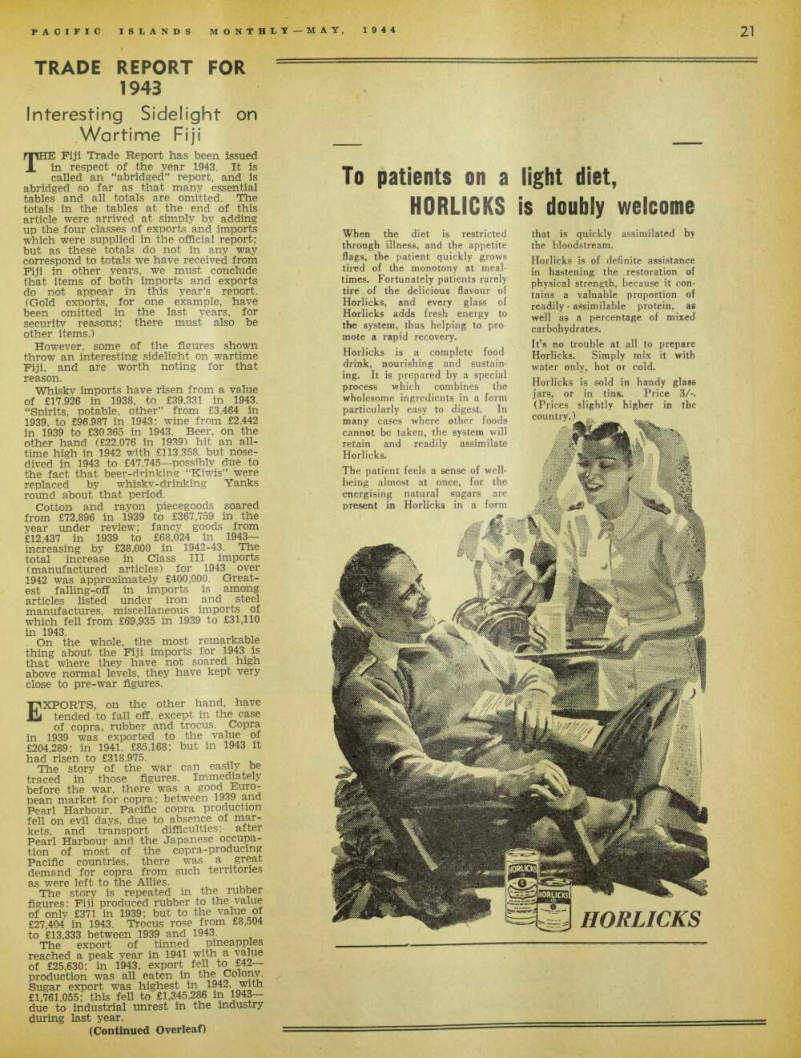
mHE Fiji Trade Report has been issued X in respect of the year 1943. It is called an “abridged” report, and is abridged so far as that many essential tables and all totals are omitted. The totals in the tables at the end of this article were arrived at simply by adding up the four classes of exports and imports which were supplied in the official report; but as these totals do not in any way correspond to totals we have received from Fiji in other years, we must conclude that items of both imports and exports do not appear in this year’s report. (Gold exports, for one example, have been omitted in the last years, for security reasons; there must also be other items.) However, some of the figures shown throw an interesting sidelight on wartime Fiji, and are worth noting for that reason.
Whiskv imports have risen from a value of £17.926 in 1938, to £39.331 in 1943.
“Spirits, potable, other” from £3,464 in 1939. to £96.987 in 1943: wine from £2.442 in 1939 to £30365 in 1943. Beer, on the other hand (£22.076 in 1939) hit an all time high in 1942 with £113.358. but nose dived in 1943 to £47.74s—possibly due to the fact that beer-drinkine “Kiwis” were replaced by whiskv-drinking Yanks round about that period.
Cotton and rayon piecegoods soared from £72,896 in 1939 to £367,759 in the year under review; fancy goods from £12,437 in 1939 to £68,024 in 1943 increasing by £38,000 in 1942-43. The total increase in Class 111 imports (manufactured articles) for 1943 over 1942 was approximately £400,000. Great est falling-off in imports is among articles listed under iron and steel manufactures, miscellaneous imports of which fell from £69,935 in 1939 to £31,110 in 1943. , On the whole, the most remarkable thing about the Fiji imports for 1943 is that where they have not soared high above normal levels, they have kept very close to pre-war figures.
EXPORTS, on the other hand, have tended to fall off, except in the case of copra, rubber and trocus. Copra in 1939 was exported to the value of £204,289; in 1941. £85,168; but in 1943 it had risen to £318.975.
The story of the war can easily be traced in those figures. Immediately before the war, there was a good Euro pean market for copra; between 1939 and Pearl Harbour, Pacific copra production fell on evil days, due to absence of mar kets. and transport difficulties: after Pearl Harbour and the Japanese occupa tion of most of the copra-producing Pacific countries, there was a great demand for copra from such territories as were left to the Allies.
The story is repeated in the rubber figures: Fiji produced rubber to the value of only £371 in 1939; but to the value of £27,404 in 1943. Trocus rose from £8,504 to £13,333 between 1939 and 1943.
The export of tinned pineapples reached a peak year in 1941 with a value of £25,630; in 1943, export fell to £42— production was all eaten in the Colony.
Sugar export was highest in 1942 with £1,761.055; this fell to £1,345,286 in 1943due to industrial unrest in the industry during last year. (Continued Overleaf)
(Continued from Page 21)
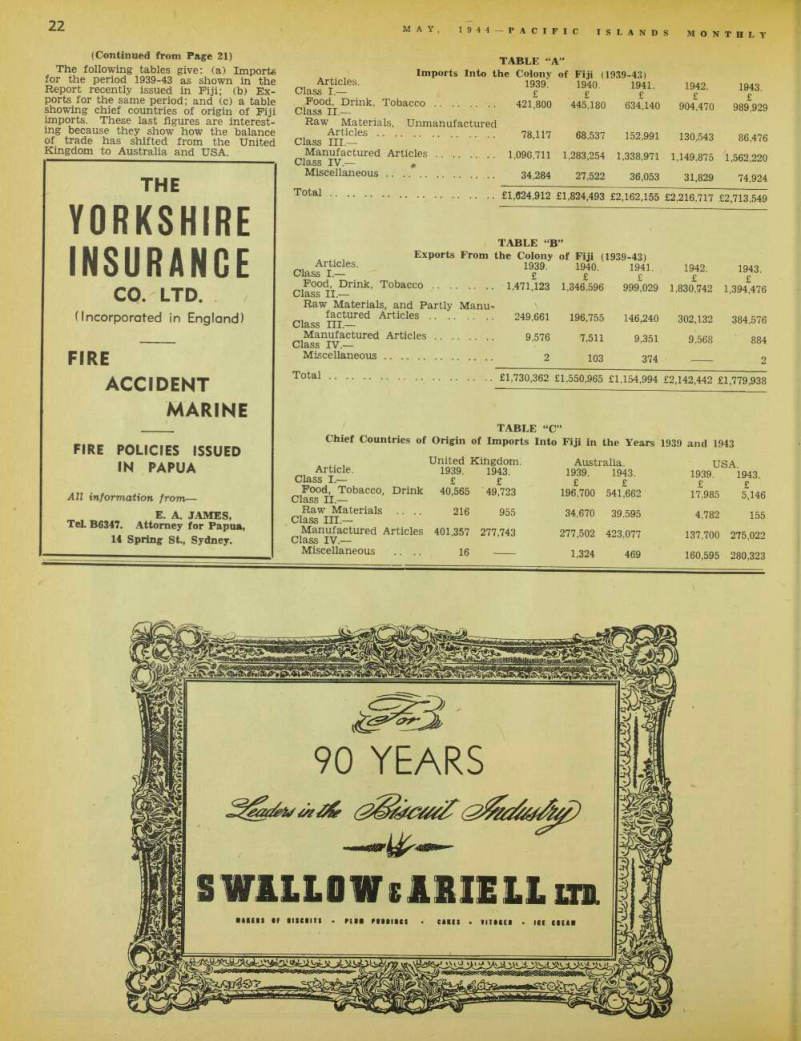
The following tables give: (a) Imports for the period 1939-43 as shown in the Report recently issued in Fiji; (b) Ex ports for the same period; and (c) a table showing chief countries of origin of Fiji imports. These last figures are interest ing because they show how the balance of trade has shifted from the United Kingdom to Australia and USA.
Table “A”
Imports Into the Colony of Fiji (1939-43) Articles. 1939 Class I.— £ 1940. £ 1941. £ 1942. £ 1943. £ Food, Drink, Tobacco 421 800 Class II.— 445.180 634,140 904,470 989,929 Raw Materials, Unmanufactured Articles 78 117 Class III.— 68,537 152,991 130,543 86,476 Manufactured Articles 1,090,711 1,283,254 Class IV.— * 1,338,971 1,149,875 1,562,220 Miscellaneous 34 284 27,522 36,053 31,829 74,924 £2,713,549
Table “B”
Exports From the Colony of Fiji (1939-43) Articles.
Class I.— 1939. £ 1940. £ 1941. £ 1942. £ 1943. £ Food. Drink, Tobacco .. ..
Class II. — .. .. 1,471,123 1,346.596 999,029 1.830.742 1,394,476 Raw Materials, and Partly Manufactured Articles .. ..
Class III.— • . .. 249,661 196,755 146,240 302,132 384,576 Manufactured Articles .. . 9 576 7,511 9,351 9,568 884 Class IV.— Miscellaneous 2 103 374 o Z Total ’ ’ ’ ’ 9 X/i,i iy,yuo
Table “C
> Chief Countries of Origin of Imports Into Fiji in the Years 1939 and 1943 Article.
Class I.— United Kihgdom.
Australia.
Its A
1939. £ 1943. £ 1939. £ 1943. £ 1939. £ 1943. £ Food, Tobacco, Drink Class II.— 40,565 49.723 196,700 541,662 17,985 5,146 Raw Materials ..
Class III.— 216 955 34,670 39,595 4,782 155 Manufactured Articles Class IV.- 401,357 277,743 277,502 423,077 137,700 275,022 Miscellaneous .. .. 16 — 1,324 469 160,595 280,323