Introduction To The Jungle
pp. 18-20 · Read in the full issue
The Wewak-Aitape District in the Time Along Before
By Judy Tudor
rE steps of the house were shaded by a huge hibiscus bush as I sat there, kicked my heels, counted my money, and wondered when, where and if I ate.
Somewhere out in front of me, hidden by the coconuts and garden that clustered around the house of Boram plantation was the “Macdhui” which I had left an hour before. Away over to the left, vaguely, across the shimmering water I could glimpse through more trees, was Wewak. And behind me, somewhere even more vaguely, “in the bush” or coming over those green hulks of mountains, was, I sincerely hoped, my immediate family.
In Australia, Wewak and beyond had meant little except a foreign, outlandish spot, to anyone. On the “Macdhui,”
Wewak had meant a number of things to everyone—and none of them pleasant. It was “no fit place for women.” And this being the general attitude, I wanted to tear off into the bush without delay and start being a pioneer, just to prove it could be done. The sort of delay I was suffering right then—caused by the early arrival of the “Macdhui” and the nonarrival of the men—irritated me unreasonably.
I had examined the house into which I had been thrust by the plantation people (who, in the throes of “boat day”
and consequent copra-loading, seemed to be hitting an all-time low in hospitality); all of it—the central room for disrobing, the protuberance at one end fitted with a black, wheezy stove, and the tiny, screened-off piece of verandah furnished with a shower bucket. Scattered around the verandah were some grass mats and cane furniture—making altogether, had I but known it, a palace in comparison with the buildings I would call house and home from that time onwards, I had also examined, through the reed curtains, another and larger residence, separated from this by a few feet of bare brown earth. There was life in this place: a great coming and going of assorted natives, in and out of the attached kitchen where smoke belched perpetually in a grey cloud. A line of bed-sails and mosquito nets and white men in various stages of pyjama-ed, or short-and-singleted undress, all unaware that a member of the sex who had no place thereabouts was examining them from a distance of a few feet. Most interesting: that place had atmosphere!
I learned later that this was the rest house—known locally as the “Blood House.” Most men stayed there at some stage of their lives in the district, and when it was mentioned always said, off
handedly, “Oh yes, the Blood House ha-ha! The Blood House was where men were men; and no-women-by-request.
ISAT and pondered, while the natives walked by, and listened to the mur mur of voices from the Blood House and an occasional outburst of profanity from the same direction. Noon came and went. It was afternoon —and still no sight of the men. As I became pro gressively emptier physically, so I men tally became more fed up. Finally I got very mad.
Then the men appeared, in a lather of perspiration, having sighted the “Mac dhui” from a distant point. I was beyond caring whether they came or not, I did not even permit myself to inquire: “Where the devil have you been?” I merely said “Hullo,” and evaded being kissed.
Half a dozen boys, of varying sizes and degrees of ugliness, hung round in the background, until dismissed to search out some poles for the bed-sails. We retreated to the district’s one store, selected what we needed from the shelves, bailed up a man who seemed to have some connec tion with the concern, and asked him to write it down in a docket-book.
This man succeeded in shaking me considerably. He looked me up and down, evidently comparing me (unfavourably) with the chunks of muscle and brawn I had seen for myself in the Blood House, and said: “How are you going to get out to the Nagum? Be carried?”
In the last, brief half-hour I had had a resume of the troubles of the Tudor clan—consisting mainly of labour, lack of labour, lack of carriers in that coastal district, and all allied subjects. Could the family labdur-line be diverted from carry ing goods to carrying me about the country? No—my stay would be short, and I knew it.
“Certainly not!” I replied. “I’ll walk— I’m a good walker.”
“H’mm,” he snorted, “You don’t look it! Well—you’ll get in, I suppose, but you’ll probably have to be carried out.”
What a pig of a man, I thought—must have one of these tropical livers. I made certain inquiries about the state of the terrain and was informed that it was a bit rough—but “alright,”
BACK in the house, bed-construction went on around us, while a boy slapped down on the table three enamel mugs, a collection of plates, a tin of milk and one of butter, some crackers and cheese, a great black billy of tea and a bottle of beer. We talked among the remnants until it was dark and another meal, on the same general pattern, but greater by the addition of two tins of “army rations” and one tin of peaches, made an abrupt appearance. Someone had suggested sending to the mission for bread, but no one had got round to it.
We helped out the meal with more cr a ckers Next morning, a Tul-Tul, from a vil
lage two hours away from where we were bound came in with eight followers, and consented to help us on our way. The Tul-Tul wore his official peaked cap teetering on top of his mat of hair, a filthy
lap-lap and a leather belt. He had a mutilated ear, a flattened nose, lips like young steps and a general, all-over, low heeled look. Subsequent experience proved that he could be pressed into most services by the judicious use of a few well-chosen words and the greasing of his dirty paw with a couple of shillings.
We spent an hour pulling down beds and making ready for the road, then crossed the river, and down the winding path through the coconuts, over the headland at Wewak, and on along the beach “Well eat at Yarabos,” they said. Well, so far so good—a dozen miles of easy going. Who wanted to be carried?
By noon, we were in the middle of the coastal swamp—and Yarabos. We ate in the rickety rest-house. More crackers — and tinned butter curdled on top—a paw paw from a deserted plantation, and a gallon of tea. On we went. About three, they said: “We turn off here, and go inland. We climb now.”
WE climbed. Up and up and always up, slipping and sliding on the damp track, dragging one’s feet out of the squelching bogs, sending down a rubble of stpnes in the dry patches. From tree root to tree-root, helped by a stick, along the ravines, stopping to catch one’s “wind,” or to burn off some leeches. And at last, long last, the cleared approach to the village, and the village itself.
Typical of the small scattered villages of that region—a few houses built on the semi-flat of the mountain-top, coconut trees around the rim, paw-paw groves and, further off, a small garden plot. The track we had followed wound steeply up from the sea-fall, and another went down even more sheerly on the other side of the village.
We had our last glimpse of the sea from the rest-house that evening—a glimpse that had to suffice for more than 12 long months—a soft, opalescent glim mer in the setting sun. On the other side of the village, looking inland, there were only valleys, dark and ominous in the quickly deepening evening, and heav ily-timbered mountains rising one from the other.
We ate our evening meal by the dis mal light of the small hurricane lantern and settled down into the brooding silence of the half-deserted village. One’s feel ings were dulled and vague, as though
muffled in a black velvet curtain, and the small noises of the night stood out but momentarily,, fading quickly into the blackness of our mountain eyrie. Fire flies flittered by, but no wind disturbed
the coconuts and only an occasional word came from the boys.
We were on our way again soon after daybreak. Down the side of the moun tain we had climbed so bitterly the pre vious evening, then for hours along the ridges and spurs, up and down, down and up—endlessly.
I walked myself into a state of blind plodding. Nine steps to the accompani ment of Sorry-I-was-rude-to-the-man at-Boram. Nine more on the same theme. Again and again, until at last the last grassy saddle, the last “top,” and the last “down” into the cool Schill ing River, along it, up- to our shorts in water, over into the swirling Nagum; the last little pinch up the soggy track. We were mud-spattered, sweat soaked and oozed water —but we had arrived.
Down below, a scattering of native built houses, planked down without design or plan, dwarfed by the moun tains, hemmed in by thick jungle. But, oh Lord, just then, so very, very good. * ♦ * IT was 18 months before I did the “for ward” journey again. In that time we had moved five days further inland from our Nagum camp; planes had come to the Sepik and landed vari ously at But, Maprik (on the Sepik plain), and Worn; but not Wewak, where
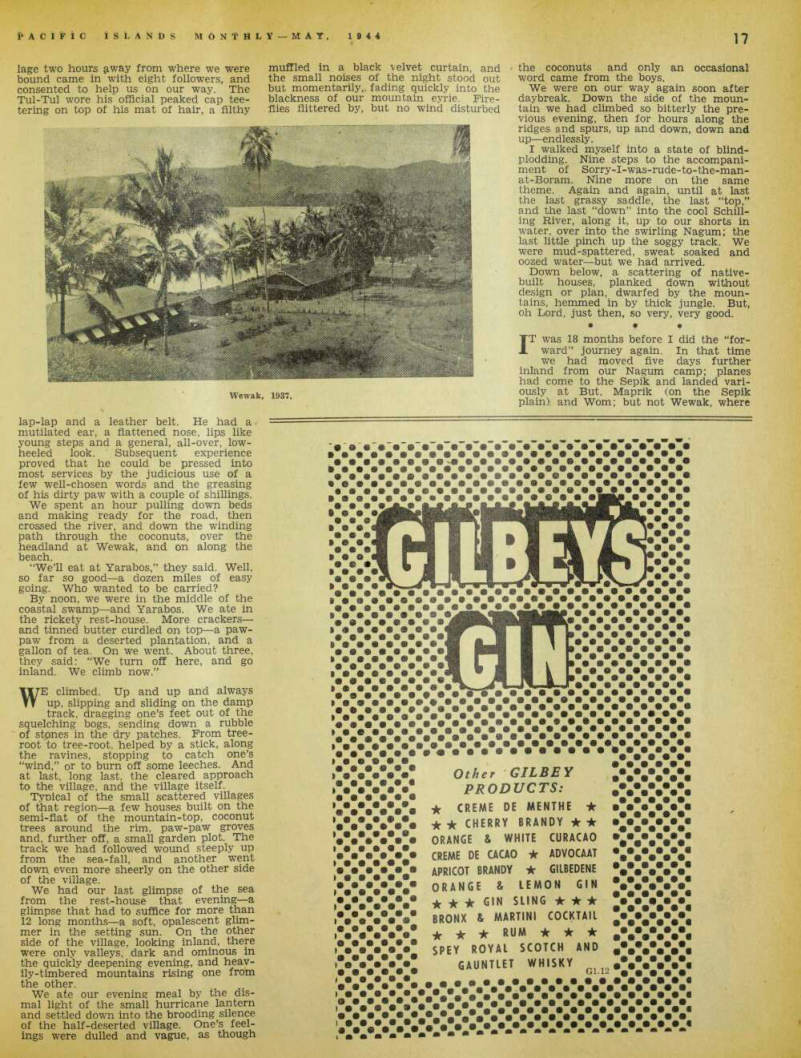
Wewak, 1937.
the ’drome had yet to be built. There was a W. R. Carpenter store at But, and on this trip I travelled like a.lady. From Boram to But, eight hours m the plantation schooner: But to Mapnk, half an hour by plane, and the last four hours over the range by boot.
At Boram, perched on top of a pile of gear, painfully, slowly against the makmg tide, we were rowed out and hauled ourselves on board this typical Islands schooner: a clayed-in stove, two camp stretchers under an awning, a sentrybox dangling over the stern half-sized and ominous. I reconnoitred this last contrivance from afar and decided that, come what may, it was not for me.
It was on this trip that I committed the social faux pas of sleeping with good old .r~: l*>e sha U be nameless). It was m this fashion: I kicked off my shoes and crawled into the one unoccupied bed as soon as we got aboard and, hours later, when we sailed out on a full tide, silvered with moonlight, I went to sleep.
Came the dawn. I awoke, turned, fCe D «ir of fST MvTert wlri ta someone’s I oneriedone eve and peered ove? the edge of the c?tton bllSkerkindW nrovideri b? 1 thp nant of the P bed Behold—a bed mate P At some time in the semi darkmfif’ of the „ S £ht a™d Tn ‘an aftomathTf °a Boram celebration, he must have spied knowing Cl whn d mplfNbp hirin’ hnff in top h lf ’ h crawled in at the bottom.
I had disturbed him, and he woke, lifted his head, and automatically surveyed the scene. Then his eyes met mine.
Sleep melted miraculously; amazement gave place to horrified embarrassment.
His head flopped back for a moment, while he digested this strange thing, then it popped up again for another look.
This time, sure that I was no part of a hang-over, he cautiously disentangled himself from the blanket, groped for his shoes on the deck and beat a retreat.
The whole drama, occupying in all about two minutes, had been carried out in complete and heavy silence.
We were off But at eight. But, like the whole of that northern coast, is open to the full blast of the north-west sea son; but on that morning there was little but a lacy frill of white on the reef, and the mountains behind, standing like green sentinels between us and home, were clear of their early mists. The yel low beach, bordered by a thick fringe of coconuts, was swept clean by the tide.
Inland from Aitape the mountains rise again to towering peaks, but along this Wewak-Aitape coast, the formidable mountain giants do not stand perpen dicularly up from the sea in seven or eight thousand feet peaks, as they do further south. It is bad enough coun try to negotiate, but its problems of ter rain and transport are less in degree if not in number. mO-DAY, as this is being written, Aus- J[ tralian units are pressing along the „ coast from Madan| ilSafen 6 A bed forces have occu P ied Hollandia and Altape ’ and RAAF ™ its ar e using Tadji anstnp, close to Aitape, from which to bomb Jap posts between there and JJadang. It is obvious that the hours of f^, tt J ,? panese are numbered in that Not qn «drant?p nnw npi-hnnc +n this northern district as a great poten tial AlUed base— a hopping-off place for some other milestone nearer Tokio But viewed in the cold light of their pre-war isolation, it is strange indeed to see these backwaters assuming world-wide import ance. y Wewak and its hinterland mustered a population of perhaps a couple of hun dred Europeans: Aitape fluctuated around the half-dozen mark. Wewak had a gold industry, but Aitape, with a bad anchor age, thin native population, soil too poor and transport too difficult to make it a profitable copra producing centre, was on
the map merely as a hopping-off place for recruiters, who found a fertile field for their labours in the well-populated districts over on the landward fall of the ranges.
The coastal natives certainly and probably many from the hinterland, have had 16 months of Jap “co-prosperity” in this area. Here, then, will be a job for the men of ANGAU. But what of the future?
As the Americans and Australians have progressed in New Guinea, so have the public, through the Press, become aware of the country’s “vast potentialities”
Rubber for Papua; coffee tea quinine for the Upper Ramu What is in store for the Sepik-Aitape district? Before the war, hundreds of thousands of pounds had been spent on oil-search in that area, and residents had high hopes that petroleum would be found. It will be strange, indeed, if the Army, and the newshounds who have done some pretty sizable discovering in New Guinea in the last two years, do not re-orientate Aitape as a “vast potential oil-producer.”
And with the Army’s amazing capacity for producing vast quantities of money and equipment at will—a trick beyond the Powers of peacetime private enterprise or Territories Administrations—there may be a great deal in the idea, at that, A skipper well known in the Pacific over a number of years, Captain D. H.
Cambridge, has retired from the sea because of ill-health and will live per manently at Rarotonga. Captain Cam bridge was formerly master of the Mela nesian Mission ship, “Southern Cross,” and has commanded three schooners in Cook Islands waters during recent years.
“ Under a new contract, made recently, the French Colony of Tahiti has agreed to sell the United States a further 10,000 tons of copra at the maximum price of 67.54 dollars per ton f.o.b. Papeete.