Remarkable Possibilities of High Country
pp. 15-16 · Read in the full issue

Fiji For Mixed Farming
A DISCUSSION on a proposal by the Fiji Returned Soldiers and Sailors' Association, thaj; steps now be taken to prepare for the settlement on the land of suitable ex-servicemen, has brought to light interesting information about the possibilities of Fiji as a home for Euro pean and part-European mixed farmers.
The Association, in its 1943 report, pointed out that, although Fiji’s two chief industries are sugar-growing and gold-mining (measured in terms of pro duction and export), only part of the income from sugar and none from gold remain in the Colony. It was urged, therefore, that every encouragement should be given to the settlement of individual farmers and planters; and the claims of coconut-planting, banana growing and dairying were mentioned, in that order. It was suggested that a wider market could be found for Fiji bananas, possibly in western Canada.
This brought an interesting rejoinder from Mr. Theo D. Riaz. who has lived in Fiji for 40 years, and who is a successful farmer and planter in Nadarivatu, in the Colo North (western) section of Viti Levu. He is a practical man. who under stands agricultural life in Fiji.
Mr. Riaz has prepared, for the RSS Association (of which, as a Boer War veteran, he is a member) a detailed plan for the establishment of settlements for ex-servicemen; and the following are extracts from his covering letter.
“fIIHE president has placed considerable JL t stress upon the coconut and banana growing industries as avenues for the settlement of ex-servicemen, whilst the dairying industry is dismissed with something akin to contempt.
“As coconut-planting has been given pride of place, I will deal with that first.
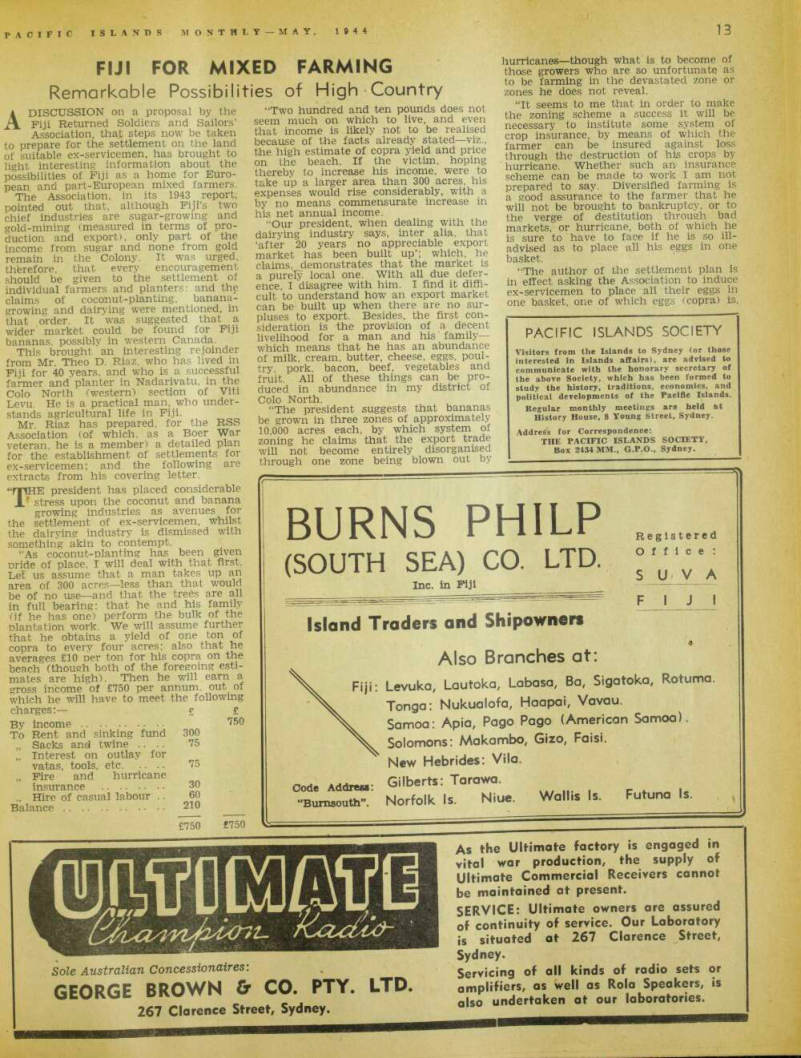
Let us assume that a man takes up an area of 300 acres—less than that would be of no use—and that the trees are all in full bearing; that he and his family (if he has one) perform the bulk of the plantation work. We will assume further that he obtains a yield of one ton of copra to every four acres; also that he averages £lO per ton for his copra on the beach Cthouah both of the foregoing esti mates are high). Then he will earn a gross income of £750 per annum, out of which he will have to meet the following charges;— £ £
“Two hundred and ten pounds does not seem much on which to live, and even that income is likely not to be realised because of the facts already stated—viz., the high estimate of copra yield and price on the beach. If the victim, hoping thereby to increase his income, were to take up a larger area than 300 acres, his expenses would rise considerably, with a by no means commensurate increase in his net annual income.
“Our president, when dealing with the dairying industry says, inter alia, that ‘after 20 years no appreciable export market has been built up’; which, he claims, demonstrates that the market is a purely local one. With all due defer ence, I disagree with him. I find it diffi cult to understand how an export market can be built up when there are no sur pluses to export. Besides, the first con sideration is the provision of a decent livelihood for a man and his family— which means that he has an abundance of milk, cream, butter, cheese, eggs, poul try. pork, bacon, beef, vegetables and fruit. All of these things can be pro duced in abundance in my district of Colo North.
“The president suggests that bananas be grown in three zones of approximately 10,000 acres each, by which system of zoning he claims that the export trade will not become entirely disorganised through one zone being blown out by
hurricanes—though what is to become of those growers who are so unfortunate as to be farming in the devastated zone or zones he does not reveal.
“It seems to me that in order to make the zoning scheme a success it will be necessary to institute some system of crop insurance, by means of which the farmer can be insured against loss through the destruction of his crops by hurricane. Whether such an insurance scheme can be made to work I am not prepared to say. Diversified farming is a good assurance to the farmer that he will not be brought to bankruptcy, or to the verge of destitution through bad markets, or hurricane, both of which he is sure to have to face if he is so ill advised as to place all his eggs in one basket.
“The author of the settlement plan is in effect asking the Association to induce ex-servicemen to place all their eggs in one basket, one of which eggs (copra) is,
By income <50 To Rent and sinking fund 300 „ Sacks and twine ... 75 „ Interest on outlay for vatas, tools, etc 75 „ Fire and hurricane insurance 30 .. Hire of casual labour .. 60 Balance 210 £750 £750
in my opinion, already badly addled. I think that there are possibilities in bananas—not as a major crop, but as an adjunct to dairying; and the maximum area which any one farmer should have under bananas ought not to exceed 10 acres—and this should be worked on a 25 per cent, rotation basis.
“■pvAIRYING, in my opinion, embraces U banana-growing, the breeding of pigs for pork and bacon curing, cattle for butcher’s meat, the production of milk for the manufacture of cheese as well as butter, together with the growing of potatoes and other vegetables.
“I am writing this on November 20, 1943, and I am looking out on a good bed of cauliflower, magnificent Ponderosa tomatoes, and good English cabbage, also parsnips and beetroot. The seeds for these were sown on July 12, 1943. This morning, I dug one hill of potatoes which yielded 12 well-shaped tubers, not one of which weighed less than 8 oz. I may mention, in passing, that the potatoes
were planted on August 28, 1943—and this is the off-season for all these vege tables on the coastal areas, “European women have lived for long periods in this (Navai) Valley without suffering any ill-effects, and these women do most of their own housework. Euro pean children born and living here all have ros y cheeks.
“European men have been living here for years on end doing heavy work, log ging in the bush and toiling in the saw mill without loss of efficiency or suffering in health, and you may believe me when I say that these men toil here for nine hours per day as hard as they do at simi lar work in New Zealand—whence they all come—or Australia.”
TN his detailed plan for a soldiers’
JL settlement, Mr. Riaz bases his cal culations on areas, which he calls Na Dala No, 1 and No. 2, in the Colo North district of Viti Levu. There are there 15,000 acres of freehold and 5,000 acres
of native-owned land. The following are extracts: “The area has a mean elevation of 2,300 feet above sea-level, the land is rich, and the climate cannot be bettered in any part of the world. The tempera ture falls as low as 35 degrees Fahr. dur ing June-July-August, and 35 degrees Fahr. was recorded in the middle of November, 1942, 90 degrees being maxi mum summer heat. The area is heavily timbered and well watered.
“Cattle, horses, pigs, and poultry do exceptionally well. Bananas also do well, whilst the soft-skinned purple passion fruit grows wild in the bush and bears prolific crops of fruit of excellent flavour.
Citrus fruit does' well, lemons crrow wild throughout the area, and coffee bears heavy crops of large-sized beans. Pota toes and most other European vegetables grow well, and yield fairly good crops Maize yields goods crops of grain and paspalum dilatatum is grown on most of the cleared areas, and spreads rapidly throughout the area. Cocksfoot grass will grow satisfactorily.
“The land should be surveyed into suitable sized blocks of from 60 to 120 acres each, and thrown open for selec tion on 99 years’ lease with the right of renewal.
“The farms should be ballotted for, and only approved ex-servicemen of European and mixed Euronean-Fijian descent should be accented as three or four civilians with a practical knoweldge of farming on bush land, who should act as mentors. Rent should be from 6d. to 1/- per acre per annum.”