Ebb-Tide In New Guinea
p. 10 · Read in the full issue
Two and a Half Years' Campaign Ending as Japs Are Chased Over the Border
MILITARY activity on the New Guinea mainland has been reduced prac tically to mopping-up operations in the Maaang-WewaK-But area. Attention is focused over the border, in Hollandia, and the tide of war has receded so aoruptiy from former active bases fur ther south, m Papua and the old Man dated Territory, that much comment has come from correspondents. Said “Sydney Morning Herald correspondent, H. J.
Summers, on May 4; "Hundreds of miles of road built round bases that were humming with activity only weeks ago are now carrying but a small fraction of their former traffic.
“Miles of air-strips laid down a few months ago have already served their purpose, and are deserted. Camps that covered, altogether, scores of square miles have been left by departing troops to be over-run by the swiitly-growing tropical vegetation.’
After almost years of the bitterest campaignmg in the history of modern warfare, New Guinea, as a theatre of active land operations, will soon become a matter of mere recorded history. The scene has changed greatly since those dark days of early 1942, when, with the tide running strongly against us, a few men, badly equipped for jungle fighting and knowing nothing of New Guinea, stood between the sons of Nippon and the completion of their southward march.
With the Battle of the Coral Sea, and the first land defeat of the Japs at Milne Bay, the tide, almost imperceptibly, turned. At that time, enemy forces were across the Owen Stanleys and only 32 miles airline from Port Moresby, but that marked the beginning of a retreat that brought the Japs in April, 1944, across the border into Netherlands New Guinea, to Hollandia; and that retreat has not stopped yet. rE two years since the turning of that tide have been bitter ones. No worse arena for war than New Guinea could be found.
In the days of peace it was considered sufficient to fight the country: its fevers, its incredible, heart-breaking terrain, its torrid, wet climate. Men had to be “tough” to get along there. It seemed too much to add to these natural obstacles war of the grimmest nature, against an enemy who was scarcely human. Yet it was done.
Hopelessly unprepared, in the begin ning. for this kind of jungle-sneaking war-craft, our men learned the country, and learned the Jap, and were able to outwit and outfight the fanatical little yellow men. New equipment, new health measures, new tactics, new food and even new clothing were devised to help win the battle.
And, with more naval and air power at his disposal, General MacArthur was able to evolve, in the closing months of 1943, new amphibious, leap-frogging tac tics that revolutionised Pacific strategy.
Already, observers are wondering if such places as the Philippines may be captured with no greater effort than other seemingly strong* bases have been in the South-west Pacific in the last few months.
NOW, with New Guinea a stepping stone to other places, it is of interest to see how the years’ campaign has gone in this area: Dec. (1941). —All women and children evacuated from Mandated Territory and Papua.
Jan. 4-19 (1942). —Sporadic raids on Rabaul.
Jan. 21. —Japs bomb Lae, Salamaua, Morobe.
Jan. 23. —Japs occupy Rabaul.
Feb. B.—Samara! (Papua) bombed.
Feb. 10.—Japs land at Gasmata (New Britain).
Feb. 24.—Japs bomb Port Moresby.
Mar. 19. —General Douglas MacArtbur appointed supreme Allied commander in South-west Pacific.
Apl. B.—Japanese occupy Lorengau (Admiralties).
May 9-11. —Battle of Coral Sea. Japanese lose 12 vessels, including two aircraft carriers and two heavy cruisers. Defeated, they withdraw northwards.
July 22,—Small Jap force lands at Gona Mission (north-east Papua) and penetrates inland towards Kokoda Valley.
Aug. 18.—Japs around Gona and Buna re inforced; they renew their advance into foot hills of Owen Stanley Ranges.
Aug. 26. —Japs land at Milne Bay; meet re sistance from Australian forces.
Sept. I.—Japs fall into trap at Milne Bay, driven into northern peninsula and systematically exterminated by Australians.
Sept. 2-9. —Persistent Japanese infiltration in Owen Stanleys. Japs reach the Gap, beyond Kokoda.
Sept. 14.—Japs cross Owen Stanleys, and are on southern slopes, 40 miles from Port Moresby.
Sept, 18. —Japs within 32 miles (air-line) of Port Moresby. Heavy fighting at loribaiwa.
Oct. I.—Australians have taken loribaiwa Ridge and are advancing—the Japs falling back.
Oct. 5. —Australians back over the Gap, chasing retreating Japs.
Nov. 4.—Australians capture Kokoda. Jap con voy, with 7,000 reinforcements, driven from Buna.
Nov. B.—US forces landed in north-west Papua by air in October have now penetrated to near Buna.
Nov. 17. —American and Australian forces in Buna-Gona area link up.
Dec. 11. —Australians occupy Gona.
Jan. 4 (1943). —Buna at last captured.
Jan. 13. —Fighting in Papua reaches climax with fierce fighting at Sanananda Point) activity then moves north. Madang and Wewak have been occupied by Japanese during December- January, and are placed on Allied bombing schedule. At end of January Japs attack Wau, in Morobe, with ground forces.
Feb. 2. —Japs retreat, Australians in pursuit, from Wau through jungles to Mubo.
Mar. 2-3. —Battle of Bismarck Sea; Japs lost 22 ships, 15,000 troops, 63 aircraft.
July . —US forces occupy Trobriands and Wood lark Island (off coast of Papua). Other US forces land at Nassau Bay (15 miles from Salamaua), and march inland to join up with Australians, who are fighting in that area. All landings unopposed.
July 17.—Americans and Australians capture Mubo and press on to Komiatum, overlooking Salamaua.
Aug. 4.—Allied artillery, manhandled up the coast from Nassau, now shelling Jap position at Salamaua.
Aug. 19-23.—Heavy air blitz on Wewak air fields; over 200 enemy planes destroyed.
Aug. 25. —Allied warships shell Finschhafen.
Sept. 4.—Allied heavy bombers attack Wewak. and Alexishafen, near Madang. Alexishafen cathedral, apparently used as enemy am munition dump, exploded from direct hit.
Sept. 4.—AIF Ninth Division lands near Lae.
Another special AIF force, after five days’ forced march through jungle, links up with American and Australian paratroops in Markham Valley. All forces advancing on Lae-Salamaua area.
Sept. 12. —Salamaua is captured by mixed Allied force.
Sept. 20. —Australians capture Lae; Japs who escaped to the mountains are being mopped up.
Sept. 24.—Australian troops land six miles north of Finschhafen.
Oct. 2. —Australians capture Finschhafen. Other Australians, pressing over Markham-Ramu divide, are now 90 miles from Madang.
Oct. 23. —The Japs now isolated behind Finsch hafen make desperate effort to reach sea, but have been driven back to Satelberg.
Nov. 1. —American troops land at Empress, Augusta Bay, Bougainville.
Nov. s.—Rabaul is being bombed continually; 11 enemy ships and 85 planes destroyed.
Nov. 25.—Australians capture Satelberg; Japs in retreat.
Dec. 14. —After heaviest Allied blitz yet made in New Britain, American troops landed and occupied Arawe, between Gasmata and Cape Gloucester.
Dec. 28.—Successful new landings made by Americans in Cape Gloucester area, New Britain.
Jan. 4 (1944). —Americans land at Saidor (New Guinea mainland), 60 miles south-east of Madang. Japs now between Australians advancing from east, and Americans.
Feb. 16. —Allied troops land on Rooke Island, between New Britain and New Guinea.
Teb. 17.—New Zealand and US troops land and occupy Green Islands ((Nissan).
Feb. 27.—Allied destroyers have shelled Kavieng (New Ireland) and Rabaul (New Britain).
Mar. I.—American troops land on Los Negros (Admiralty Islands).
Mar. 9.—American Marines land at Talasea, 180 miles from Rabaul, on north coast of New Britain.
Mar. 20.—US Marines land at Emirau and Elo musao Island, north-west of Kavieng, New Ireland.
Mar. 30.—Daily air-blitz on Kavieng and Rabaul continues.
Apl. I.—llB Japanese planes destroyed at Hol landia, Dutch New Guinea.
Apl. 6.—290 Japanese planes destroyed at Hollandia.
Apl. 12.—Major portion of New Britain now in Allied hands; Japs withdrawing for final stand in Rabaul.
Apl. 14. —Australians have captured Bogadjim, Jap base on northern New Guinea coast.
Apl. 22.—Allied landings at Aitape (Australian New Guinea), and Humbolt Bay, Hollandia and Tanahmerah (Dutch New Guinea).
Apl. 24.—Australians capture Madang; and, a few days later, Alexishafen. rE campaign in the South and South west Pacific (Solomons, Bismarck Archipelago and New Guinea) is ended. The Jap lines of organised defence are broken and gone. There are no Jap bases capable of aggressive action nearer than the Netherlands Indies and the Caroline Islands. There are thousands of Japs still in the areas mentioned; but they are only the broken remnants of enemy divisions, and they are wandering, foodless and hopeless, in the jungles of New Guinea, New Britain, New Ireland
and Bougainville,
Now that the campaign there is over, many people hope that civilians soon may be permitted to return to the Mandated Territory. There is little chance of that.
A few selected miners and planters may go back; but it is plain that the New Guinea area, for some considerable time, will be used as a base for operations westwards and northwards, and there fore it may remain under military administration.
If the authorities really wished for civilian re-occupation, they could arrange it easily enough, once the Jap remnants have been mopped up. But it is not expected that the military administra tion will take a favourable view of civilian
re-occupation, in any circumstances,
before the end of the war.
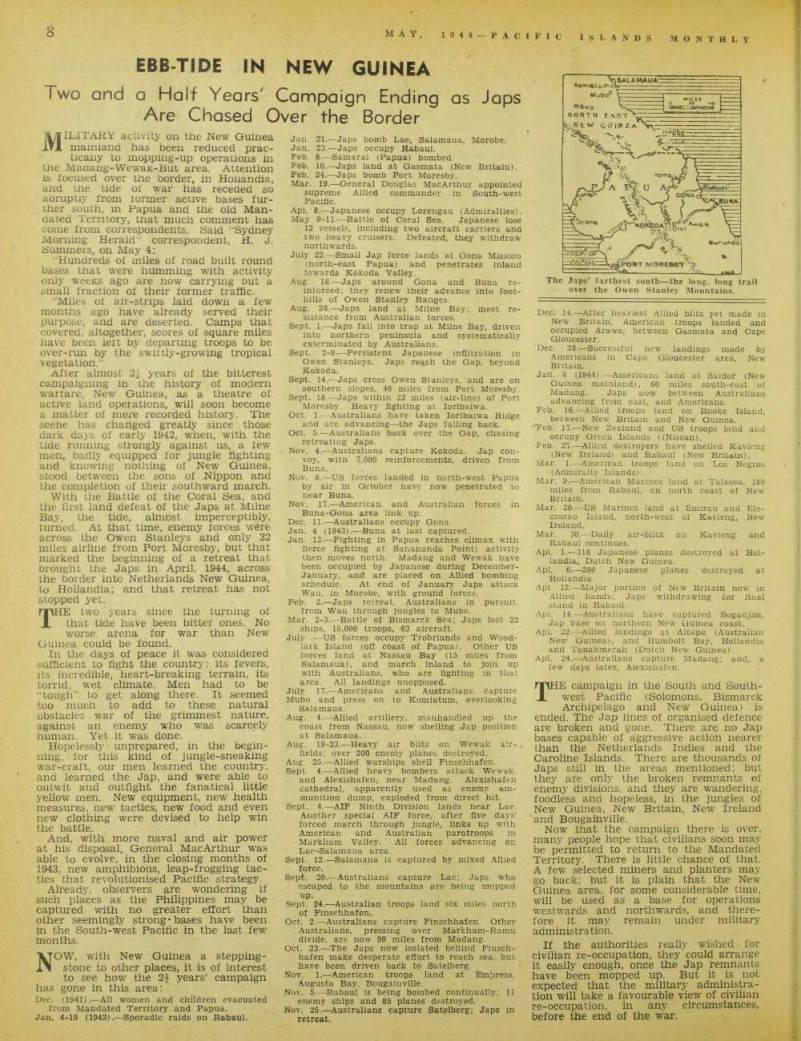
The Japs’ farthest south —the long, long trail over the Owen Stanley Mountains.