Fijians On Patrol
pp. 28-29 · Read in the full issue
Much Feared by the Japs in Bougainville
Prom a Special Correspondent
* Bougainville, March 14.
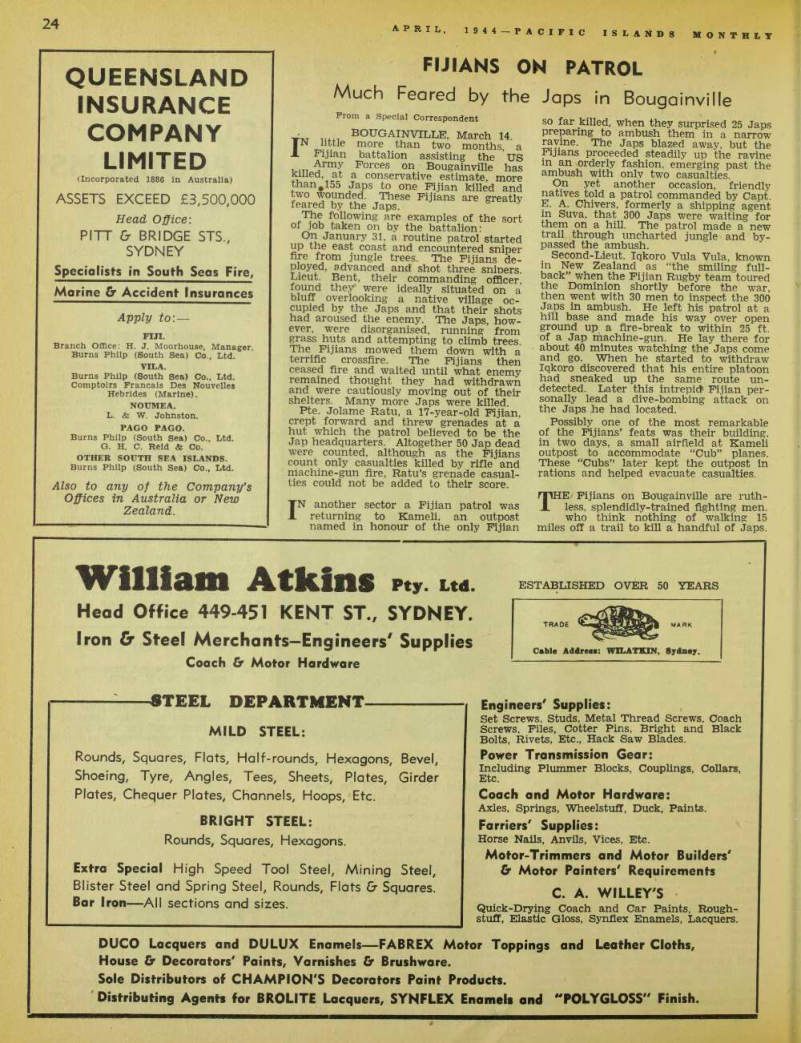
TN little more than two months, a X Fijian battalion assisting the US i *ii Forces on Bougainville has jailed, at a conservative estimate, more than 155 Japs to one Fijian killed and two wounded. These Fijians are greatly feared by the Japs.
The following are examples of the sort of job taken on by the battalion: °n January 31, a routine patrol started up the east coast and encountered sniper fire from jungle trees. The Fijians de ployed, advanced and shot three sniners.
Lieut. Bent, their commanding officer found they were ideally situated on a bluff overlooking a native village oc cupied by the Japs and that their shots had aroused the enemy. The Japs, how ever. were disorganised, running from grass huts and attempting to climb trees The Fijians mowed them down with a terrific crossfire. The Fijians then ceased fire and waited until what enemy remained thought they had withdrawn and were cautiously moving out of their shelters. Many more Japs were killed.
Pte. Jolame Ratu, a 17-year-old Fijian, crept forward and threw grenades at a hut which the patrol believed to be the Jap headquarters. Altogether 50 Jap dead were counted, although as the Fijians count only casualties killed by rifle and machine-gun fire, Ratu’s grenade casual ties could not be added to their score.
IN another sector a Fijian patrol was returning to Kameli, an outpost named in honour of the only Fijian
so far killed, when they surprised 25 Japs preparing to ambush them in a narrow ravine. The Japs blazed away, but the Fijians proceeded steadily up the ravine in an orderly fashion, emerging past the ambush with only two casualties.
On yet another occasion, friendly natives told a patrol commanded by Capt.
E. A. Chivers, formerly a shipping agent m Suva, that 300 Japs were waiting for them on a hill. The patrol made a new trail through uncharted jungle and by passed the ambush.
Second-Lieut, Iqkoro Vula Vula, known in New Zealand as “the smiling full back” when the Fijian Rugby team toured the Dominion shortly before the war, then went with 30 men to inspect the 300 Japs in ambush. He left his patrol at a hill base and made his way over open ground up a fire-break to within 25 ft. of a Jap machine-gun. He lay there for about 40 minutes watching the Japs come and go. When he started to withdraw Iqkoro discovered that his entire platoon had sneaked up the same route un detected. Later this intrepid Fijian per sonally lead a dive-bombing attack on the Japs he had located.
Possibly one of the most remarkable of the Fijians’ feats was their building, in two days, a small airfield at Kameli outpost to accommodate “Cub” planes.
These “Cubs” later kept the outpost in rations and helped evacuate casualties. rE Fijians on Bougainville are ruth less, splendidly-trained fighting men. who think nothing of walking 15 miles off a trail to kill a handful of Japs.
Their commanding officers have no trouble with discipline—the mere threat to keep a Fijian from going on patrol constitutes all the discipline necessary.
An average Fijian carries a 40 lb. pack in addition to a share of mortars, heavy machine-guns and extra ammunition. In command of the battalion is Lieut.-Col.
Geoffrey Upton, of Auckland. The ori ginal commander, Lieut.-Colonel J. B. K.
Taylor, a New Zealander, living in Fiji, who helped organise the force, was wounded by a personnel bomb, December 21—the day of the battalion’s arrival in Bougainville.