Mordvinoff
p. 27 · Read in the full issue
The Work of Nicolai Mordvinoff The Young Artist Who Interprets Tahitian Life
By Walter G. Smith
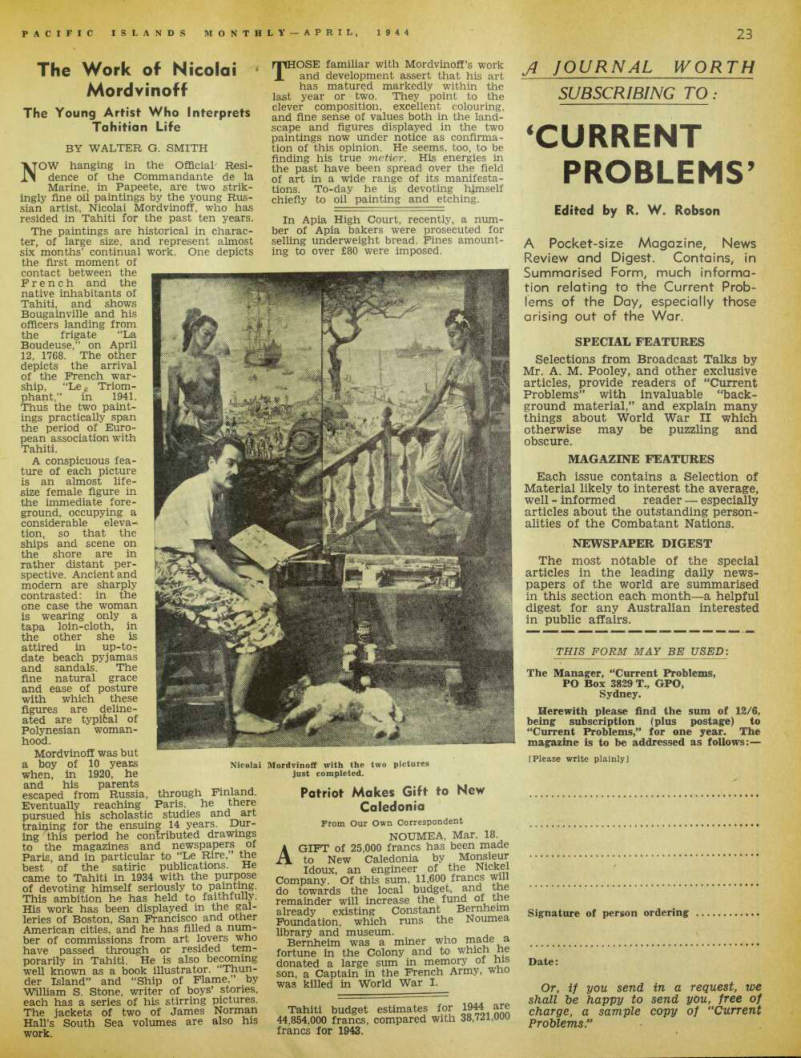
NOW hanging in the Official Resi dence of the Commandante de la Marine, in Papeete, are two strik ingly fine oil paintings by the young Rus sian artist, Nicolai Mordvinoff, who has resided in Tahiti for the past ten years.
The paintings are historical in charac ter, of large size, and represent almost six months’ continual work. One depicts
the first moment of contact between the French and the native inhabitants of Tahiti, and shows Bougainville and his officers landing from the frigate “La Boudeuse,” on April 12, 1768. The other depicts the arrival of the French war ship, “Le t Triom phant,” in 1941.
Thus the two paint ings practically span the period of Euro pean association with Tahiti.
A conspicuous fea ture of each picture is an almost life size female figure in the immediate fore ground, occupying a considerable eleva tion, so that the ships and scene on the shore are in rather distant per spective. Ancient and modem are sharply contrasted: in the one case the woman is wearing only a tapa loin-cloth, in the other she is attired in up-to date beach pyjamas and sandals. The fine natural grace and ease of posture with which these figures are deline ated are typifcal of Polynesian woman hood.
Mordvinoff was but a boy of 10 years when, in 1920, he
and his parents , , escaped from Russia, through Finland.
Eventually reaching Paris, he there pursued his scholastic studies and art training for the ensuing 14 years. Dur ing this period he contributed drawings to the magazines and newspapers of Paris, and in particular to “Le Rire,” the best of the satiric publications. He came to Tahiti in 1934 with the purpose of devoting himself seriously to painting.
This ambition he has held to faithfully.
His work has been displayed in the gal leries of Boston, San Francisco and other American cities, and he has filled a num ber of commissions from art lovers who have passed through or resided tem porarily in Tahiti. He is also becoming well known as a book illustrator. “Thun der Island” and “Ship of Flame,” by William S. Stone, writer of boys’ stones, each has a series of his stirring pictures.
The jackets of two of James Norman Hall’s South Sea volumes are also his work.
rOSE familiar with Mordvinoff’s work and development assert that his art has matured markedly within the last year or two. They point to the clever composition, excellent colouring, and fine sense of values both in the land scape and figures displayed in the two paintings now under notice as confirma tion of this opinion. He seems, too, to be finding his true metier. His energies in the past have been spread over the field of art in a wide range of its manifesta tions. To-day he is devoting himself chiefly to oil painting and etching.
In Apia High Court, recently, a num ber of Apia bakers were prosecuted for selling underweight bread. Fines amount ing to over £BO were imposed.
Nicolai Mordvinoff with the two pictures just completed.