Chance Meeting in Algiers Brings News
p. 21 · Read in the full issue
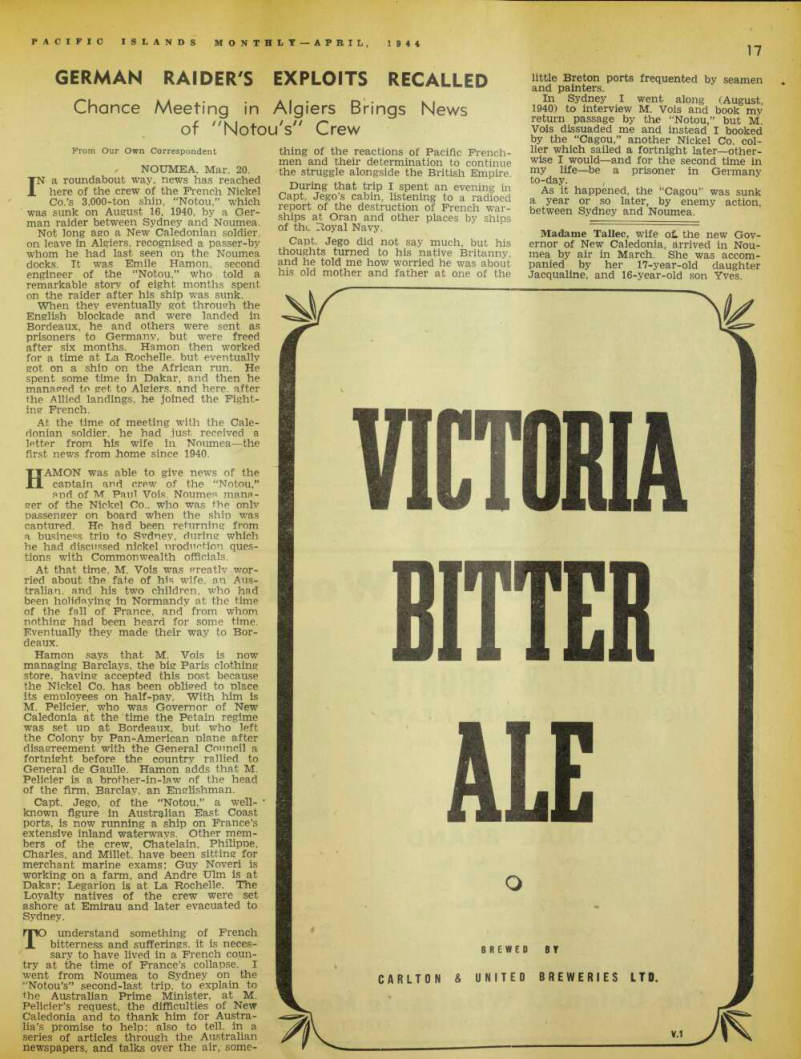
German Raider's Exploits Recalled
Chance Meeting in Algiers Brings News of "Notou's" Crew
From Our Own Correspondent
✓ Noumea, Mar. 20.
IN a roundabout way, news has reached here of the crew of the French Nickel Co.’s 3,000-ton ship, “Notou,” which was sunk on August 16, 1940, by a Ger man raider between Sydney and Noumea.
Not long ago a New Caledonian soldier, on leave in Algiers, recognised a passer-by whom he had last seen on the Noumea docks. It was Emile Hamon, second engineer of the “Notou,” who told a remarkable story of eight months spent on the raider after his ship was sunk.
When they eventually got through the English blockade and were landed in Bordeaux, he and others were sent as prisoners to Germany, but were freed after six months. Hamon then worked for a time at La Rochelle, but eventually got on a shin on the African run. He spent some time in Dakar, and then he managed to get to Algiers, and here, after the Allied landings, he joined the Fight in sr French.
At the time of meeting with the Cale donian soldier, he had just received a letter from his wife in Noumea—the first news from home since 1940.
HAMON was able to give news of the captain and crew of the “Notou,” and of M Paul Vois, Noumea mana ger of the Nickel Co., who was the onlv passenger on board when the ship was captured. He had been returning from a business trio to Svdney. during which he had discussed nickel nroduotion ques tions with Commonwealth officials.
At that time, M. Vois was preatlv wor ried about the fate of his wife, an Aus tralian. and his two children, who had been holidaying in Normandy at the time of the fall of France, and from whom nothing had been heard for some time.
Eventually they made their way to Bor deaux.
Hamon says that M. Vois is now managing Barclays, the big Paris clothing store, havinsr accepted this post because the Nickel Co. has been obliged to place its employees on half-pay. With him is M. Pelicier, who was Governor of New Caledonia at the time the Petain regime was set up at Bordeaux, but who left the Colony by Pan-American plane after disagreement with the General Council a fortnight before the country rallied to General de Gaulle. Hamon adds that M.
Pelicier is a brother-in-law of the head of the firm. Barclay, an Englishman.
Capt. Jego, of the “Notou,” a well known figure in Australian East Coast ports, is now running a ship on France’s extensive inland waterways. Other mem bers of the crew, Chatelain, Philippe, Charles, and Millet, have been sitting for merchant marine exams; Guy Noveri is working on a farm, and Andre Ulm is at Dakar; Legarion is at La Rochelle. The Loyalty natives of the crew were set ashore at Emirau and later evacuated to Sydney. mo understand something of French X bitterness and sufferings, it is neces sary to have lived in a French coun try at the time of France’s collapse. I went from Noumea to Sydney on the “Notou’s” second-last trip, to explain to the Australian Prime Minister, at M.
Pelicier’s request, the difficulties of New Caledonia and to thank him for Austra lia’s promise to help; also to tell, in a series of articles through the Australian newspapers, and talks over the air, some
thing of the reactions of Pacific French men and their determination to continue the struggle alongside the British Empire.
During that trip I spent an evening in Capt. Jego’s cabin, listening to a radioed report of the destruction of French war ships at Oran and other places by ships of the Royal Navy, Capt. Jego did not say much, but his thoughts turned to his native Britanny, and he told me how worried he was about his old mother and father at one of the
little Breton ports frequented by seamen and painters.
In Sydney I went along (August, 1940) to interview M. Vois and book my return passage by the “Notou,” but M Vois dissuaded me and instead I booked by the “Cagou,” another Nickel Co. col lier which sailed a fortnight later—other wise I would—and for the second time in my life—be a prisoner in Germany to-day.
As it happened, the “Cagou” was sunk a year or so later, by enemy action, between Sydney and Noumea.
Madame Tallec, wife oL the new Gov ernor of New Caledonia, arrived in Nou mea by air in March. She was accom panied by her 17-year-old daughter Jacqualine, and 16-year-old son Yves.