Will There Be A “Peace
pp. 17-18 · Read in the full issue
Conference”?
Interesting Possibilities Affecting Japan
BY A. M. POOLEY, IN “CURRENT PROBLEMS”
THERE are constant references to a “peace conference” at the end of this war. Presumably the people who talk about a peace conference have in mind something like the Versailles peace conference at the end of the last war.
Maybe there will be such a confer ence. Personally, I am very doubtful of that. The Versailles conference was a ghastly failure, because there were so many conflicting interests, with the result that a peace was finally signed, which could mean nothing but a renewal of the war in the future.
IN his biography, written mostly during his lifetime by his niece, the late Earl Balfour, who was Foreign Secretary and deputy leader of the British delegation at the con ference, is quoted as saying that the great mistake of Versailles was that it ever took place. He was of the opinion that there should have been no peace conference and no per manent settlement of Europe at
tempted until from 20 to 25 years after the armistice. During that time the passions of war would have died down; the new States which had been agreed upon would have had time to settle down and function, and all those years Europe would have been under the guardianship of the Allied powers.
I think that there will be no peace conference of the Versailles type.
The peace conference will be more in the nature of a dictation class than a matter of discussion and negotiation, and I do not think there should be any Germans at this peace conference after World War 11.
AS for a peace conference with Japan, that also may be some thing which will not happen. The Japanese are convinced that it will They believe that the Allies will be come so weary of the war that they will be able to negotiate a peace,
which will leave Japan part of her stolen territories, which will serve as a springboard for the next attempt to conquer the world.
Not so many people believe that the Japanese did intend to conquer the world. But they did.
An Englishman who, at the out break of the war, was in the employ of the Japanese Government and had a good deal to do with the Foreign Office, quotes his friends there as be ing quite definite on the subject.
They reckoned (Hitler will, be pleased to learn) that after defeating Britain and the United States, Germany would be the next ertemy to be fought. The next, and the last.
Their whole attitude is explained by this Englishman’s story of the meaning of the “Greater East Asia
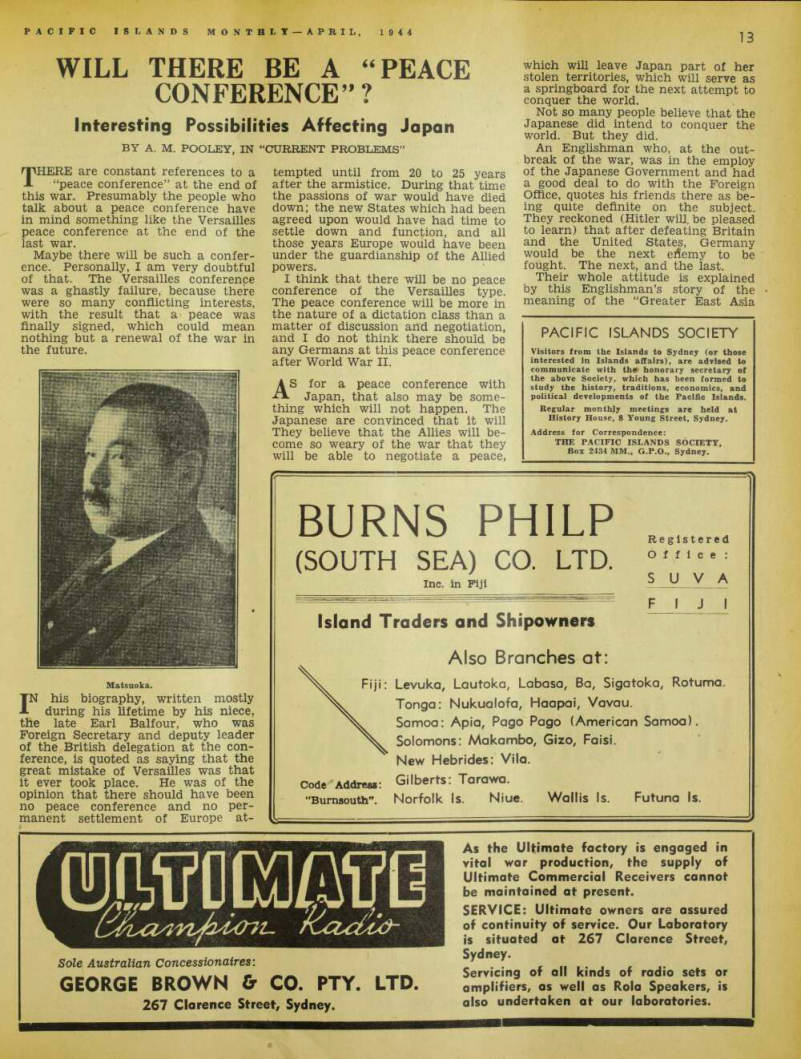
Matsuoka.
Co-Prosperity Sphere.” Asking just what this meant, he was cynically told that it might be described as “the British Empire under new owner ship.”
It is not known whether at the “Strip Japan” conference between President Roosevelt, Chiang Kai Shek and Mr. Churchill at Cairo, any other peace terms were discussed. But it is at least suggested by the decision to strip Japan of all her stolen terri tories that no idea of a formal peace conference entered the minds of the three leaders. rERE is one point on that decision worth mentioning. Though the Japanese Government might sur render, when Japan is brought under air, sea and land assault, it is highly improbable that the Kwantung army, which since 1941 has been a law unto itself, would accept surrender from Tokio.
The Kwantung army—which signi fies the army in Manchuria—is Japan’s crack military force. It numbers more than half a million excellently trained and disciplined troops. These troops are being re inforced by troops which have served in various areas of the Pacific opera tions.
The Kwantung army, therefore, consists of tough, experienced and fanatical fighters. They have never been particularly loyal to the Tokio Governments. In 1931 they occupied Manchuria without the permission or knowledge of the Tokio authorities.
The present military set-up in Tokio is drawn from the Kwantung army.
To jo was its Chief-of-Staff in suc cession to Ttagaki, who is now Home Minister. The deputy Chief-of-Staff, lida, is also out of that nest.
Not loyal to the Tokio Governments, the Kwantung army pays only lip service to the Emperor. He is merely a means to their ends.
VTEVERTHELESS, the Japs do t.hinir that there will be a negotiated peace. To that end they are Keeping in reserve their top diplomats. Mat suoka, who led the Japanese dele gallon out of the Assembly of the league of Nations when the vote of censure was passed on Japan over the seizure of Manchuria, who became Foreign Minister, signed the Russ'o- Japanese pact of non-aggression, and took Japan back into the Axis, is probably slated to lead that Japanese delegation at the expected peace conference. Born in America, speak ing very fluent English, educated at an American University, there is a belief in Tokio that he could “put it across” British and American nego tiators. Certainly he would try his best. Matsuoka has only one affec tion . . . that is, Matsuoka.
That affection is the only one he has never changed. Success at a peace conference would give him his greatest ambition . . . the Premier
shiP*
Before Shigemitsu was appointed For eign Minister, there were rumours Japan that Matsuoka would be re called to the Foreign Office. I said at the time that whe 4 that happened, JRPRR would be fishing for a peace conference. That is still worth re membering. He is not so young now 62 or He drink h ard of CoU rse he mav not last th/rniir?/ ™ U t S But his future fs
X watchine for if wifi inSStP
the course of mind Jinan’s Inne?
pf rP ip? f d J P s mner with Tanari a PrTrmTW T hopethatthere Su^eno^eSn 1
Snce “ a -K
in tSf troublTofefaVn
snan nave an tne trouoie over again