The Sepik Tragedy
pp. 14-34 · Read in the full issue
What Really Happened at Angoram in March, 1942
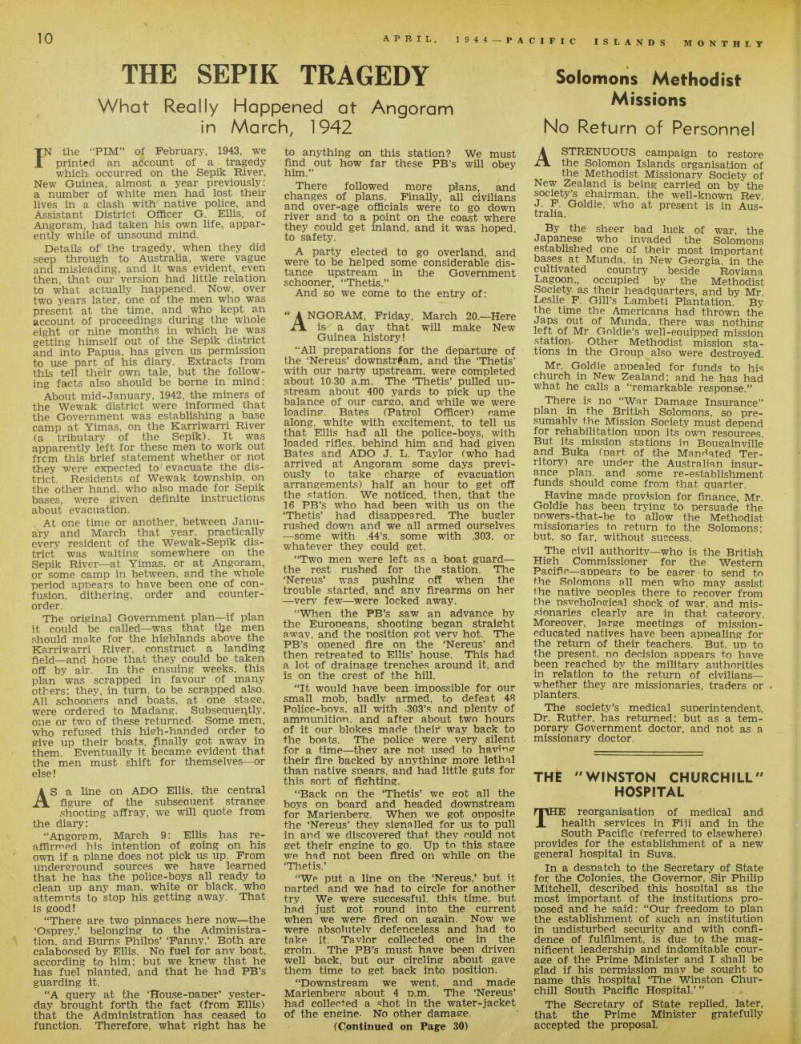
IN the “PIM” of February, 1943, we printed an account of a tragedy which occurred on the Sepik River, New Guinea, almost a year previously: a number of white men had lost their lives in a clash with native police, and Assistant District Officer G. Ellis, of Angoram, had taken his own life, appar ently while of unsound mind.
Details of the tragedy, when they did seep through to Australia, were vague and misleading, and it was evident, even then, that our version had little relation to what actually happened. Now, over two years later, one of the men who was present at the time, and who kept an account of proceedings during the whole eight or nine months in which he was getting himself out of the Sepik district and into Papua, has given us permission to use part of his diary. Extracts from this tell their own tale, but the follow ing facts also should be borne in mind: About mid-January, 1942, the miners of the Wewak district were informed that the Government was establishing a base camp at Yimas, on the Karriwarri River (a tributary of the Sepik). It was apparently left for these men to work out frcm this brief statement whether or not they were expected to evacuate the dis trict. Residents of Wewak township, on the other hand, who also made for Sepik bases, were given definite instructions about evacuation.
At one time or another, between Janu ary and March that year, practically every resident of the Wewak-Sepik dis trict was waiting somewhere on the Sepik River—at Yimas, or at Angoram, or some camp in between, and the whole period appears to have been one of con fusion, dithering, order and counter order.
The original Government plan—if plan it could be called—was that tlje men should make for the highlands above the Karriwarri River, construct a landing field—and hope that they could be taken off by air. In the ensuing weeks, this plan was scrapped in favour of many others: they, in turn, to be scrapped also.
All schooners and boats, at one stage, were ordered to Madang. Subsequently, one or two of these returned- Some men, who refused this high-handed order to give up their boats, finally got away in them. Eventually it became evident that the men must shift for themselves—or else!
AS a line on ADO Ellis, the central figure of the subseouent strange shooting affray, we will quote from the diary: “Angoram, March 9: Ellis has re affirmed his intention of going on his own if a plane does not pick us up. From underground sources we have learned that he has the police-boys all ready to clean up any man, white or black, who attempts to stop his getting away. That is good!
“There are two pinnaces here now—the ‘Osprey,’ belonging to the Administra tion, and Burns Philos’ ‘Fanny.’ Both are calaboosed by Ellis. No fuel for anv boat, according to him; but we knew that he has fuel planted, and that he had PB’s guarding it.
“A query at the ‘House-paper’ yester day brought forth the fact (from Ellis) that the Administration has ceased to function. Therefore, what right has he
to anything on this station? We must find out how far these PB’s will obey him.”
There followed more plans, and changes of plans. Finally, all civilians and over-age officials were to go down river and to a point on the coast where they could get inland, and it was hoped, to safety.
A party elected to go overland, and were to be helped some considerable dis tance upstream in the Government schooner, “Thetis.”
And so we come to the entry of: “ A NGORAM, Friday, March 20.—Here is a day that will make New Guinea history!
“All preparations for the departure of the ‘Nereus’ downstream, and the ‘Thetis’ with our party upstream, were completed about 10-30 a.m. The ‘Thetis’ pulled up stream about 400 yards to pick up the balance of our cargo, and while we were loading. Bates (Patrol Officer) came along, white with excitement, to tell us that Ellis had all the police-boys, with loaded rifles, behind him and had given Bates and ADO J. L. Taylor (who had arrived at Angoram some days previ ously to take charge of evacuation arrangements) half an hour to get off the station. We noticed, then, that the 16 PB’s who had been with us on the ‘Thetis’ had disappeared. The bugler rushed down and we all armed ourselves —some with .44’s. some with .303, or whatever they could get.
“Two men were left as a boat guard— the rest rushed for the station. The ‘Nereus’ was pushing off when the trouble started, and any firearms on her —very few—were locked away.
“When the PB’s saw an advance by the Euroneans, shooting began straight away, and the nosition got verv hot. The PB’s opened fire on the ‘Nereus’ and then retreated to Ellis’ house. This had a lot of drainage trenches around it, and is on the crest of the hill.
“It would have been impossible for our small mob, badlv armed, to defeat 46 Police-boys, all with -303’s and plenty of ammunition, and after about two hours of it our blokes made their way back to the boats. The police were very silent for a time—thev are not used to having their fire backed by anything more lethal than native spears, and had little guts for this sort of fighting.
“Back on the ‘Thetis’ we got all the boys on board ahd headed downstream for Marienberg. When we got opposite the ‘Nereus’ they signalled for us to pull in and we discovered that they could not get their engine to go. Up to this stage we had not been fired on while on the ‘Thetis.’
“We put a line on the ‘Nereus,’ but it Darted and we had to circle for another try. We were successful, this time, but had just got round into the current when we were fired on again. Now we were absolutely defenceless and had to take it. Tavlor collected one in the groin. The PB’s must have been driven well back, but our circling about gave them time to get back into position.
“Downstream we went, and made Marienberg about 4 o.m. The ‘Nereus’ had collected a shot in the water-jacket of the engine- No other damage.
(Continued on Page 30)
MARCH 22: Jones, DO at Wewak, arrived at Marienberg yesterday.
Last night two boys arrived from Angoram by road and told us that some of the PB’s had deserted Ellis, and that Ellis had been sitting in his house since we left, without food. • He has plenty to think about, I guess! We agreed to accompany Jones back —we civilians being sworn in as Special Constables.
The party consisted of Jones, Thurston, Hindwood, Mason, Petterson, Bates and Odgers. We had 10 PB’s whom Jones had brought from Wewak.
“Upstream to Angoram—and, having sand-bagged the ‘Thetis,’ we felt better.
The station looked deserted, but we con tinued on to Angoram village and after dark sent out scouts. They reported that there were no lights in the houses, but that they saw matches being struck in one of the avenues of trees.
“We have decided to have a go in the morning, but it will be a helluva turn out if they have the place trenched.
“March 23. —Back now at Marienberg.
We landed at Angoram station as plan ned. The party split in two to circle round Ellis’ house and come in on two sides- We all got within 100 yards of the house —and waited. Nothing hap pened—so we ventured the rest of the way. We got in and found Mr. Ellis among the dear departed. Evidently suicide. He was shot right through the forehead and had left a note for his people—only the address, and no details of the business. A happy ending for all of us.
“All the renegade PB’s had left, but they took with them all the muskets and all the ammunition they could find—we calculate about 4.000 rounds. What a menace they will be if they stick together!”
WITHIN a day or so of this entry, the party, which later went overland from the Sepik to the Fly River, returned up-river on the ‘Thetis’; and, subsequently, set out on their incredible journey, that was to bring them, six months later, to Papua and safety. And. from this point, our original account of the tragedy is substantially correct.
A grouo of deserting police-boys entrenched themselves on an island in
the Chambrai Lakes, about three days upstream from Angoram, but not before they had ambushed and killed Patrol- Officer R. B- Strudwick, at Timbunku, on the Sepik, had shot several natives molested women, plundered gardens and generally terrorised the whole district between them and Angoram. Allegedly their intention was to kill every European whom they could find. This, they said they had been told to do by Ellis.
Later, they made their way through a channel from Chambrai and surrounded a party of miners who had gone from their claims up the Karriwarri The police-boys surprised the ihiners while they were at a meal and killed G Eichorn, Sr., J. Mitchell. R. J. Beckett’ and a Chinese carpenter. Two other miners, J. Wilton, and Eichorn Jr escaped.
It was reported, later, that the whole of this unsavoury Sepik situation had been cleared up and that an official inquiry had been held. The real facts of the case, however, have never seen the light of day. It was, presumably, one of those minor incidents which might have been lost in the maze of larsrer events stemming out from the Pacific w * r - We are glad, therefore, to be able —belated thousrh it is—to present an eve-witness’s account of what actuallv happened on the Senik in March. 1942 and which, to date, has been “shrouded in mystery.”