Trans-New Guinea
p. 10 · Read in the full issue
Pygmies and Moss Forests on Incredible New Road
BY degrees, the constructional achieve ments that have taken place in New Guinea since that region went under a heavy blanket of official hush hush, some two years ago, are being revealed.
Latest revelation concerns a road, cap able of taking vehicular traffic, which has been made across the Owen Stanley Range, from a point 135 miles north-west of Port Moresby to Wau. Constructional problems met with on this route are believed, by those who have seen the fin ished production, to be comparable to those of the Burma Road. It was built by Australian Army engineers.
As a sort of comic relief in this story of an achievement, which for sheer per severance and the conquest of apparently insuperable obstacles, cannot be exag gerated, is the discovery by a “Sydney Morning Herald” correspondent, of a tribe of pygmies. Those pygmies—how they bob up!
This is what he says: “If the route were traversed at all it was by a wild tribe of pygmies—the notorious Kuku Kuku head-hunters, believed to be the world’s only surviving tribe of cannibals. The adults are about 4 ft. 6 in. tall, their heads shaven except for a tall top-knot of matted hair, necklets of dogs’ tails strung round their necks, boars’ tusks piercing their noses.”
The Kukukukus have been known well since Morobe was put on the map. They are nomads, inhabiting the high moun tain country between Wau and Papua; they have a number of strange charac teristics, most of them unpleasant; they are of short stature, but they are not pygmies. Miss Blackwood, an anthro pologist, lived among them for a year, in the late ’thirties- Pygmies, too, are known to exist in New Guinea. Great have been past controversies as to who discovered them—if, and just where.
They live in the region between the Pinschhafen hinterland and the Upper Ramu country. They were first described, scientifically, by the late Father Kirsch baum, about 20 years ago. rpHE road itself was commenced at a i. time when the Japs still held Sala maua and Lae firmly, and when a force of NGVR and Australian Com mandoes were the only Allied forces operating from Wau.
It was considered necessary then to have a back-door supply route to Wau, and at the end of 1942 a party of sur veyors was sent in to survey the pro posed route. Comparatively few white men had been that way until a few months earlier, when a party of Morobe miners, with great difficulty, had made their way out to safety by that route.
The road would run from Wau up to Edie Creek, and from there across eerie moss forests and a 10,000 feet mountain barrier, and ultimately down to Bulldog, a deserted mining settlement, 90 miles upstream, on the Lakekamu River (which runs into the Gulf of Papua).
Hundreds of square miles of swamps fringe the Lakekamu and the only means of transport from the mouth to Bulldog were the large, local canoes.
Later, barges were brought in, with bull dozers, graders and power shovels. rpHE road was commenced in February, A. 1943, construction being pushed ahead from both ends of the route.
While the grades round up, looping and re-looping from the Bulldog end to around the 6,000 feet mark, road-making equipment was of some use; but from then on it was a matter of pick and shovel, dynamite and sweat.
During the whole length of the con struction the builders, living in almost perpetual rain and fog, on “hard” rations, suffering all the chills and fevers of life under such conditions, were driven, almost insane by the perpetual slips and
landslides that wiped out in minutes the newly-constructed portions of the route that had taken days and weeks of heart breaking toil to build- But, in a little over six months, the incredible road was completed; and on August 31, 1943, the first Jeep went over it from end to end.
Hailed as one of the greatest engineer ing feats of military history, this road has nevertheless been robbed of its great est military worth by the evolution of a new strategy and amphibious tactics ‘in the Pacific war, and by the consequent expulsion of the Japs from the Morobe area. At the time the work was under taken, it appeared a matter of vital necessity that a land route into the Bulolo Valley be constructed somewhere and somehow. If the Japs had succeeded in establishing a firm land-front in New Guinea, the road, which to-days stands as a monument to the skill, guts and per severance of Australian Army engineers, would have been of the greatest possible importance to the Allies.
Will it be of use in peace? Who knows! The cost of maintenance is said to be practically as high as the cost of construction.
But war has proved at least one thing in New can go through.
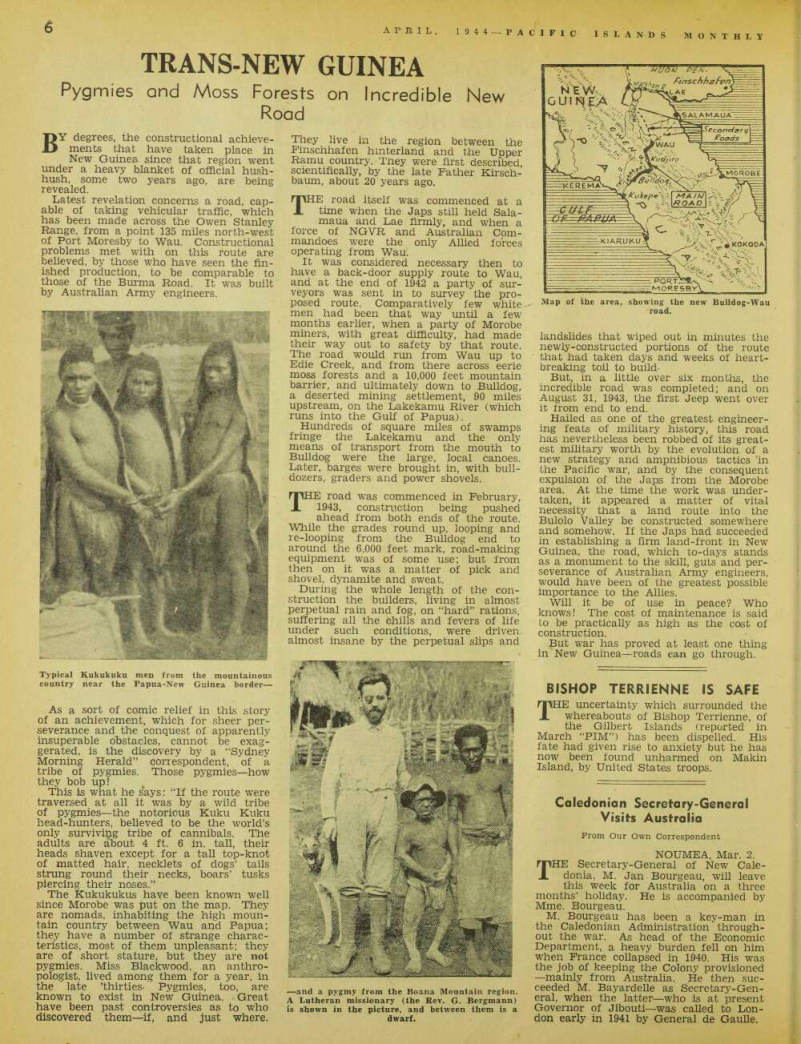
Typical Kukukuku men from the mountainous country near the Papua-New Guinea border—
—and a pygmy from the Boana Mountain region.
A Lutheran missionary (the Rev. G. Bergmann) is shown in the picture, and between them is a dwarf.
Map of the area, showing the new Bulldog-Wau road.