"Bird of Passage" Officials
p. 22 · Read in the full issue
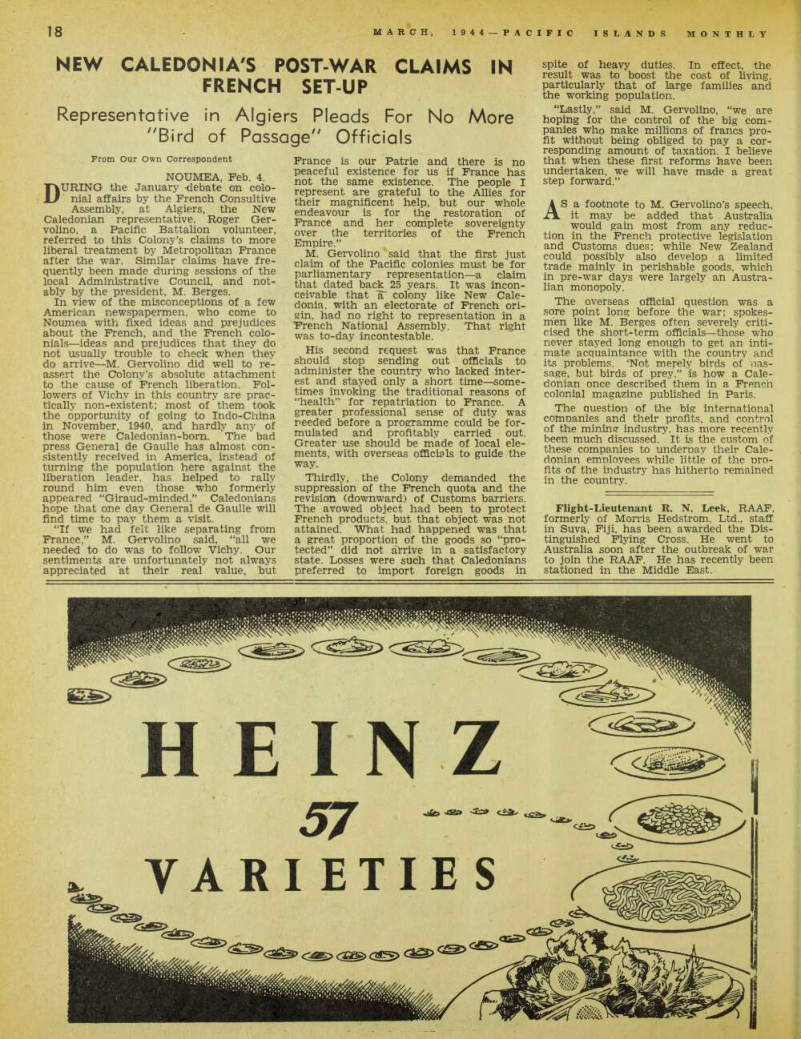
New Caledonia's Post-War Claims In
French Set-Up
Representative in Algiers Pleads For No More "Bird of Passage" Officials
From Our Ovrn Correspondent
Noumea, Feb. 4.
DURING the January -debate on colo nial affairs by the French Consultive Assembly, at Algiers, the New Caledonian representative, Roger Ger volino, a Pacific Battalion volunteer, referred to this Colony’s claims to more liberal treatment by Metropolitan France after the war. Similar claims have fre quently been made during sessions of the local Administrative Council, and not ably by the president, M. Berges.
In view of the misconceptions of a few American newspapermen, who come to Noumea with fixed ideas and prejudices about the French, and the French colo nials—ideas and prejudices that they do not usually trouble to check when they do arrive—M. Gervolino did well to re assert the Colony’s absolute attachment to the cause of French liberation. Fol lowers of Vichy in this country are prac tically non-existent; most of them took the opportunity of going to Indo-China in November, 1940, and hardly any of those were Caledonian-born. The bad press General de Gaulle has almost con sistently received in America, instead of turning the population here against the liberation leader, has helped to rally round him even those who formerly appeared “Giraud-minded.” Caledonians hope that one day General de Gaulle will find time to pay them a visit.
“If we had felt like separating from France,” M. Gervolino said, “all we needed to do was to follow Vichy. Our sentiments are unfortunately not always appreciated at their real value, but
France is our Patrie and there is no peaceful existence for us if France has not the same existence. The people I represent are grateful to the Allies for their magnificent help, but our whole endeavour is for the restoration of France and her complete sovereignty over the territories of the French Empire.”
M. Gervolino said that the first just claim of the Pacific colonies must be for parliamentary representation—a claim that dated back 25 years. It was incon ceivable that a colony like New Cale donia, with an electorate of French ori gin, had no right to representation in a French National Assembly. That right was to-day incontestable.
His second request was that France should stop sending out officials to administer the country who lacked inter est and stayed only a short time—some times invoking the traditional reasons of “health” for repatriation to France. A greater professional sense of duty was reeded before a programme could be for mulated and profitably carried out.
Greater use should be made of local ele ments, with overseas officials to guide the way.
Thirdly, the Colony demanded the suppression of the French quota and the revision (downward) of Customs barriers.
The avowed object had been to protect French products, but that object was not attained. What had happened was that a great proportion of the goods so “pro tected” did not arrive in a satisfactory state. Losses were such that Caledonians preferred to import foreign goods in
spite of heavy duties. In effect, the result was to boost the cost of living, particularly that of large families and the working population.
“Lastly,” said M. Gervolino, “we are hoping for the control of the big com panies who make millions of francs pro fit without being obliged to pay a cor responding amount of taxation. I believe that when these first reforms have been undertaken, we will have made a great step forward.”
AS a footnote to M. Gervolino’s speech, it may be added that Australia would gain most from any reduc tion in the French protective legislation and Customs dues; while New Zealand could possibly also develop a limited trade mainly in perishable goods, which in pre-war days were largely an Austra lian monopoly.
The overseas official question was a sore point long before the war; spokes men like M. Berges often severely criti cised the short-term officials—those who never stayed long enough to get an inti mate acquaintance with the country and its problems. ‘Not merely birds of oas sage, but birds of prey.” is how a Cale donian once described them in a French colonial magazine published in Paris.
The Question of the big international comnanies and their profits, and control of the mininsr industry, has more recently been much discussed. It is the custom of these companies to undemay their Cale donian emnloyees while little of the pro fits of the industry has hitherto remained in the country.
Flight-Lieutenant R. N. Leek, RAAF, formerly of Morris Hedstrom, Ltd., staff in Suva, Fiji, has been awarded the Dis tinguished Flying Cross. He went to Australia soon after the outbreak of war to join the RAAF. He has recently been stationed in the Middle East.