Tropicalities
pp. 15-16 · Read in the full issue
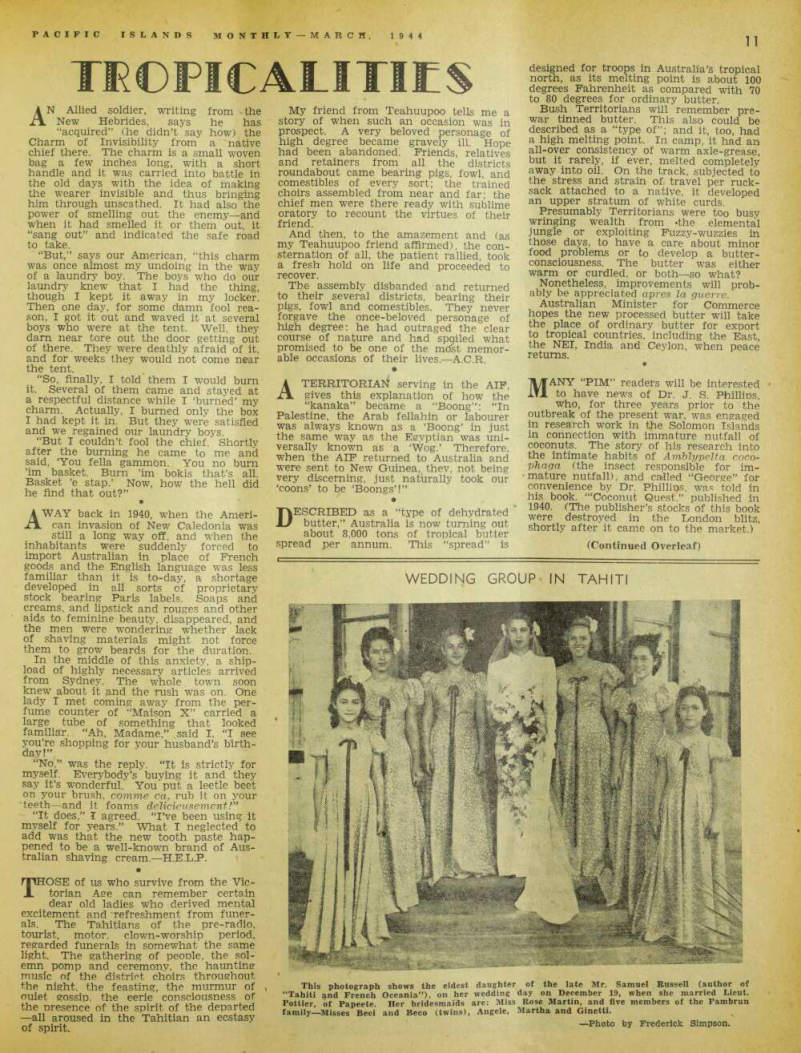
AN Allied soldier, writing from New Hebrides, says he has “acquired” (he didn’t say how) the Charm of Invisibility from a native chief there. The charm is a small woven bag a few inches long, with a short handle and it was carried into battle in the old days with the idea of making the wearer invisible and thus bringing him through unscathed. It had also the power of smelling out the enemy—and when it had smelled it or them out, it “sang out” and indicated the safe road to take.
“But,” says our American, “this charm was once almost my undoing in the way of a laundry boy. The boys who do our laundry knew that I had the thing, though I kept it away in my locker.
Then one day, for some damn fool rea son, I got it out and waved it at several boys who were at the tent. Well, they dam near tore out the door getting out of there. They were deathly afraid of it, and for weeks they would not come near the tent.
“So, finally, I told them I would burn it. Several of them came and stayed at a respectful distance while I ‘burned’ my charm. Actually, I burned only the box I had kept it in. But they were satisfied and we regained our laundry boys.
“But I couldn’t fool the chief. Shortly after the burning he came to me and said, ‘You fella gammon. You no burn ’im basket. Burn ’im bokis that’s all.
Basket ’e stap.’ Now, how the hell did he find that out?” * AWAY back in 1940, when the Ameri can invasion of New Caledonia was still a long way off, and when the inhabitants were suddenly forced to import Australian in place of French goods and the English language was less familiar than it is to-day, a shortage developed in all sorts of proprietary stock bearing Paris labels. Soaps and creams, and lipstick and rouges and other aids to feminine beauty, disappeared, and the men were wondering whether lack of shaving materials might not force them to grow beards for the duration.
In the middle of this anxiety, a ship load of highly necessary articles arrived from Sydney. The whole town soon knew about it Rnd the rush was on. One lady I met coming away from the per fume counter of “Maison X” carried a large tube of something that looked familiar. “Ah, Madame,” said I, “I see you’re shopping for your husband’s birth day!”
“No,” was the reply. “It is strictly for myself. Everybody’s buying it and they say it’s wonderful. You put a leetle beet on your brush, comme ca, rub it on your 'teeth —and it foams delicieusement!”
“It does,” I agreed. “I’ve been using it myself for years.” What I neglected to add was that the new tooth paste hap pened to be a well-known brand of Aus tralian shaving cream.—H.E.L.P. * rOSE of us who survive from the Vic torian Age can remember certain dear old ladies who derived mental excitement and refreshment from funer als. The Tahitians of the pre-radio, tourist, motor, clown-worship period, regarded funerals in somewhat the same light. The gathering of people, the sol emn pomp and ceremony, the hauntine music of the district choirs throughout the night, the feasting, the murmur of ouiet gossip, the eerie consciousness of the presence of the spirit of the departed —all aroused in the Tahitian an ecstasy of spirit.
My friend from Teahmipoo tells me a story of when such an occasion was in prospect. A very beloved personage of high degree became gravely ill. Hope had been abandoned. Friends, relatives and retainers from all the districts roundabout came bearing pigs, fowl, and comestibles of every sort; the trained choirs assembled from near and far; the chief men were there ready with sublime oratory to recount the virtues of their friend.
And then, to the amazement and (as my Teahuupoo friend affirmed), the con sternation of all, the patient rallied, took a fresh hold on life and proceeded to recover.
The assembly disbanded and returned to their several districts, bearing their pigs, fowl and comestibles. They never forgave the once-beloved personage of high degree: he had outraged the clear course of nature and had spoiled what promised to be one of the mdst memor able occasions of their lives.—A.C.R. • A TERRITORIAL serving in the AIP, gives this explanation of how the “kanaka” became a “Boong”: “In Palestine, the Arab fellahin or labourer was always known as a ‘Boong’ in just the same way as the Egyptian was uni versally known as a ‘Wog.’ Therefore, when the AIP returned to Australia and were sent to New Guinea, they, not being very discerning, just naturally took our ‘coons’ to be ‘Boongs’!” • DESCRIBED as a “type of dehydrated butter,” Australia is now turning out about 8,000 tons of tropical butter spread per annum. This “spread” is
designed for troops in Australia’s tropical north, as its melting point is about 100 degrees Fahrenheit as compared with 70 to 80 degrees for ordinary butter.
Bush Territorians will remember pre war tinned butter. This also could be described as a “type of”; and it, too, had a high melting point. In camp, it had an all-over consistency of warm axle-grease, but it rarely, if ever, melted completely away into oil. On the track, subjected to the stress and strain of travel per ruck sack attached to a native, it developed an upper stratum of white curds.
Presumably Territorians were too busy wringing wealth from .the elemental jungle or exploiting Fuzzy-wuzzies in those days, to have a care about minor food problems or to develop a butter consciousness. The butter was either warm or curdled, or both—so what?
Nonetheless, improvements will prob ably be appreciated apres la guerre.
Australian Minister for Commerce hopes the new processed butter will take the place of ordinary butter for export to tropical countries, including the East, the NEI, India and Ceylon, when peace returns. * MANY “PIM” readers will be interested to have news of Dr. J. S. Phillies, who, for three years prior to the outbreak of the present war, was engaged in research work in the Solomon Islands in connection with immature nutfall of coconuts. The story of his research into the intimate habits of Amblypelta coco phaga (the insect responsible for im • mature nutfall). and called “George” for convenience by Dr. Phillips, was told in his book. ‘“Coconut Quest,” published in 1940. (The publisher’s stocks of this book were destroyed in the London blitz, shortly after it came on to the market.)
(Continued Overleaf)
After completing his Solomons’ engage ment with Lever Bros., Dr. Phillips re turned to his home in England, and reached there shortly before World War 11, On the declaration of war, he tried to join the Army (he had won the Mili tary Cross and held the rank of captain in World War I) but was not accepted— entomology was regarded as a reserved occupation. However, no work could be found for him as an entomologist, so he did voluntary war work for over two years.
Early in 1942 he received a Govern ment appointment in West Africa; here he did anti-malarial research work among the Forces in Nigeria and Sierra Leone.
Writing from England on Christmas
Day, 1943, Dr. Phillips says: “West Africa cannot be compared with the Pacific in scenic beauty or general interest and the natives are very inferior to those of Polynesia and Indonesia; all the same, I had a very interesting time there .. .
After three months in England I have another engagement with the Unilever combine and I am going out to the Congo to do research work on a number of
interesting problems.-
J. D. Mcc.
SINCE American troops garrisoned some of the Cook Islands, a new market has arisen for the tiny snail-shells that the women of Mangaia make into necklaces, and also use for the ornamen tation of baskets, etc. At one time these
were so little esteemed that threepence a string was “good money.” To-day, they fetch 7/6 a dozen for yard-long neck laces, and the market is still rising. The present buyers are the Cook Island Trad ing Co., Ltd., and a European resident of Rarotonga.
It would be interesting to know who first saw in these tiny snails that swarm upon the rocks in wet weather, a bead of value! No record exists; and natives do not regard the art as ancient, or truly Polynesian. These snails are the size of a fruit-box nail head, and when boiled in caustic lye they turn yellow (the com monest colour), red, orange, or brown.
At one village a purple and a maroon shell are found.
The present shortage of needles and caustic soda is holding up this “pupu” trade; but in spite of difficulties, a large trade in the shells will later be possible.
E.G.
A YOUNG Government official in Suva, Fiji, before the war, Flying-Officer Ronald Crook, RAF, recently “made the news” when he completed his bomb run and led his formation of light bom bers back to their base in Central Italy, although dazed and wounded in the head by anti-aircraft shrapnel.
Three years ago he left Suva with 18 other young RAF recruits and Italy is the 24th country he has visited since leaving home. He trained in Southern Rhodesia and Kenya, and at present he is the only pilot among the air crews representing the United Nations in the Desert Air Force who wears Fiji shoulder titles. The other men who joined with him are now scattered to RAF squadrons throughout the world. • SAID to be the most decorated native in the South Pacific is Sergeant- Major Vooza of the Solomon Islands Native Constabulary. His refusal to divulge information valuable to the enemy when he was captured by the Japanese in the early days of the fight ing on Guadalcanal, earned him the George Medal from the British and the Silver Star from the Americans. From “along before” he had the Long Service and the Good Conduct medal—Sergeant Vooza had already retired from the Native Constabulary at the time of the Japanese invasion of the Solomons, but he voluntarily went back into service when the Americans landed. • OUR Mangaia correspondent informs us that there is a good opening for a dairy farmer there. “There were two cows on Mangaia in 1931,” he writes, “but one died and the other was killed.
We have seen no cattle since. The local goats are a poor lot—more interested in making pests of themselves than in re producing their kind and supplying milk.
Consequently much money is expended on ‘condensed’ —money that should go into the pockets of some enterprising dairy farmer as it does in progressive Rarotonga.”
The Secretary of State for the Colo nies has approved of the promotion of Mr. A. H. Phillips to be Director of Edu cation in Fiji, in succession to Mr. J.
Russell, who retired recently.
A new appointee to the Fiji War Fund Executive Committee is Mr. John Trotter, who will take the place of Mr. T. M.
Bryce, who has left the Colony.
A young Fiji resident who left the Col ony with the first RAF contingent, has just received his commission. He is Pilot-Officer G. Edwards, and he is sta tioned in England. He was married last September to Miss Maureen Mackie, of Salisbury, Rhodesia.