Death Of Mr. O. F. Nelson
pp. 14-34 · Read in the full issue
Mau Leader Who Fought NZ Officialdom For 15 Years
NEWS of the death of Mr. O. F. Nelson, of Samoa, on February 21, though not unexpected, was received throughout the South Pacific with genuine regret. Mr. Nelson was the leader of the Mau (Samoan National Movement); and, if he had made errors, he also had made great personal sacrifices for the cause in which he believed, and he never ceased to fight for the Samoans against what he regarded as oppression.
“Fred” Nelson, as he was generally known, was the son of a Swedish sea captain and a Samoan lady a woman of chiefly rank. Although he grew up and was educated as a Euro pean, his attach ment to the Samoans, through his mother’s family, was very strong.
He was born in 1884, and therefore all his young and formative years were spent under the Ger man regime", which terminated with the occupation of Samoa by New Zealand
troops in 1914. He knew three languages —German, English and Samoan—and when the New Zealand administration took over in 1920, he was a prominent member of both the European and Samoan communities. He also was one of the richest men in the South Seas.
During World War I, and for some years afterwards, copra boomed, and Nelson proved himself a shrewd trader and manager. The war had killed the German firms, and O. F. Nelson & Co., Ltd., stepped quickly into the vacant field.
The firm opened branches or established traders in every Samoan village; and its enterprise and activity, combined with the popularity of Nelson himself among the natives, gave it almost a monopoly of native trade and a very large share of all oversea trade. When the New Zealand civil administration came to Samoa, Mr. Nelson, then in his late thirties, was sitting on top of the world.
His firm was big, and rich, and appar ently unassailable; and he himself had become increasingly the mouthpiece of the Samoans in their dealings with the British.
IT is a little difficult to form an opinion of the Nelson of this period. He has been represented as arrogant, and over-ambitious, and a profound hater of the new British administration. That is probably an exaggeration. Nelson was a very successful young man, and he loved power; but there is no real evidence (apart from the statements of very pre judiced New Zealand officials) that he was at that time anti-British, or that he had any motive other than a sincere desire to do the best he could for the Samoans under the new regime.
But. in that latter respect, he was doomed to utter failure and complete exasperation—and it was not his fault.
The primary blame for all the sorry his tory of Samoa in the ’twenties and ’thirties goes primarily to the blundering gentlemen who arranged the League of Nations Mandates, and the greater fools
who tried to administer the Mandate which had been issued to New Zealand in respect of Samoa.
The Samoan Mandate was “C” Class— that is, it assumed that the Samoans were a primitive people, incapable of governing themselves. That, in itself, was an insult to a proud people, with fine traditions of culture. True, under the German administration, they had had little share in the government, in an official sense; but, actually, the German administration had made itself thoroughly familiar with the native viewpoint, and understood Samoan ways, and the Samoans had actually a considerable voice in their own affairs, while the Germans were careful always to consider native wishes and native susceptibilities in all that they did. The majority of the Samoans were educated and quite capable of taking a part in local govern ment, at least.
THE new set-up provided for a Legis lative Council, and O. F. Nelson was one of the three European non official members thereon. The official members easily swamped the non-official; and trouble soon, developed.
It had its roofs in the New Zealand approach to the Samoan administrative problem. A party of New Zealand mem bers of Parliament, led by a very stubborn and one-eyed Minister named James Allen, was organised to go to Samoa and look the situation over and (the Samoans believed) recommend the form of govern ment to be adopted. The Samoan people made elaborate preparations to meet the Parliamentarians and confer with them.
To their utter discomfiture, the New Zealanders made no attempt to confer.
Instead, Mr. Allen simply told them the form of government which had been arranged for them (it included total pro hibition of liquor, which still endures, and which has been much criticised); while his Parliamentarians proceeded to disport themselves on what they regarded as a tropical picnic.
That was the beginning of unrest which lasted for 15 years, and which, among other things, showed the New Zealand administration in a very bad light. From his position on the Legis lative Council, Mr. Nelson began to argue with the New Zealanders, on behalf of the Samoans, who had many grievances in regard to native affairs. But the attitude of the Administrators (especially Sir George Richardson, 1923-28, and Colonel Stephen Allen, 1928-31) was that New Zealand could do no wrong, and that the Samoans must accept their dictates without question and obey at once.
They treated Nelson with contempt; and this aroused Nelson’s fighting spirit.
Within a very few years, the Samoans had organised the Mau, to fight for the national rights of the natives; and Nelson, whom they trusted, naturally be came their leader. He took their griev ances to New Zealand, and even to the League of Nations headquarters at Geneva; but, wherever he turned, he got up against stiff-necked, unimaginative officialdom—the kind of people who had control of the world between World War I and World War 11, and who made World War II inevitable.
There was the Nosworthy incident, for example. New Zealand appointed a
(Continued on Page 30)
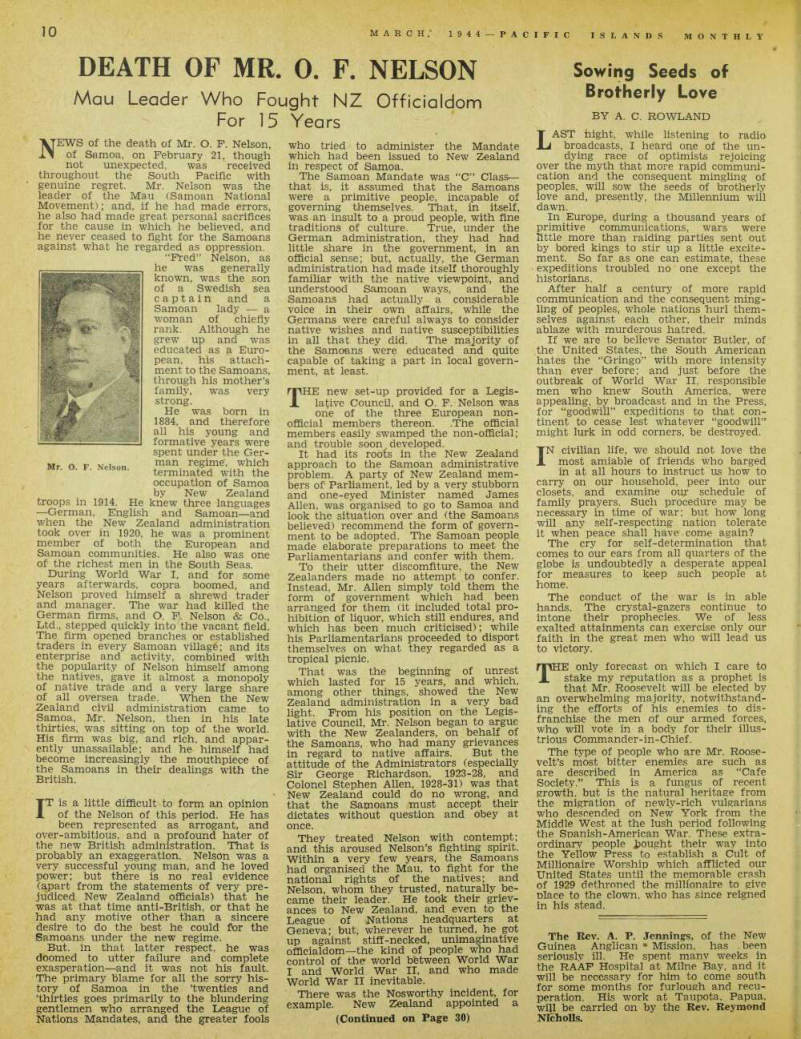
Mr. O. F. Nelson.
Minister called Nosworthy to Samoa to settle the troubles there. The Samoans made elaborate preparations to meet him and discuss their grievances. Mr. Nos worthy delayed his visit for eight months.
Then he spent his time in Samoa mostly at pleasant Vailima (the official re sidence) and did not meet the Samoans until a few hours before his departure; and then his manner was harsh and over-bearing, and he achieved nothing, fTIHE Samoan position deteriorated X steadily. The heavy-booted, un compromising Richardson finally took action against the Europeans who were helping the Mau, and O. F. Nelson, A. G.
Smythe (a well-known merchant) and Judge Gurr (an American, with Eastern Samoan connections) were banished from the Territory for terms of years, without trial.
Mr. Nelson settled down in Auckland, and threw himself heart and soul into the fight of the Samoans against the high-handed authority of New Zealand.
He maintained close contact with the Mau, and he published in New Zealand a newspaper which carried on very vigorous propaganda. He spent his own money very freely for the cause he had espoused.
The period of his banishment (1928-33) corresponded with the depression, in which his firm, like all others, suffered greatly. There was a time when it was rumoured that O. F. Nelson & Co., Ltd.,
being without the directive hand of its chief, being under a sort of official ban, and suffering from the depression, was “going out”; but it weathered the storm, although its operations were considerably curtailed.
The Mau, led by Nelson and certain devoted Samoan chiefs, becanie more aggressive and noisy, the more official dom tried to suppress it. A chain of events led inevitably from the visit of the grim prohibitionist, James Allen, in 1920, to the riot of December 28, 1929, in which a European policeman and eleven Samoans were killed. After that, New Zealand used sterner measures. A war ship, early in 1929, landed parties which chased members of the Mau all over the central mountains of Upolu.
OFFICIALLY, the Mau was dispersed.
Actually, it remained actively in existence, and welcomed Nelson eagerly when, in 1933, he returned from his five years” banishment. By this time, a more reasonable man, Sir Herbert Hart, had come in as Administrator, after the disastrous regime of Richardson and Allen; and Hart got far along the road to a conference and settlement with the Mau. But a deadlock occurred when the Mau, quite properly, insisted that Mr.
Nelson be one of its delegates. Stiff necked Wellington, still trying to rule Samoa on . the do-as-you’re-told-you naughty-child principle, would not accept Nelson.
By now, the patience of Mr. Nelson and the Mau leaders had worn thin, and they acted foolishly and unwisely. They did things which, in a subsequent trial, officialdom was able to construe as sedi tion and plotting against the adminis tration. Several leaders were punished.
An over-zealous Court sentenced Nelson to eight months’ gaol, and ten years’ banishment. Nelson was taken to New Zealand, under humiliating conditions; but an Appeal Court there promptly quashed the sentence of imprisonment.
That sentence was an ugly episode; but only in line with New Zealand’s black record in Samoa.
The banishment lasted only eighteen months. One of the first acts of the new Labour Government in New Zealand, in 1936, was to cancel the decree, and send Mr. Nelson and his family back to Samoa, at the State’s expense, with full honours.
The Samoan administrative system was completely revised, so as to give the Samoans a much larger share in local government; and Mr. Nelson’s voice carried much weight in administrative affairs.
THUS did the most famous Euronesian of the South Pacific finally see success crown his 15 years of bitter fighting. But by now his health had failed; and, after 1936, he took less and less part in public affairs. He had many official enemies—but few personal foes.
Everyone liked the big, kindly, hospitable “Fred” —his friends, among both Euro peans and Samoans, were countless. He had some very human faults; but he was an outstanding, able man, and if only the New Zealand Government had had the wit to enlist his aid in the beginning, instead of ignoring and insulting him, one of the blackest chapters in Samoa’s chequered history need not have been written.
As it is, the name of Nelson always will be remembered in the Samoan Nationalist Movement —especially if, as now seems possible, the revision of the League Mandate system should give Samoa some definite measure of self government.
Mr. Nelson had a large family—mostly girls. All are well-known and popular, and some have attained distinction in the professions.