New Guinea Missionaries Escape Japs
p. 10 · Read in the full issue
Extraordinary Trek of Three Priests and Five Nuns
ONLY recently released for publication is the story of how, between May and August last year, eight missionaries (three priests and five nuns) made a nightmare journey, on foot, from Japanese-occupied Wewak on the north coast of New Guinea, over the mountains and through the Sepik Valley, to a point where they were picked up by plane and flown out to an Allied base.
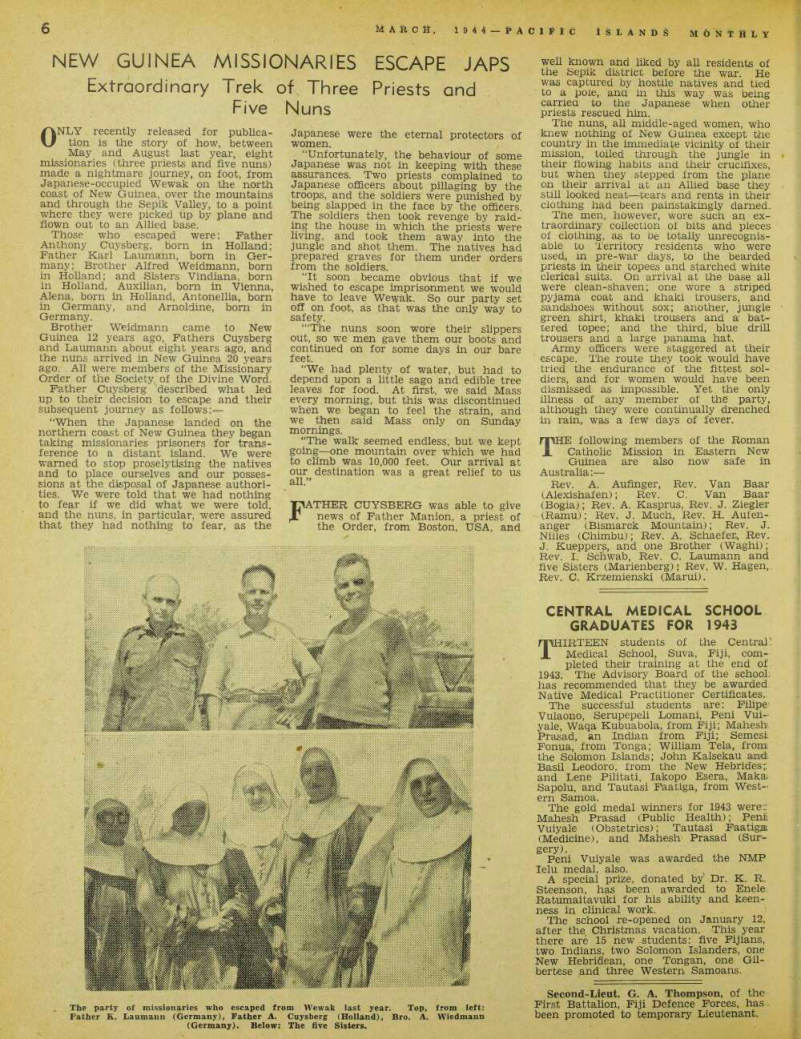
Those who escaped were: Father Anthony Cuysberg, born in Holland; Father Karl Laumann, born in Germany; Brother Alfred Weidmann, born in Holland; and Sisters Vindiana, born in Holland, Auxilian, born in Vienna, Alena, born in Holland, Antonellia, born in Germany, and Arnoldine, bom in Germany.
Brother Weidmann came to New Guinea 12 years ago, Fathers Cuysberg and Laumann about eight years ago, and the nuns arrived in New Guinea 20 years ago. All were members of the Missionary Order of the Society of the Divine Word.
Father Cuysberg described what led up to their decision to escape and their subsequent journey as follows: “When the Japanese landed on the northern coast of New Guinea they began taking missionaries prisoners for transference to a distant island. We were warned to stop proselytising the natives and to place ourselves and our possessions at the disposal of Japanese author!ties. We were told that we had nothing to fear if we did what we were told, and the nuns, in particular, were assured that they had nothing to fear, as the
Japanese were the eternal protectors of women.
“Unfortunately, the behaviour of some Japanese was not in keeping with these assurances. Two priests complained to Japanese officers about pillaging by the troops, and the soldiers were punished by being slapped in the face by the officers The soldiers then took revenge by raid ing the house in which the priests were living, and took them away into the jungle and shot them. The natives had prepared graves for them under orders from the soldiers.
“It soon became obvious that if we wished to escape imprisonment we would have to leave Wewak. So our party set off on foot, as that was the only way to safety.
“‘The nuns soon wore their slippers out, so we men gave them our boots and continued on for some days in our bare feet.
“We had plenty of water, but had to depend unon a little sago and edible tree leaves for food. At first, we said Mass every morning, but this was discontinued when we began to feel the strain, and we then said Mass only on Sunday mornings.
“The walk seemed endless, but we kept going—one mountain over which we had to climb was 10,000 feet. Our arrival at our „ destination was a great relief to us a ”*” 171ATHER CUYSBERG was able to give f? news of Father Manion, a priest of the Order, from Boston, USA, and
well known and liked by all residents of the Sepik district before the war. He was captured by hostile natives and tied to a pole, ana in this way was being carried to the Japanese when other priests rescued him.
The nuns, all middle-aged women, who knew nothing of New Guinea except the country in the immediate vicinity of their mission, toiled through the jungle in their flowing habits and their crucifixes, but when they stepped from the plane on their arrival at an Allied base they still looked neat—tears and rents in their clothing had been painstakingly darned„ The men, however, wore such an ex traordinary collection of bits and pieces of clothing, as to be totally unrecognis able to Territory residents who were used, in pre-war days, to the bearded priests in their topees and starched white clerical suits. On arrival at the base all were clean-shaven; one wore a striped pyjama coat and khaki trousers, and sandshoes without sox; another, jungle green shirt, khaki trousers and a bat tered topee; and the third, blue drill trousers and a large panama hat.
Army officers were staggered at their escape. The route they took would have tried the endurance of the fittest sol diers, and for women would have been dismissed as impossible. Yet the only illness of any member of the party, although they were continually drenched in rain, was a few days of fever. rE following members of the Roman Catholic Mission in Eastern New Guinea are also now safe in Australia: — Rev. A. Aufinger, Rev. Van Baar (Alexishafen); Rev. C. Van Baar (Bogia); Rev. A. Kasprus, Rev. J. Ziegler (Ramu); Rev. J. Much, Rev. H. Aufen anger (Bismarck Mountain); Rev. J.
Nilles (Chimbu); Rev. A. Schaefen, Rev.
J. Kueppers, and one Brother (Waghi); Rev. I. Schwab, Rev. C. Laumann and five Sisters (Marienberg); Rev. W. Hagen, Rev. C. Krzemienski (Marui).
The party of missionaries who escaped from Wewak last year. Top, from left: Father K. Laumann (Germany), Father A. Cuysberg (Holland), Bro. A. Wiedmann (Germany). Below: The five Sisters.