Dictator—Or What?
The Delicate Position of Mr. Tojo of Tokio
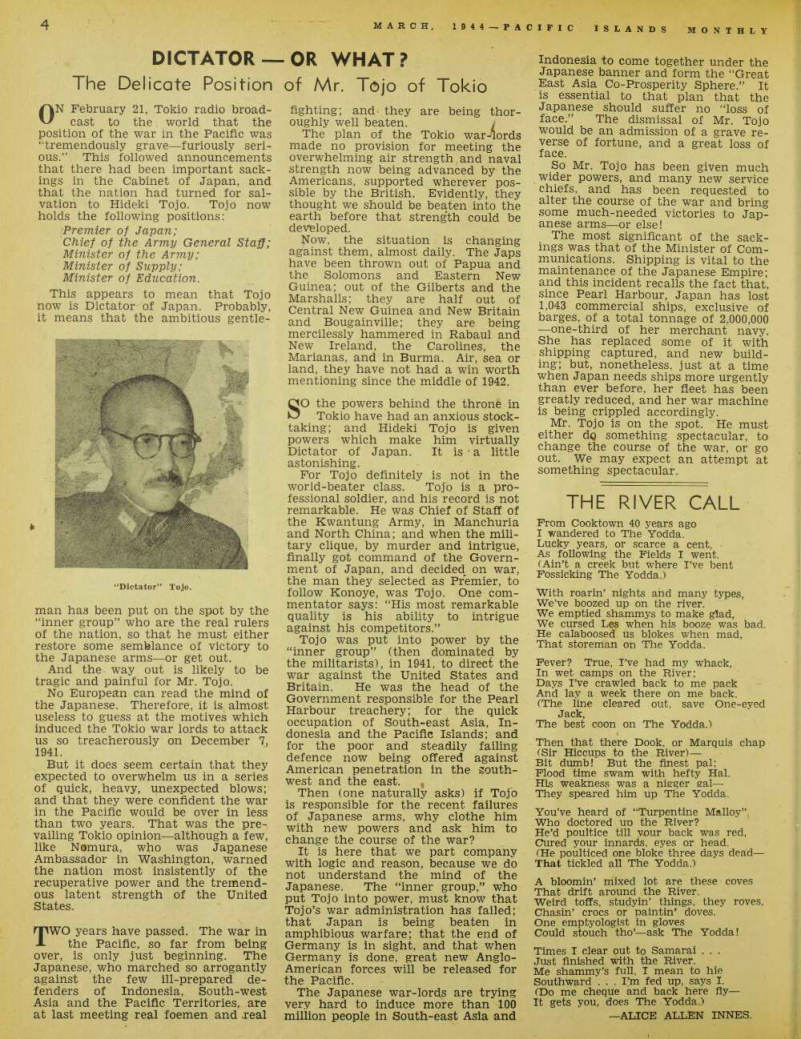
ON February 21, Tokio radio broad cast to the world that the position of the war in the Pacific was “tremendously grave—furiously seri ous.” This followed announcements that there had been important sack ings in the Cabinet of Japan, and that the nation had turned for sal vation to Hideki Tojo. Tojo now holds the following positions; Premier of Japan; Chief of the Army General Staff; Minister of the Army; Minister of Supply; Minister of Education.
This appears to mean that Tojo now is Dictator of Japan. Probably, it means that the ambitious gentle-
man has been put on the spot by the “inner group” who are the real rulers of the nation, so that he must either restore some semblance of victory to the Japanese arms—or get out.
And the way out is likely to be tragic and painful for Mr. Tojo.
No European can read the mind of the Japanese. Therefore, it is almost useless to guess at the motives which induced the Tokio war lords to attack us so treacherously on December 7, 1941.
But it does seem certain that they expected to overwhelm us in a series of quick, heavy, unexpected blows; and that they were confident the war in the Pacific would be over in less than two years. That was the pre vailing Tokio opinion—although a few, like Nomura, who was Japanese Ambassador in Washington, warned the nation most insistently of the recuperative power and the tremend ous latent strength of the United States.
TWO years have passed. The war in the Pacific, so far from being over, is only just beginning. The Japanese, who marched so arrogantly against the few ill-prepared de fenders of Indonesia, South-west Asia and the Pacific Territories, are at last meeting real foemen and Teal
fighting; and they are being thor oughly well beaten. / The plan of the Tokio war-lords made no provision for meeting the overwhelming air strength and naval strength now being advanced by the Americans, supported wherever pos sible by the British. Evidently, they thought we should be beaten into the earth before that strength could be developed.
Now, the situation is changing against them, almost daily. The Japs have been thrown out of Papua and the Solomons and Eastern New Guinea; out of the Gilberts and the Marshalls; they are half out of Central New Guinea and New Britain and Bougainville; they are being mercilessly hammered in Rabaul and New Ireland, the Carolines, the Marianas, and in Burma. Air, sea or land, they have not had a win worth mentioning since the middle of 1942.
SO the powers behind the throne in Tokio have had an anxious stock taking; and Hideki Tojo is given powers which make him virtually Dictator of Japan. It is • a little astonishing.
For Tojo definitely is not in the world-beater class. Tojo is a pro fessional soldier, and his record is not remarkable. He was Chief of Staff of the Kwantung Army, in Manchuria and North China; and when the mili tary clique, by murder and intrigue, finally got command of the Govern ment of Japan, and decided on war, the man they selected as Premier, to follow Konoye, was Tojo. One com mentator says: “His most remarkable quality is his ability to intrigue against his competitors.”
Tojo was put into power by the “inner group” (then dominated by the militarists), in 1941, to direct the war against the United States and Britain. He was the head of the Government responsible for the Pearl Harbour treachery; for the quick occupation of South-east Asia, In donesia and the Pacific Islands; and for the poor and steadily failing defence now being offered against American penetration in the south west and the east. * Then (one naturally asks) if Tojo is responsible for the recent failures of Japanese arms, why clothe him with new powers and ask him to change the course of the war?
It is here that we part company with logic and reason, because we do not understand the mind of the Japanese. The “inner group,” who put Tojo into power, must know that To jo’s war administration has failed; that Japan is being beaten in amphibious warfare; that the end of Germany is in sight, and that when Germany is done, great new Anglo- American forces will be released for the Pacific.
The Japanese war-lords are trying very hard to induce more than 100 million people in South-east Asia and
Indonesia to come together under the Japanese banner and form the “Great East Asia Co-Prosperity Sphere.” It is essential to that plan that the Japanese should suffer no “loss of face.” The dismissal of Mr. Tojo would be an admission of a grave re verse of fortune, and a great loss of face.
So Mr. Tojo has been given much wider powers, and many new service chiefs, and has been requested to alter the course of the war and bring some much-needed victories to Jap anese arms—or else!
The most significant of the sack ings was that of the Minister of Com munications. Shipping is vital to the maintenance of the Japanese Empire; and this incident recalls the fact that, since Pearl Harbour, Japan has lost 1,043 commercial ships, exclusive of barges, of a total tonnage of 2,000,000 —one-third of her merchant navy.
She has replaced some of it with shipping captured, and new build ing; but, nonetheless, just at a time when Japan needs ships more urgently than ever before, her fleet has been greatly reduced, and her war machine is being crippled accordingly.
Mr. Tojo is on the spot. He must either dq something spectacular, to change the course of the war, or go out. We may expect an attempt at something spectacular.
“Dictator” Tojo.