To Govern New Guinea
A New Set-up for Present and Immediate Post-war Period
rE creation of a standing sub-commit tee to deal with all future civil administration in Papua and New Guinea, was announced by the Australian .
Prime Minister, Mr. Curtin, on February ' 22. The standing sub-committee will consist of the Minister for the Army (Mr.
Forde), the Attorney-General (Dr. Evatt), the Treasurer (Mr. Chifley) and the Minister for External Territories (Mr.
Ward).
That day, Mr. Curtin stated, Full Cabi net had considered a report by this sub committee on a conference with the Com mander-in-Chief of the Allied Land Forces, Sir Thomas Blarney, as to the future administration of these Territories, and Cabinet had adopted the views and conclusions expressed in the sub-commit tee’s report, with which Sir Thomas Blarney had also concurred.
These conclusions were as follows: • That the Ministerial sub-committee be a standing sub-committee to deal with all matters of civil administration in the territories of Papua and New Guinea; • That there be the closest possible col laboration and direct communication between the Department of External Territories and the Army (through the Director of Research, Lieut.-Col.
Conlon); • That the Department of External Ter ritories be the secretariat for the Cabinet sub-committee; • That the Minister for External Ter ritories be the responsible Minister in all matters relating to civil adminis tration in Papua and New Guinea, whether for immediate or post-war application; • That when War Cabinet discussed matters affecting the territories, the Minister for External Territories should attend and that submissions should be presented through him.
OTHER agreements arrived at by the sub-committee and Sir Thomas Blarney were also approved by Cabinet: The present administrative unit, the Australian New Guinea Administration Unit, although of a military nature, should carry on the training of staff for native administration in that unit (ANGAU) and later on, personnel for appointment to the reconstituted ad ministration. A school of administration will be established under the control of the Director of Research, Lieut.-Col.
Conlon.
The Commander-in-Chief agreed that approved civilians be allowed entry into parts of the Territory declared by the military authorities to be available. All applications for entry are to be approved by the General Officer Commanding the New Guinea Forces and the Department of External Territories.
Female missionary teachers will be allowed entry into the Territories in view of the need to resume native primary education. But other females, including wives of planters, will not be permitted to enter the Territories.
With regard to the future of the Ter ritories, while it was realised that it was too early to form estimates, it was agreed that substantial financial provi
sion for these Territories would have to be made available by the Commonwealth Government.
Territorians' Reaction
rRRITORIES’ evacuees, at present in Australia, were bewildered at this sudden bolt from the blue, and viewed the “conclusions and views” approved by Cabinet with consternation.
Immediately Mr. Curtin’s statement was released, the Pacific Territories Associa tion sent a telegram to Mr. Ward, asking for clarification. His reply, and discus sion arising therefrom, is reported in an account of the PTA quarterly meeting, on page 9, this issue.
Anthropologists For
New Guinea
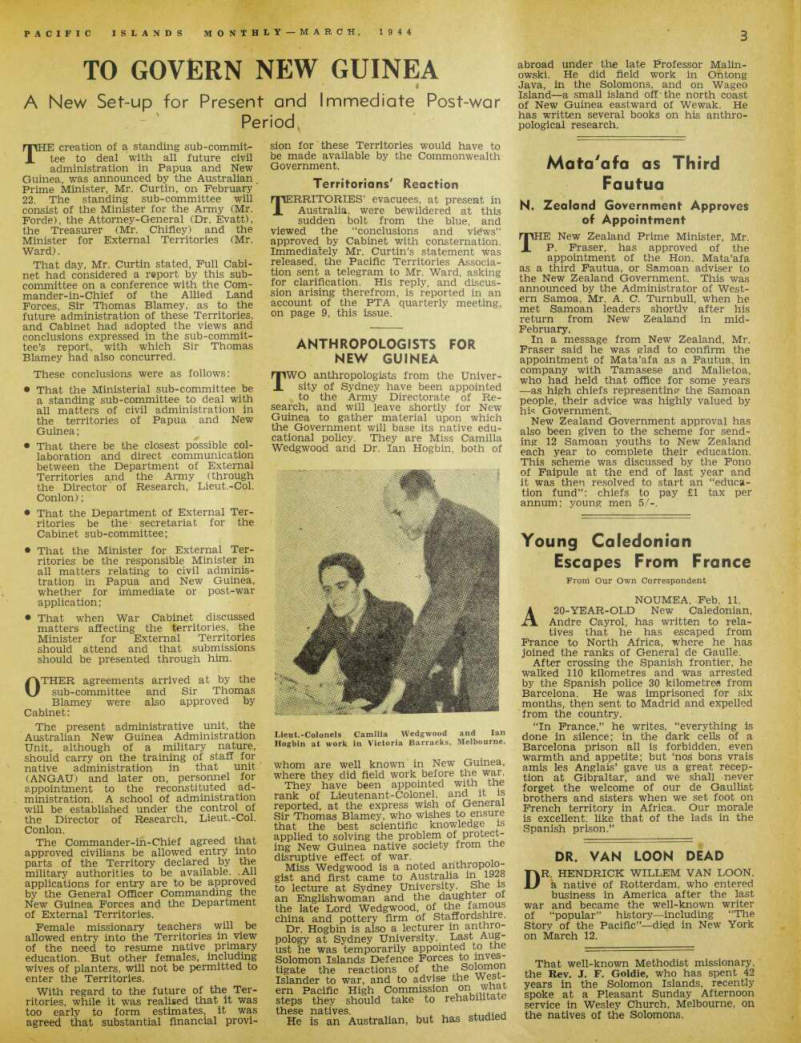
rO anthropologists from the Univer sity of Sydney have been appointed to the Army Directorate of Re search, and will leave shortly for New Guinea to gather material upon which the Government will base its native edu cational policy. They are Miss Camilla Wedgwood and Dr. lan Hogbin, both of
whom are well known in New Gumea, where they did field work before the war.
They have been appointed with the rank of Lieutenant-Colonel, and it is reported, at the express wish of General Sir Thomas Blarney, who wishes to ensure that the best scientific knowledge is applied to solving the problem of protect ing New Guinea native society from the disruptive effect of war.
Miss Wedgwood is a noted anthropolo gist and first came to Australia in i 920 to lecture at Sydney University. She is an Englishwoman and the daughter oi the late Lord Wedgwood, of the famous china and pottery firm of Staffordshire.
Dr. Hogbin is also a lecturer in anthro pology at Sydney University. Last ust he was temporarily appointed to tne Solomon Islands Defence Forces to inves tigate the reactions of the So J9p°. n Islander to war, and to advise the west ern Pacific High Commission on what steps they should take to rehabilitate these natives. . H He is an Australian, but has studied
abroad under the late Professor Malin owski. He did field work in Ontong Java, in the Solomons, and on Wageo Island —a small island off the north coast of New Guinea eastward of Wewak. He has written several books on his anthro pological research.
Lieut.-Colonels Camilla Wedgwood and Ian Hogbin at work in Victoria Barracks, Melbourne.