Caledonian Mines
p. 22 · Read in the full issue
Another Wartime
Casualty
From Our Own Correspondent
Noumea, Jan. 20.
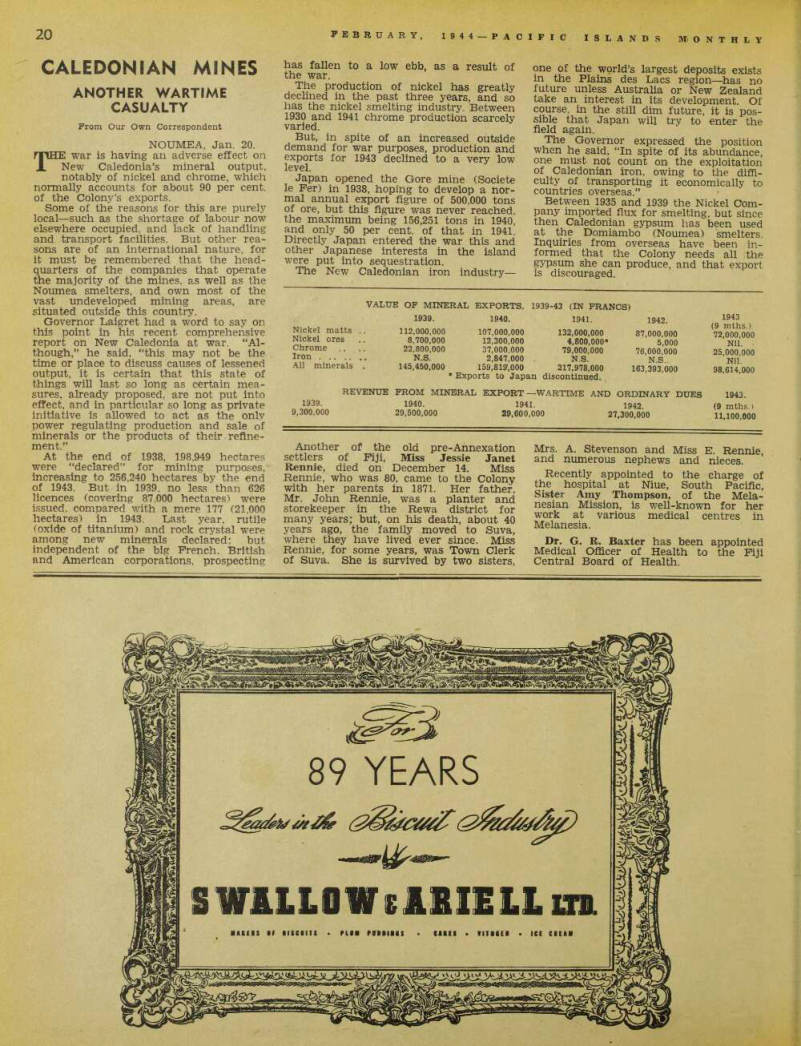
mHE war is having an adverse effect on X New Caledonia’s mineral output, notably of nickel and chrome, which normally accounts for about 90 per cent, of the Colony’s exports.
Some of the reasons for this are purely local —such as the shortage of labour now elsewhere occupied, and lack of handling and transport facilities. But other rea sons are of an international nature, for it must be remembered that the head quarters of the companies that operate the majority of the mines, as well as the Noumea smelters, and own most of the vast undeveloped mining areas, are situated outside this country.
Governor Laigret had a word to say on this point in his recent comprehensive report on New Caledonia at war. “Al though,” he said, “this may not be the time or place to discuss causes of lessened output, it is certain that this state of things will last so long as certain mea sures, already proposed, are not put into effect, and in particular so long as private initiative is allowed to act as the only power regulating production and sale of minerals or the products of their refine ment.”
At the end of 1938, 198,949 hectares were “declared” for mining purposes, increasing to 256,240 hectares by the end of 1943. But in 1939. no less than 626 licences (covering 87,000 hectares) were issued, compared with a mere 177 (21,000 hectares) in 1943. Last year, rutile (oxide of titanium) and rock crystal were among new minerals declared; but independent of the big French. British and American corporations, prospecting
has fallen to a low ebb, as a result of the war.
The production of nickel has greatly declined in the past three years, and so has the nickel smelting industry. Between 1930 and 1941 chrome production scarcely varied.
But, in spite of an increased outside demand for war purposes, production and exports for 1943 declined to a very low level.
Japan opened the Gore mine (Societe le Fer) in 1938, hoping to develop a nor mal annual export figure of 500,000 tons of ore, but this figure was never reached, the maximum being 156,251 tons in 1940, and only 50 per cent, of that in 1941.
Directly Japan entered the war this and other Japanese interests in the island were put into sequestration.
The New Caledonian iron industry—
Another of the old pre-Annexation settlers of Fiji, Miss Jessie Janet Rennie, died on December 14. Miss Rennie, who was 80, came to the Colony with her parents in 1871. Her father, Mr. John Rennie, was a planter and storekeeper in the Rewa district for many years; but, on his death, about 40 years ago, the family moved to Suva, where they have lived ever since. Miss Rennie, for some years, was Town Clerk of Suva. She is survived by two sisters,
<pne of the world’s largest deposits exists in the Plains des Lacs region—has no future unless Australia or New Zealand take an interest in its development. Of course, in the still dim future, it is pos sible that Japan will try to enter the field again.
The Governor expressed the position when he said, “In spite of its abundance, one must not count on the exploitation of Caledonian iron, owing to the diffi culty of transporting it economically to countries overseas.”
Between 1935 and 1939 the Nickel Com pany imported flux for smelting, but since then Caledonian gypsum has been used at the Domiambo (Noumea) smelters.
Inquiries from overseas have been in formed that the Colony needs all the gypsum she can produce, and that export is discouraged.
Mrs. A. Stevenson and Miss E. Rennie, and numerous nephews and nieces.
Recently appointed to the charge of the hospital at Niue, South Pacific, Sister Amy Thompson, of the Mela nesian Mission, is well-known for her work at various medical centres in Melanesia.
Dr. G. R. Baxter has been appointed Medical Officer of Health to the Fiji Central Board of Health.