The Gilberts
Well Known Men Missing In
WHEN the Japanese occupied the Gilbert Islands, the following men were reported missing:— The Rev. A. L. Sadd, of the London Missionary Society, at Beru; Mr. B. P. Cleary, dispenser at the Government Hospital, Tarawa; Captain I. R. Handley, retired master mariner, of Tarawa; Mr, A. M. MacArthur, a trader at Nonouti; Mr. R. G. Morgan, officer in charge of the King George V school, at Tarawa.
In an announcement from Fiji, in early January, it was stated that from infor mation received it was necessary to assume that all of these men had lost their lives.
It has been impossible to obtain con clusive evidence—but that they are all dead is beyond doubt, and they have accordingly been officially reported “miss ing, believed killed.”
London Mission Society headquarters, -’n Sydney have made the following state ment with regard to Mr. Sadd:— “It is believed that Mr. Sadd was im prisoned about August, 1942, and he and the others were kept in confinement at Tarawa Island in the Northern Gil berts. It is also believed that some, if not all the men, were made to work by the Japanese on the strong defensive positions they prepared at Tarawa.
“Nothing more was known of their whereabouts or welfare until after the American Marines occupied the Gilberts in November last. Mr. Sadd and the others had then disappeared.
Mr. Sadd was a graduate of Cambridge University, and was appointed to Beru in 1933. His qualities as a man, no less than his qualities as a missionary, en deared him to all who came in contact with him, and in the years he spent in the Gilberts a whole series of very human legends grew up around him. He remained at his post when most other civilians were evacuated early in 1942.
High tribute has been paid to him for his cheerful, generous, character and devotion to his work in the Gilberts; of his recent imprisonment it has been said of him by an official: “He put up a very good show. The natives say he taught the others songs and kept cheerful throughout. It made a great impression on the natives. He was a very brave man.”
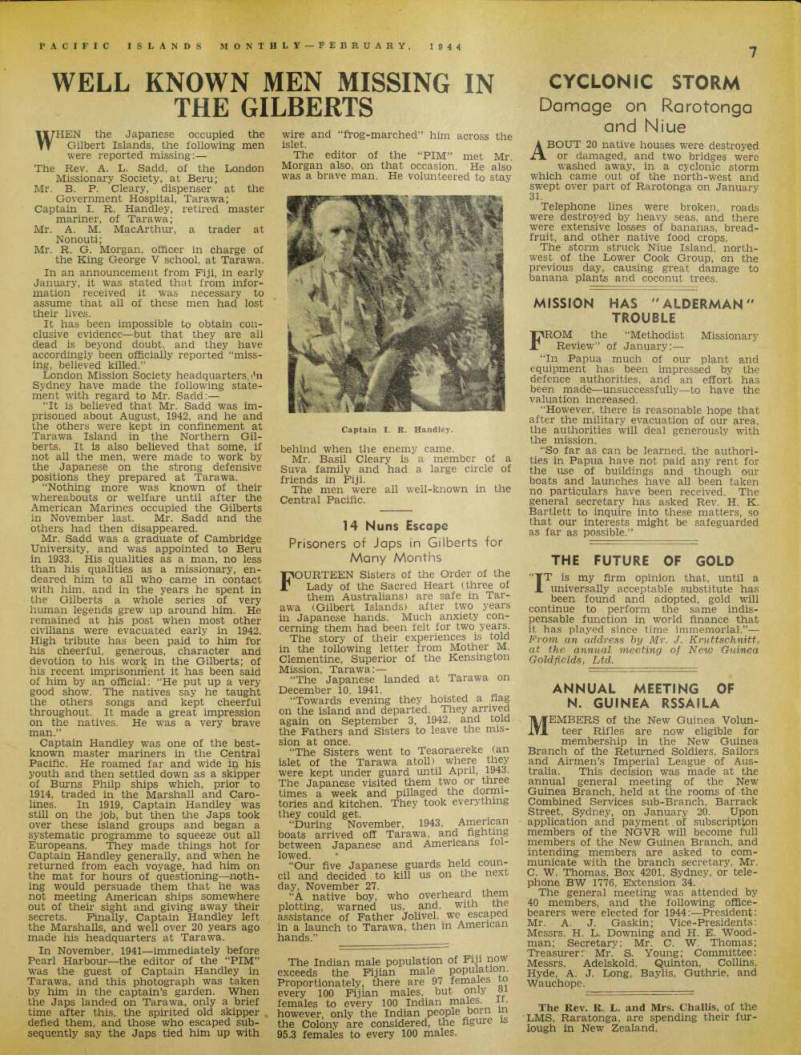
Captain Handley was one of the best known master mariners in the Central Pacific. He roamed far and wide in his youth and then settled down as a skipper of Burns Philp ships which, prior to 1914, traded in the Marshall and Caro lines. In 1919, Captain Handley was still on the job, but then the Japs took over these island groups and began a systematic programme to squeeze out all Europeans. They made things hot for Captain Handley generally, and when he returned from each voyage, had him on the mat for hours of questioning—noth ing would persuade them that he was not meeting American ships somewhere out of their sight and giving away their secrets. Finally, Captain Handley left the Marshalls, and well over 20 years ago made his headquarters at Tarawa.
In November, 1941 —immediately before Pearl Harbour —the editor of the “PIM” was the guest of Captain Handley in Tarawa, and this photograph was taken by him in the captain’s garden. When the Japs landed on Tarawa, only a brief time after this, the spirited old skipper defied them, and those who escaped sub sequently say the Japs tied him up with
wire and “frog-marched” him across the islet.
The editor of the “PIM” met Mr.
Morgan also, on that occasion. He also was a brave man. He volunteered to stay
behind when the enemy came.
Mr. Basil Cleary is a member of a Suva family and had a large circle of friends in Fiji.
The men were all well-known in the Central Pacific.
Captain I. R. Handley.