Caledonia
pp. 33-36 · Read in the full issue
How The French Came To New
Centenary Celebrations at Balade
From Our Own Correspondent
Balade, New Caledonia, Dec. 22.
ASSOCIATED with the names of Cook, d’Entrecastreaux, Huon de Kerma dec, the first French Catholic fathers, and Admiral Febvrier-Des pointes, who proclaimed French posses sion in 1853, this isolated hamlet on the desolate north-east coast of New Cale donia is to-day the scene of centenary celebrations. Pontifical mass and native feasting and dancing are attended by the Governor, M. Christian Laigret, French officials and the three Catholic bishops of New Caledonia, New Hebrides and Solomon Islands, Yesterday, at Matamate beach, near Balade, where 100 years ago the first missionaries landed under Monsignor Douarre, the Magnificat was sung under the historic banyan tree where the first mass in the Colony was celebrated on Christmas Day, 1843.
In a speech broadcast throughout the island, the Governor’ praised the ten acity of the Marist fathers, thanks to whom New Caledonia was to-day a French country and recalled how they had thrice been driven from the country —to Sydney, to the Isle of Pines, to Anatom —and how one of their number had suffered martyrdom at the hands of the cannibals.
The official party will also visit other historic spots, including the tomb of Monsignor Douarre, and the tiny island of Poudie, where the navigator* Huon de Kermadec, commander of the “Esper ance,” was buried secretly and at night for fear the cannibals should discover his remains. It was on this islet, too, that Cook had set up his observatory. rE French man-o’-war, “Bucephale,” which brought the party to Balade 100 years ago, was the first war ves sel the natives had seen since the disas trous voyage of Bruny d’Entrecasteaux.
“Almost at once,” one of that party records, “the sea was covered with canoes expertly handled by picturesquely tattooed savages. They surrounded the ship, but dared not come too near. These canoes were from Balade and neighbour ing streams, whose inhabitants ran up en masse to look at the whites. It was curious to notice their different colour ing, some black, the majority of a dark red-brown colour, and others of the same bronzed skin as the Polynesians.
“Our least noise frightened them. It was a hard job to get them to climb aboard and they examined us with stupe faction, mixed with fear. Everything intrigued them—the sound of the bell, the roll of the drums, the loud com mands and the rapid and orderly move ments of the crew.
“Little by little, they grew bolder and it was a carved canoe that first drew alongside. Presently a much-tattooed native, for whom the others showed con siderable respect, climbed to the bridge, at the invitation of the officers. It was the Balade chief, Paiama. He was fol lowed by his escort, bringing gifts of yams, taros, coconuts, and all sorts of native weapons, spears and tomahawks.
In exchange, they were given glass beads and calico, with which they were delighted.
(Continued on Page 33)
(Continued from Page 31)
“Thanks to having picked up the ele ments of the Polynesian language, Pere Viafd was able to make himself under stood by some of the coppery-skinned natives, whom he learnt had come, mostly, from a neighbouring isle (prob ably Ouvea) where a large number of inhabitants were of Polynesian origin.
From them he also learnt that no whites had attempted to establish themselves at Balade. French missionaries and sailors could pride themselves on being the first.”
THE missionaries landed the day after their arrival —on December 22, 1843.
One of their first acts was to pay a visit to Paiama. They were escorted to his dwelling by hundreds of armed
savages, and during the walk, writes one of them, “we got separated from one another. It would have been a simple matter to knock us on the head. They stared at us wonderingly and unceas ingly, and often made us stop so that they could contemplate us at their ease.”
The object of the visit was a conces sion of land on which to establish a mission. They were well received by the chief and obtained what they wanted — a piece of ground in a coconut grove fringing the sea at Matamate. It was here, under the banyan tree, that that first mass was celebrated on Christmas Day.
With the help of sailors and natives, the next few weeks were spent building the mission, which was to experience such vicissitudes, and on January 21, 1844, a French flag, presented by the “Buce phale’s” commander, Vicomte de la Fer riere, was hoisted ashore and a 21-gun salute fired—a sort of preliminary an nexation of the island, which some writers say the French Government later repudiated at the request of Great Britain.
Nonetheless, it was as a direct result of the establishment of the Balade mission that the French flag was officially hoisted 10 years later. It was the great age of settlement in some of the choicest of the earth’s regions, and there is no doubt that Frenchmen regarded New Caledonia as in some measure making up for the loss of the South Island of New Zealand.
IN Australia, the growth of Sydney, Melbourne and, to a lesser Adelaide, was spectacular, and New Caledonians will never forget the part emigrants from the two former cities played in the making of their country.
There is to-day a neighbourliness between the inhabitants of New Zealand, Aus tralia and New Caledonia, based on past liking and present respect, which augurs well for the future of South Pacific relations.
Americans, too, may find it helpful to recall that French settlement in the Pacific coincides with the Texas annexa tion and the mass movement along the Oregan trail, as well as with California’s “days of old, and days of gold, and days of the ’49.’’
It should be remembered that the handful of French and other Europeans in New Caledonia, experienced pioneer conditions, and lived lives just as ardu ous, dangerous and adventurous as those of the men who a hundred years ago fought in the Maori wars, or who opened up Australia’s great stock routes, or who joined the American waggon convoys moving west.
Mrs. Fred. Gore, mother of Mr. Justice R. T. Gore, of the Supreme Court of Papua, and now Federal Deputy Crown Solicitor at Adelaide, died recently at Goondiwindi (Qld.). She was one of the earliest Queensland women to receive the badge of merit from the Returned Sol diers’ League. She was also a life mem ber of the Incapacitated and Wounded
Sailors and Soldiers’ Association. During the last war she was a constant visitor to the Rosemount Military Hospital, Bris bane, and she continued her work there in the present war.
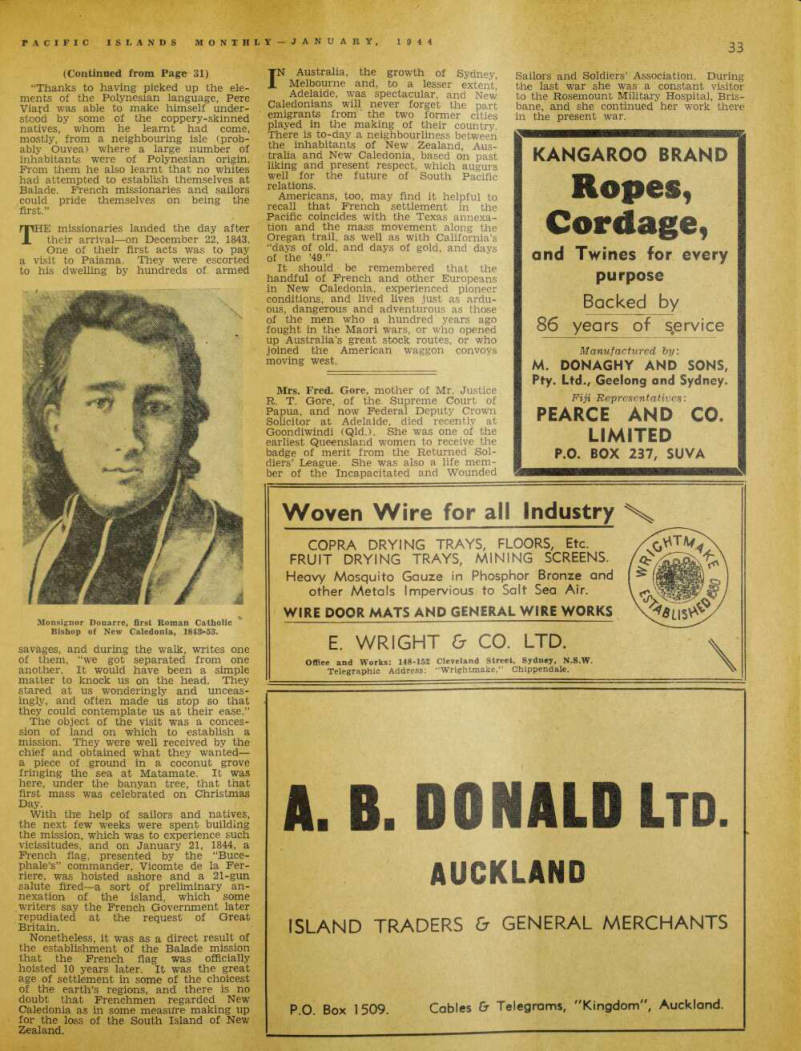
Monsignor Douarre, first Roman Catholic Bishop of New Caledonia, 1843-53.
Frenchmen in the New Hebrides contri buted 427,649 francs (over £3,050) to the French Empire fund for patriots carrying on the underground warfare against the Germans in France.