Pacific Control
pp. 5-7 · Read in the full issue
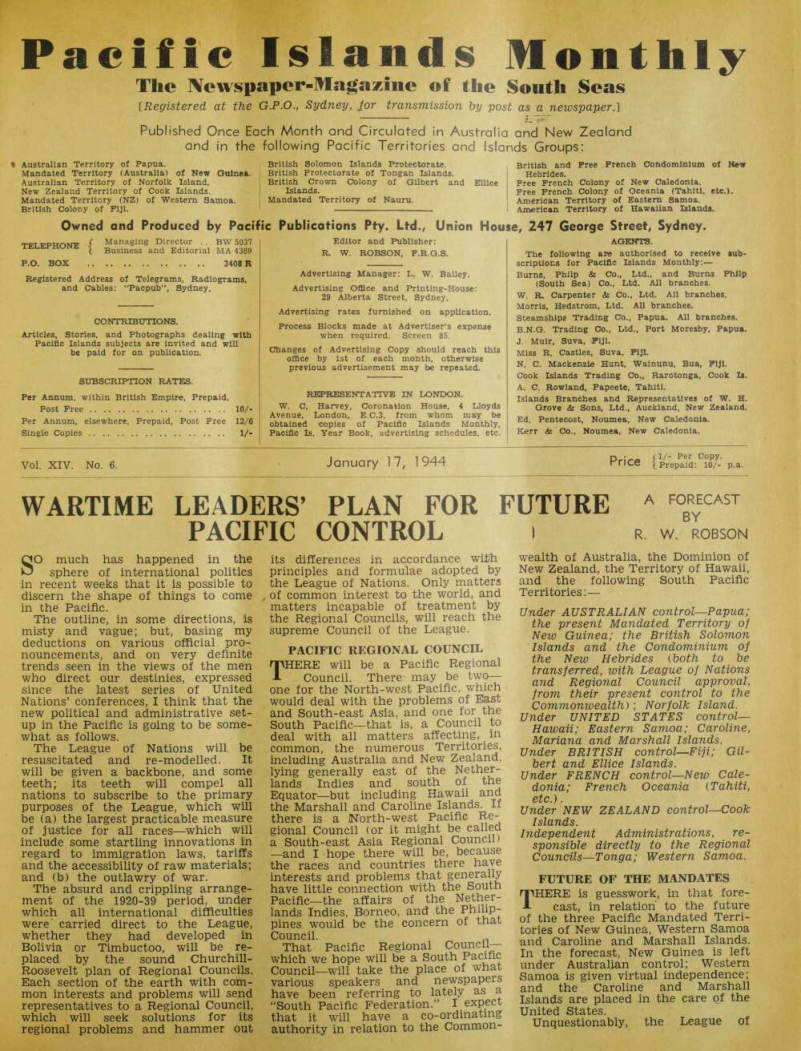
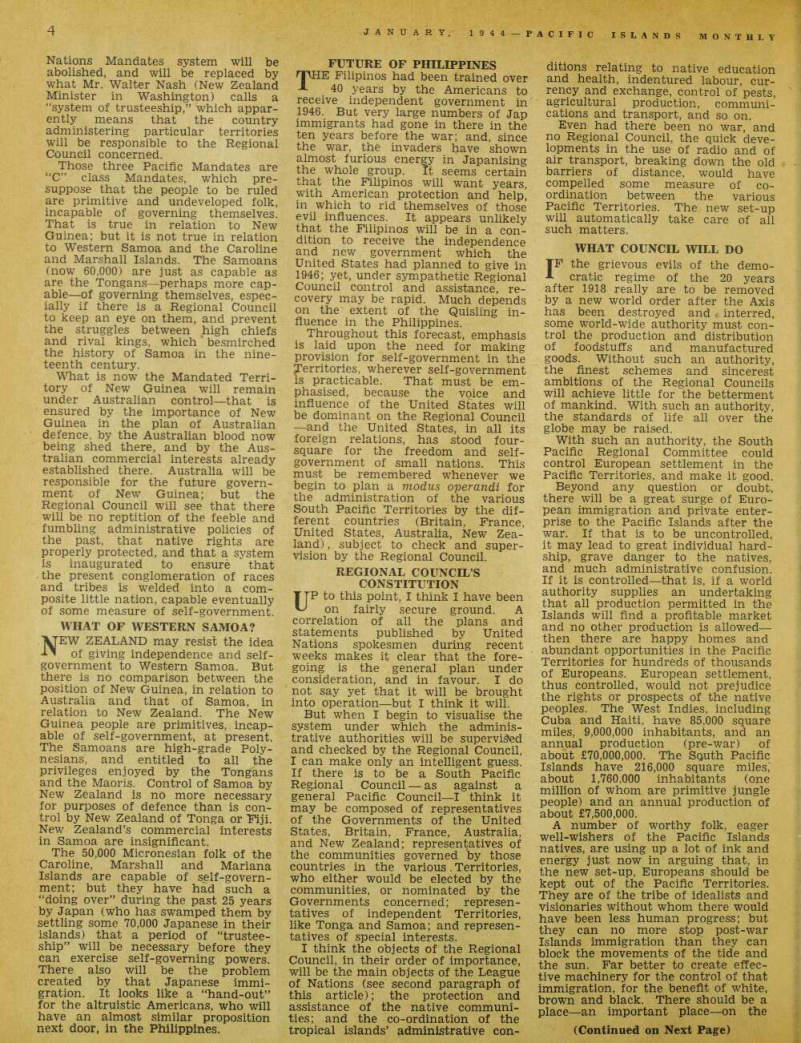
Wartime Leaders’ Plan For Future
A Forecast
BY
R. W. Robson
SO much has happened in the sphere of international politics in recent weeks that it is possible to discern the shape of things to come in the Pacific.
The outline, in some directions, is misty and vague; but, basing my nouncements on and rlo on veTy'deffnUe trends seen in the views of the men who direct our destinies, expressed since the latest series of United Nations’ conferences, I think that the new political and administrative setup in the Pacific is going to be somewhat as fofiows.
The League of Nations will be resuscitated and re-modelled. It will be given a backbone, and some teeth; its teeth will compel all nations to subscribe to the primary purposes of the League, which will be (a) the largest practicable measure of justice for all races—which will include some startling innovations in regard to immigration laws, tariffs and the accessibility of raw materials; and (b) the outlawry of war.
The absurd and crippling arrangement of the 1920-39 period, under which all international difficulties were carried direct to the League, whether they had developed in Bolivia or Timbuctoo, will be replaced by the sound Churchill- Roosevelt plan of Regional Councils.
Each section of the earth with common interests and problems will send representatives to a Regional Council, which will seek solutions for its regional problems and hammer out
its differences in accordance wiifti principles and formulae adopted by the League of Nations. Only matters of common interest to the world, and matters incapable of treatment by the Regional Councils, will reach the supreme Council of the League.
Pacific Regional Council
THERE will be a Pacific Regional Council. There may be two — one for the North-west Pacific, which would deal with the problems of East and South-east Asia, and one for the South Pacific—that is, a Council to deal with all matters affecting, in common, the numerous Territories, including Australia and New Zealand, lying generally east of the Nether lands Indies and south of the Equator—but including Hawaii and the Marshall and Caroline Islands. If there is a North-west Pacific Re gional Council (or it might be called a South-east Asia Regional Council) —and I hope there will be, because the races and countries there have interests and problems that generally have little connection with the South Pacific—the affairs of the Nether lands Indies, Borneo, and the Philip pines would be the concern of that Council. ..
That Pacific Regional Council—which we hope will be a South Pacific Council—will take the place of what various speakers and newspapers have been referring to lately as a “South Pacific Federation.” I expect that it will have a co-ordinating authority in relation to the Common
wealth of Australia, the Dominion of New Zealand, the Territory of Hawaii, and the following South Pacific Territories:— Under AUSTRALIAN control — Papua; the present Mandated Territory of New Guinea; the British Solomon Islands and the Condominium of the New Hebrides (both to be transferred, with League of Nations and Regional Council approval, from their present control to the Commonwealth) ; Norfolk Island.
Under UNITED STATES control— Hawaii; Eastern Samoa; Caroline, Mariana and Marshall Islands.
Under BRITISH control — Fiji; Gil bert and Ellice Islands.
Under FRENCH control—New Cale donia; French Oceania ( Tahiti, etc.) .
Under NEW ZEALAND control—Cook Islands.
Independent Administrations, re sponsible directly to the Regional Councils — Tonga; Western Samoa.
Future Of The Mandates
THERE is guesswork, in that fore cast, in relation' to the future of the three Pacific Mandated Terri tories of New Guinea, Western Samoa and Caroline and Marshall Islands.
In the forecast, New Guinea is left under Australian control; Western Samoa is given virtual independence; and the Caroline and Marshall Islands are placed in the care of the United States.
Unquestionably, the League of
Nations Mandates system will be abolished, and will be replaced by what Mr. Walter Nash (New Zealand Minister in Washington) calls a “system of trusteeship,” which appar ently means that the country administering particular territories will be responsible to the Regional Council concerned.
Those three Pacific Mandates are “C” class Mandates, which pre suppose that the people to be ruled are primitive and undeveloped folk, incapable of governing themselves.
That is true in relation to New Guinea; but it is not true in relation to Western Samoa and the Caroline and Marshall Islands. The Samoans (now 60,000) are just as capable as are the Tongans—perhaps more cap able—of governing themselves, espec ially if there is a Regional Council to keep an eye on them, and prevent the struggles between high chiefs and rival kings, which besmirched the history of Samoa in the nine teenth century.
What is now the Mandated Terri tory of New Guinea will remain under Australian control—that is ensured by the importance of New Guinea in the plan of Australian defence, by the Australian blood now being shed there, and by the Aus tralian commercial interests already established there. Australia will be responsible for the future govern ment of New Guinea; but the Regional Council will see that there will be no reptition of the feeble and fumbling administrative policies of the past, that native rights are properly protected, and that a system is inaugurated to ensure that the present conglomeration of races and tribes is welded into a com posite little nation, capable eventually of some measure of self-government.
What Of Western Samoa?
NEW ZEALAND may resist the idea of giving independence and self government to Western Samoa. But there is no comparison between the position of New Guinea, in relation to Australia and that of Samoa, in relation to New Zealand. The New Guinea people are primitives, incap able of self-government, at present.
The Samoans are high-grade Poly nesians, and entitled to all the privileges enjoyed by the Tongans and the Maoris. Control of Samoa by New Zealand is no more necessary for purposes of defence than is con trol by New Zealand of Tonga or "Fiji.
New Zealand’s commercial interests in Samoa are insignificant.
The 50,000 Micronesian folk of the Caroline, Marshall and Mariana Islands are capable of self-govern ment; but they have had such a “doing over” during the past 25 years by Japan (who has swamped them by settling some 70,000 Japanese in their islands) that a period of “trustee ship” will be necessary before they can exercise self-governing powers.
There also will be the problem created by that Japanese immi gration. It looks like a “hand-out” for the altruistic Americans, who will have an almost similar proposition next door, in the Philippines.
Future Of Philippines
rpHE Filipinos had been trained over -*■ 40 years by the Americans to receive independent government in 1946. But very large numbers of Jap immigrants had gone in there in the ten years before the war; and, since the war, the invaders have shown almost furious energy in Japanising the whole group. It seems certain that the Filipinos will want years, with American protection and help, in which to rid themselves of those evil influences. It appears unlikely that the Filipinos will be in a con dition to receive the independence and new government which the United States had planned to give in 1946; yet, under sympathetic Regional Council control and assistance, re covery may be rapid. Much depends on the extent of the Quisling in fluence in the Philippines.
Throughout this forecast, emphasis is laid upon the need for making provision for self-government in the Territories, wherever self-government is practicable. That must be em phasised, because the voice and influence of the United States will be dominant on the Regional Council —and the United States, in all its foreign relations, has stood four square for the freedom and self government of small nations. This must be remembered whenever we begin to plan a modus operandi for the administration of the various South Pacific Territories by the dif ferent countries (Britain, France, United States, Australia, New Zea land), subject to check and super vision by the Regional Council.
Regional Council’S
Constitution
UP to this point, I think I have been on fairly secure ground. A correlation of all the plans and statements published by United Nations spokesmen during recent weeks makes it clear that the fore going is the general plan under consideration, and in favour. I do not say yet that it will be brought into operation—but I think it will.
But when I begin to visualise the system under which the adminis trative authorities will be supervised and checked by the Regional Council, I can make only an intelligent guess.
If there is to be a South Pacific Regional Council —as against a general Pacific Council—l think it may be composed of representatives of the Governments of the United States, Britain, France, Australia, and New Zealand; representatives of the communities governed by those countries in the various Territories, who either would be elected by the communities, or nominated by the Governments concerned; represen tatives of independent Territories, like Tonga and Samoa; and represen tatives of special interests.
I think the objects of the Regional Council, in their order of importance, will be the main objects of the League of Nations (see second paragraph of this article); the protection and assistance of the native communi ties; and the co-ordination of the tropical islands’ administrative con
ditions relating to native education and health, indentured labour, cur rency and exchange, control of pests, agricultural production, communi cations and transport, and so on.
Even had there been no war, and no Regional Council, the quick deve lopments in the use of radio and of air transport, breaking down the old barriers of distance, would have compelled some measure of co ordination between the various Pacific Territories. The new set-up will automatically take care of all such matters.
What Council Will Do
IF the grievous evils of the demo cratic regime of the 20 years after 1918 really are to be removed by a new world order after the Axis has been destroyed and • interred, some world-wide authority must con trol the production and distribution of foodstuffs and manufactured goods. Without such an authority, the finest schemes and sincerest ambitions of the Regional Councils will achieve little for the betterment of mankind. With such an authority, the standards of life all over the globe may be raised.
With such an authority, the South Pacific Regional Committee could control European settlement in the Pacific Territories, and make it good.
Beyond any question or doubt, there will be a great surge of Euro pean immigration and private enter prise to the Pacific Islands after the war. If that is to be uncontrolled, it may lead to great individual hard ship, grave danger to the natives, and much administrative confusion.
If it is controlled—that is, if a world authority supplies an undertaking that all production permitted in the Islands will find a profitable market and no other production is allowed— then there are happy homes and abundant opportunities in the Pacific Territories for hundreds of thousands of Europeans. European settlement, thus controlled, would not prejudice the rights or prospects of the native peoples. The West Indies, including Cuba and Haiti, have 85,000 square miles, 9,000,000 inhabitants, and an annual production (pre-war) of about £70,000,000. The Squth Pacific Islands have 216,000 square miles,' about 1,760.000 inhabitants (one million of whom are primitive jungle people) and an annual production of about £7,500,000.
A number of worthy folk, eager well-wishers of the Pacific Islands natives, are using up a lot of ink and energy just now in arguing that, in the new set-up, Europeans should be kept out of the Pacific Territories.
They are of the tribe of idealists and visionaries without whom there would have been less human progress; but they can no more stop post-war Islands immigration than they can block the movements of the tide and the sun. Far better to create effec tive machinery for the control of that immigration, for the benefit of white, brown and black. There should be a place—an important place—on the
(Continued on Next Page)
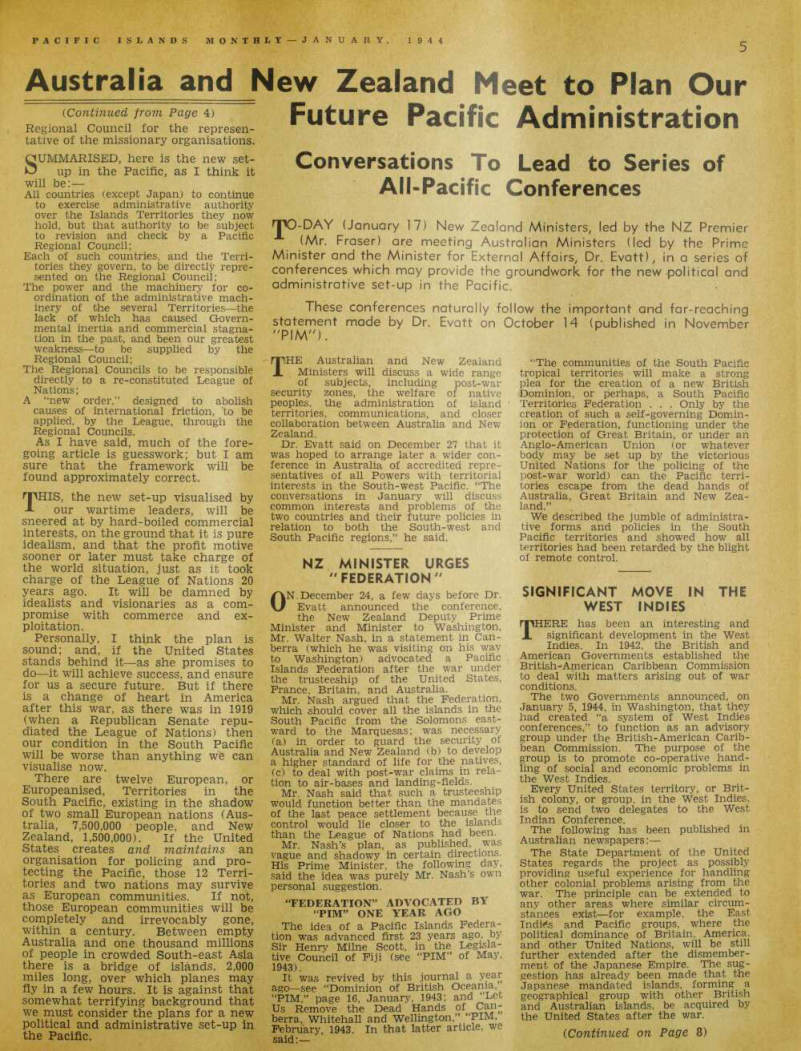
{Continued from Page 4)
Regional Council for the represen tative of the missionary organisations.
SUMMARISED, here is the new set up in the Pacific, as I think it will be:— All countries (except Japan) to continue to exercise administrative authority over the Islands Territories they now hold, but that authority to be subject to revision and check by a Pacific Regional Council; Each of such countries, and the Terri tories they govern, to be directly repre sented on the Regional Council; The power and the machinery for co ordination of the administrative mach inery of the several Territories—the lack of which has caused Govern mental inertia and commercial stagna tion in the past, and been our greatest weakness—to be supplied by the Regional Council; The Regional Councils to be responsible directly to a re-constituted League of Nations; A “new order,” designed to abolish causes of international friction, 'to be applied, by the League, through the Regional Councils.
As I have said, much of the fore going article is guesswork; but I am sure that the framework will be found approximately correct.
THIS, the new set-up visualised by our wartime leaders, will be sneered at by hard-boiled commercial interests, on the ground that it is pure idealism, and that the profit motive sooner or later must take charge of the world situation, just as it took charge of the League of Nations 20 years ago. It will be damned by idealists and visionaries as a com promise with commerce and ex ploitation.
Personally, I think the plan is sound; and, if the United States stands behind it—as she promises to do—it will achieve success, and ensure for us a secure future. But if there is a change of heart in America after this war, as there was in 1919 (when a Republican Senate repu diated the League of Nations) then our condition in the South Pacific will be worse than anything we can visualise now.
There are twelve European, or Europeanised, Territories in the South Pacific, existing in the shadow of two small European nations (Aus tralia, 7,500,000 people, and New Zealand, 1,500,000). If the United States creates and maintains an organisation for policing and pro tecting the Pacific, those 12 Terri tories and two nations may survive as European communities. If not, those European communities will be completely and irrevocably gone, within a century. Between empty Australia and one thousand millions of people in crowded South-east Asia there is a bridge of islands, 2,000 miles long, over which planes may fly in a few hours. It is against that somewhat terrifying background that we must consider the plans for a new political and administrative set-up in the Pacific.