Gold In Sudest
p. 38 · Read in the full issue
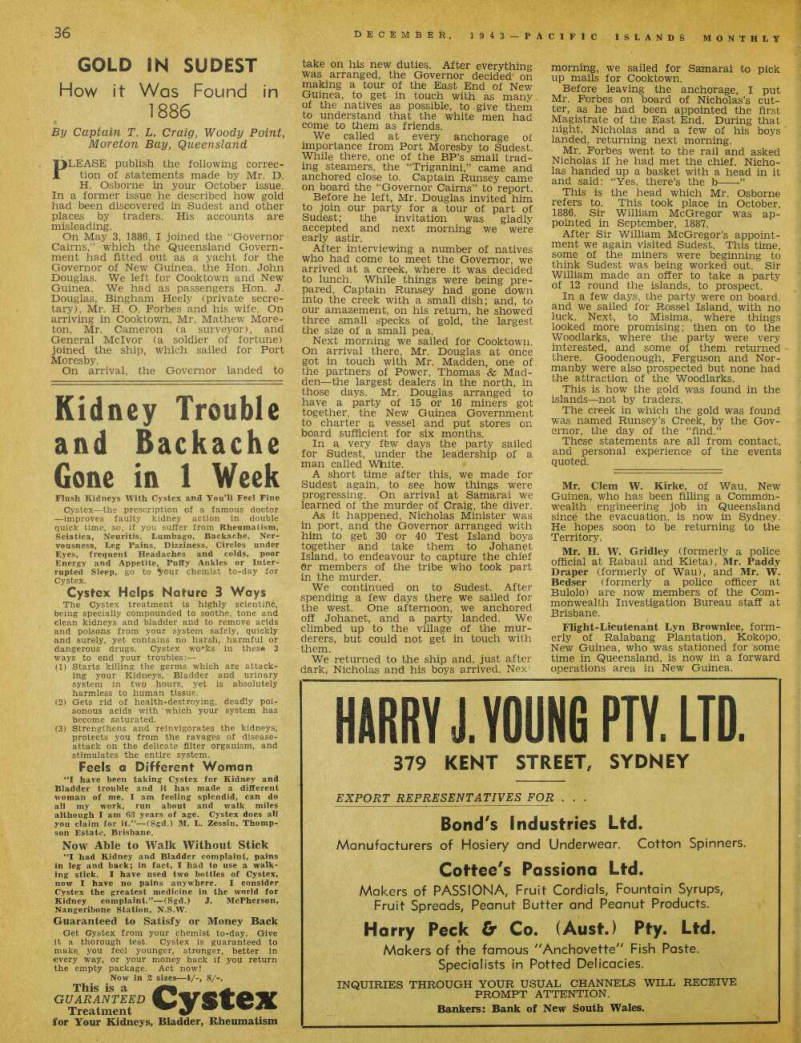
How it Was Found in 1886
By Captain T. L. Craig, Woody Point,
Moreton Bay, Queensland
PLEASE publish the following correc tion of statements made by Mr. D.
H. Osborne in your October issue.
In a former issue he described how gold had been discovered in Sudest and other places by traders. His accounts are misleading.
On May 3, 1886, I joined the “Governor Cairns,” which the Queensland Govern ment had fitted out as a yacht for the Governor of New Guinea, the Hon. John Douglas. We left for Cooktown and New Guinea. We had as passengers Hon. J.
Douglas, Bingham Heely (private secre tary), Mr. H. O. Forbes and his wife. On arriving in Cooktown, Mr. Mathew More ton, Mr. Cameron (a surveyor), and General Mclvor (a soldier of fortune) joined the ship, which sailed for Port Moresby, On arrival, the Governor landed to
take on his new duties. After everything was arranged, the Governor decided on making a tour of the East End of New Guinea, to get in touch with as many of the natives as possible, to give them to understand that the white men had come to them as friends.
We called at every anchorage of importance from Port Moresby to Sudest.
While there, one of the BP’s small trad ing steamers, the “Triganini,” came and anchored close to. Captain Runsey came on board the “Governor Cairns” to report.
Before he left, Mr. Douglas invited him to join our party for a tour of part of Sudest; the invitation was gladly accepted and next morning we were early astir.
After interviewing a number of natives who had come to meet the Governor, we arrived at a creek, where it was decided to lunch. While things were being pre pared, Captain Runsey had gone down into the creek with a small dish; and, to our amazement, on his return, he showed three small specks of gold, the largest the size of a small pea.
Next morning we sailed for Cooktown.
On arrival there, Mr. Douglas at once got in touch with Mr, Madden, one of the partners of Power, Thomas & Mad den—the largest dealers in the north, in those days. Mr. Douglas arranged to have a party of 15 or 16 miners got together, the New Guinea Government to charter a vessel and put stores on board sufficient for six months.
In a very fbw days the party sailed for Sudest, under the leadership of a man called White.
A short time after this, we made for Sudest again, to see how things were progressing. On arrival at Samarai we learned of the murder of Craig, the diver.
As it happened, Nicholas Minister was in port, and the Governor arranged with him to get 30 or 40 Test Island boys together and take them to Johanet Island, to endeavour to capture the chief or members of the tribe who took part in the murder.
We continued on to Sudest. After spending a few days there we sailed for the west. One afternoon, we anchored off Johanet, and a party landed. We climbed up to the village of the mur derers, but could not get in touch with them.
We returned to the ship and, just after dark, Nicholas and his boys arrived. Nex'
morning, we sailed for Samarai to pick up mails for Cooktown.
Before leaving the anchorage, I put Mr. Forbes on board of Nicholas’s cut ter, as he had been appointed the first Magistrate of the East End. During that night, Nicholas and a few of his boys landed, returning next morning.
Mr. Forbes went to the rail and asked Nicholas if he had met the chief. Nicho las handed up a basket with a head in it and said; “Yes, there’s the b ”
This is the head which Mr. Osborne refers to. This took place in October, 1886. Sir William McGregor was ap pointed in September, 1887.
After Sir William McGregor’s appoint ment we again visited Sudest. This time, some of the miners were beginning to think Sudest was being worked out. Sir William made an offer to take a party of 12 round the islands, to prospect.
In a few days, the party were on board, and we sailed for Rossel Island, with no luck. Next, to Misima, where things looked more promising; then on to the Woodlarks, where the party were very interested, and some of them returned there. Goodenough, Ferguson and Nor manby were also prospected but none had the attraction of the Woodlarks.
This is how the gold was found in the islands—not by traders.
The creek in which the gold was found was named Runsey’s Creek, by the Gov ernor, the day of the “find.”
These statements are all from contact, and personal experience of the events quoted.
Mr. Clem W. Kirke, of Wau, New Guinea, who has been filling a Common wealth engineering job in Queensland since the evacuation, is now in Sydney.
He hopes soon to be returning to the Territory.
Mr. H. W. Gridley (formerly a police official at Rabaul and Kieta), Mr. Paddy Draper (formerly of Wau), and Mr. W.
Bedser (formerly a police officer at Bulolo) are now members of the Com monwealth Investigation Bureau staff at Brisbane.
Flight-Lieutenant Lyn Brownlee, form erly of Ralabang Plantation, Kokopo, New Guinea, who was stationed for some time in Queensland, is now in a forward operations area in New Guinea.