Soldier's Story
p. 27 · Read in the full issue
By “Daika”
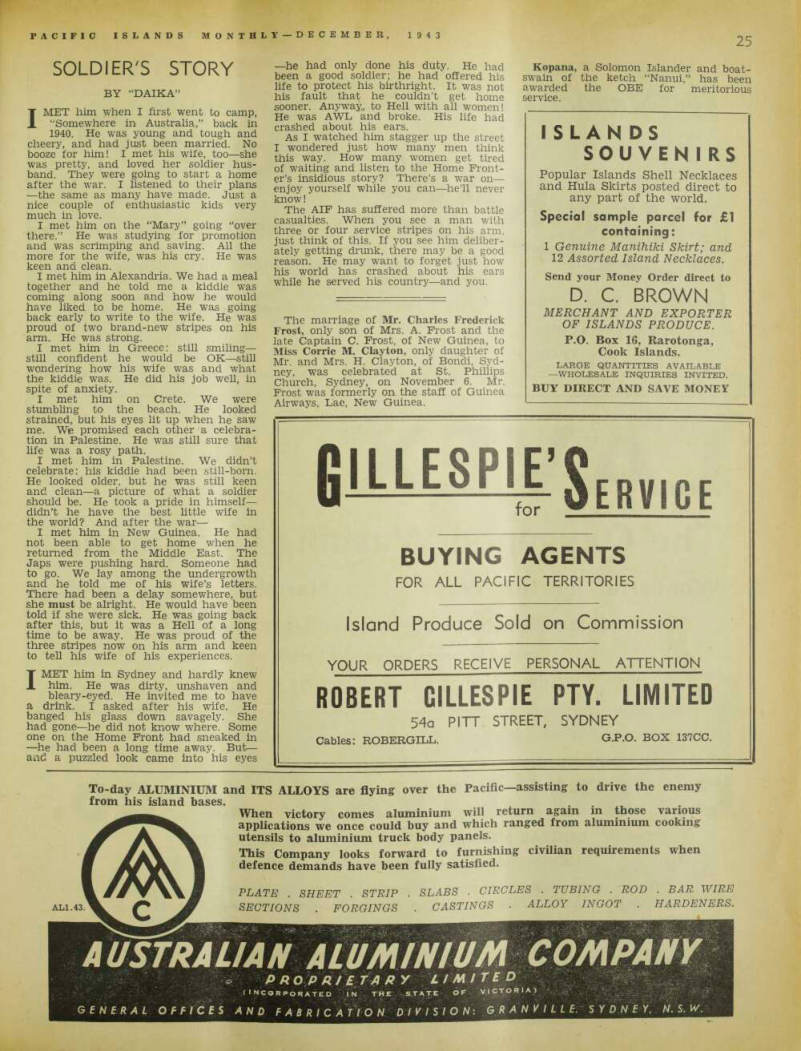
IMET him when I first went to camp, “Somewhere in Australia,” back in 1940. He was young and tough and cheery, and had just been married. No booze for him! I met his wife, too—she was pretty, and loved her soldier hus band. They were going to start a home after the war. I listened to their plans —the same as many have made. Just a nice couple of enthusiastic kids very much in love.
I met him on the “Mary” going “over there.” He was studying for promotion and was scrimping and saving. All the more for the wife, was his cry. He was keen and clean.
I met him in Alexandria. We had a meal together and he told me a kiddie was coming along soon and how he would have liked to be home. He was going back early to write to the wife. He was proud of two brand-new stripes on his arm. He was strong.
I met him in Greece: still smiling— still confident he would be OK—still wondering how his wife was and what the kiddie was. He did his job well, in spite of anxiety.
I met him on Crete. We were stumbling to the beach. He looked strained, but his eyes lit up when he saw me. We promised each other a celebra tion in Palestine. He was still sure that life was a rosy path.
I met him in Palestine. We didn’t celebrate: his kiddie had been still-born.
He looked older, but he was still keen and clean—a picture of what a soldier should be. He took a pride in himself— didn’t he have the best little wife in the world? And after the war — I met him in New Guinea. He had not been able to get home when he returned from the Middle East. The Japs were pushing hard. Someone had to go. We lay among the undergrowth and he told me of his wife’s letters.
There had been a delay somewhere, but she must be alright. He would have been told if she were sick. He was going back after this, but it was a Hell of a long time to be away. He was proud of the three stripes now on his arm and keen to tell his wife of his experiences.
IMET him in Sydney and hardly knew him. He was dirty, unshaven and bleary-eyed. He invited me to have a drink. I asked after his wife. He banged his glass down savagely. She had gone—he did not know where. Some one on the Home Front had sneaked in —he had been a long time away. But— and a puzzled look came into his eyes
—he had only done his duty. He had been a good soldier; he had offered his life to protect his birthright. It was not his fault that he couldn’t get home sooner. Anyway, to Hell with all women!
He was AWL and broke. His life had crashed about his ears.
As I watched him stagger up the street I wondered just how many men think this way. How many women get tired of waiting and listen to the Home Front er’s insidious story? There’s a war on— enjoy yourself while you can—he’ll never know!
The AIF has suffered more than battle casualties. When you see a man with three or four service stripes on his arm. just think of this. If you see him deliber ately getting drunk, there may be a good reason. He may want to forget just how his world has crashed about his ears while he served his country—and you.
The marriage of Mr. Charles Frederick Frost, only son of Mrs. A. Frost and the late Captain C. Frost, of New Guinea, to Miss Corrie M. Clayton, only daughter of Mr. and Mrs. H. Clayton, of Bondi, Syd ney, was celebrated at St. Phillips Church, Sydney, on November 6. Mr.
Frost was formerly on the staff of Guinea Airways, Lae, New Guinea.
Kopana, a Solomon Islander and boat swain of the ketch “Nanui,” has been awarded the OBE for meritorious service.