Dutch Rule In Nei
pp. 15-17 · Read in the full issue

Guidance for Pacific Administrators The Second of Three Articles Written for “PIM” by Wolfe Preger.
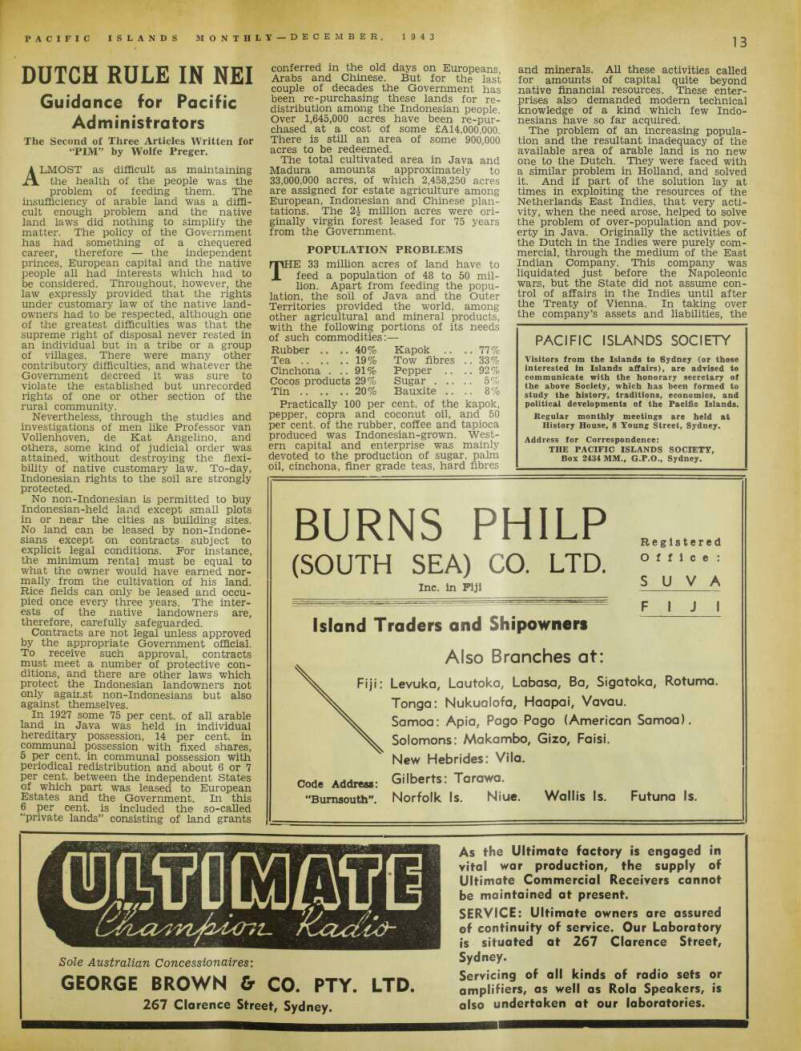
ALMOST as difficult as maintaining the health of the people was the problem of feeding them. The insufficiency of arable land was a diffi cult enough problem and the native land laws did nothing to simplify the matter. The policy of the Government has had something of a chequered career, therefore the independent princes, European capital and the native people all had interests which had to be considered. Throughout, however, the law expressly provided that the rights under customary law of the native land owners had to be respected, although one of the greatest difficulties was that the supreme right of disposal never rested in an individual but in a tribe or a group of villages. There were many other contributory difficulties, and whatever the Government decreed it was sure to violate the established but unrecorded rights of one or other section of the rural community.
Nevertheless, through the studies and investigations of men like Professor van Vollenhoven, de Kat Angelino, and others, some kind of judicial order was attained, without destroying the flexi bility of native customary law. To-day, Indonesian rights to the soil are strongly protected.
No non-Indonesian is permitted to buy Indonesian-held land except small plots in or near the cities as building sites.
No land can be leased by non-Indone sians except on contracts subject to explicit legal conditions. For instance, the minimum rental must be equal to what the owner would have earned nor mally from the cultivation of his land.
Rice fields can only be leased and occu pied once every three years. The inter ests of the native landowners are, therefore, carefully safeguarded.
Contracts are not legal unless approved by the appropriate Government official.
To receive such approval, contracts must meet a number of protective con ditions, and there are other laws which protect the Indonesian landowners not only against non-Indonesians but also against themselves.
In 1927 some 75 per cent, of all arable land in Java was held in individual hereditary possession, 14 per cent, in communal possession with fixed shares, 5 per cent, in communal possession with periodical redistribution and about 6 or 7 per cent, between the independent States of which part was leased to European Estates and the Government. In this 6 per cent, is included the so-called “private lands” consisting of land grants
conferred in the old days on Europeans Arabs and Chinese. But for the last couple of decades the Government has been re-purchasing these lands for re distribution among the Indonesian people.
Over 1,645,000 acres have been re-pur chased at a cost of some £A14,000,000.
There is still an area of some 900,000 acres to be redeemed.
The total cultivated area in Java and Madura amounts approximately to 33,000,000 acres, of which 2,458,250 acres are assigned for estate agriculture among European, Indonesian and Chinese plan tations. The 2i million acres were ori ginally virgin forest leased for 75 years from the Government.
Population Problems
rE 33 million acres of land have to feed a population of 48 to 50 mil lion. Apart from feeding the popu lation, the soil of Java and the Outer Territories provided the world, among other agricultural and mineral products, with the following portions of its needs of such commodities: — Rubber .. .. 40% Kapok .. ..77% Tea 19% Tow fibres .. 33% Cinchona . ..91% Pepper .. ..92% Cocos products 29% Sugar 5% Tin 20% Bauxite .. .. 8% Practically 100 per cent, of the kapok, pepper, copra and coconut oil, and 50 per cent, of the rubber, coffee and tapioca produced was Indonesian-grown. West ern capital and enterprise was mainly devoted to the production of sugar, palm oil, cinchona, finer grade teas, hard fibres
and minerals. All these activities called for amounts of capital quite beyond native financial resources. These enter prises also demanded modern technical knowledge of a kind which few Indo nesians have so far acquired.
The problem of an increasing popula tion and the resultant inadequacy of the available area of arable land is no new one to the Dutch. They were faced with a similar problem in Holland, and solved it. And if part of the solution lay at times in exploiting the resources of the Netherlands East Indies, that very acti vity, when the need arose, helped to solve the problem of over-population and pov erty in Java. Originally the activities of the Dutch in the Indies were purely com mercial, through the medium of the East Indian Company. This company was liquidated just before the Napoleonic wars, but the State did not assume con trol of affairs in the Indies until after the Treaty of Vienna, In taking over the company’s assets and liabilities, the
Government also took over its bankrupt estates, which it had to carry on to con vert into an asset. In fact, the State was the only European party with invest ments in the country. It was not until about 1870 that private capital was attracted to the Netherlands Indies.
The resources and possibilities of the soil were then investigated, irrigation projects and land-reclamation schemes undertaken, new commercial agricultural growths investigated, experimented with, introduced and marketed.
Increasing Production
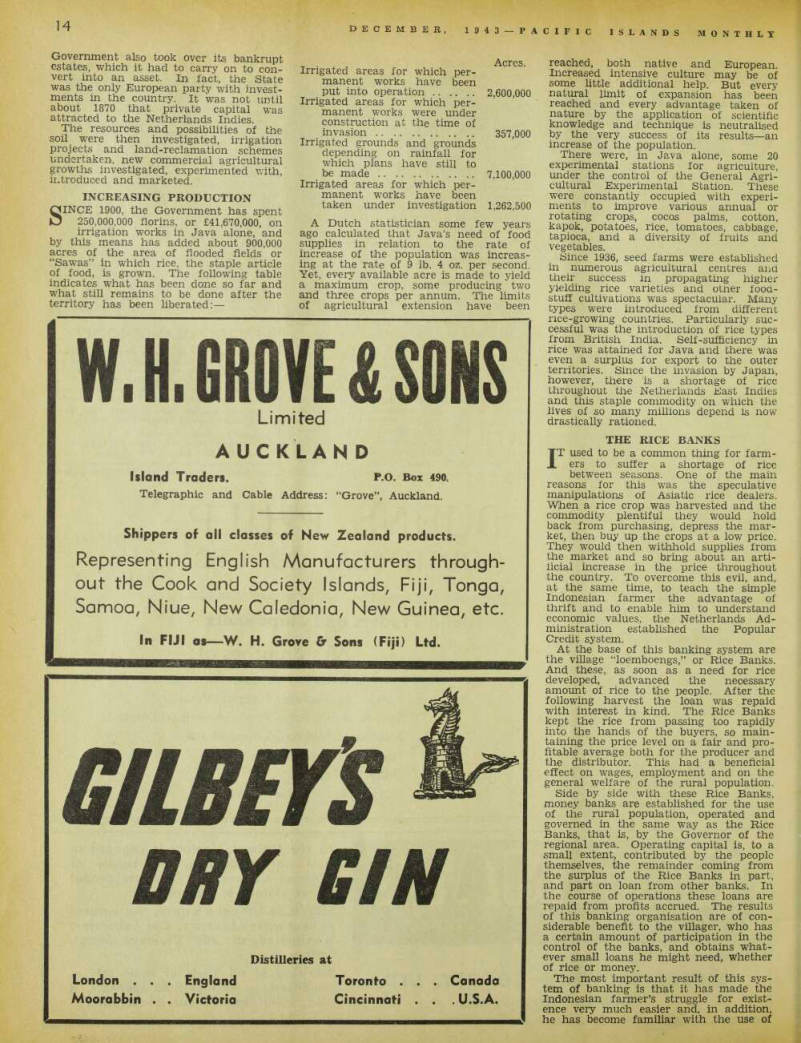
SINCE 1900, the Government has spent 250,000,000 florins, or £41,670,000, on irrigation works in Java alone, and by this means has added about 900,000 acres of the area of flooded fields or “Sawas” in which rice, the staple article ?f food, is grown. The following table indicates what has been done so far and what still remains to be done after the territory has been liberated:—
A Cre g Irrigated areas for which per manent works have been put into operation 2,600,000 Irrigated areas for which per manent works were under construction at the time of invasion 357,000 Irrigated grounds and grounds depending on rainfall for which plans have still to be made 7,100,000 Irrigated areas for which per manent works have been taken under investigation 1,262,500 A Dutch statistician some few years ago calculated that Java’s need of food supplies in relation to the rate of increase of the population was increas ing at the rate of 9 lb, 4 oz. per second.
Yet, every available acre is made to yield a maximum crop, some producing two and three crops per annum. The limits of agricultural extension have been
reached, both native and European.
Increased intensive culture may be of some little additional help. But every natural limit of expansion has been reached and every advantage taken of nature by the application of scientific knowledge and technique is neutralised by the very success of its results—an increase of the population.
There were, in Java alone, some 20 experimental stations for agriculture, under the control of the General Agri cultural Experimental Station. These were constantly occupied with experi ments to improve various annual or rotating crops, cocos palms, cotton, kapok, potatoes, rice, tomatoes, cabbage, tapioca, and a diversity of fruits and vegetables.
Since 1936, seed farms were established in numerous agricultural centres and their success in propagating higher yielding rice varieties and otner food stuff cultivations was spectacular. Many types were introduced from different nce-growing countries. Particularly suc cessful was the introduction of rice types from British India. Self-sufficiency in rice was attained for Java and there was even a surplus for export to the outer territories. Since the invasion by Japan, however, there is a shortage of rice throughout the Netherlands East Indies and this staple commodity on which the lives of so many millions depend is now drastically rationed.
The Rice Banks
IT used to be a common thing for farm ers to suffer a shortage of rice between seasons. One of the main reasons for this was the speculative manipulations of Asiatic rice dealers.
Wjhen a rice crop was harvested and the commodity plentiful they would hold back from purchasing, depress the mar ket, then buy up the crops at a low price.
They would then withhold supplies from the market and so bring about an arti ficial increase in the price throughout the country. To overcome this evil, and, at the same time, to teach the simple Indonesian farmer the advantage of thrift and to enable him to understand economic values, the Netherlands Ad ministration established the Popular Credit system.
At the base of this banking system are the village “loemboengs,” or Rice Banks.
And these, as soon as a need for rice developed, advanced the necessary amount of rice to the people. After the following harvest the loan was repaid with interest in kind. The Rice Banks kept the rice from passing too rapidly into the hands of the buyers, so main taining the price level on a fair and pro fitable average both for the producer and the distributor. This had a beneficial effect on wages, employment and on the general welfare of the rural population.
Side by side with these Rice Banks, money banks are established for the use of the rural population, operated and governed in the same way as the Rice Banks, that is, by the Governor of the regional area. Operating capital is, to a small extent, contributed by the people themselves, the remainder coming from the surplus of the Rice Banks in part, and part on loan from other banks. In the course of operations these loans are repaid from profits accrued. The results of this banking organisation are of con siderable benefit to the villager, who has a certain amount of participation in the control of the banks, and obtains what ever small loans he might need, whether of rice or money.
The most important result of this sys tem of banking is that it has made the Indonesian farmer’s struggle for exist ence very much easier and, in addition, he has become familiar with the use of
money and with the paying off of loans out of income.
In this way, the Administration en deavors to combine the protection of the people’s economic interests and its edu cation in thrift.
Education
NOR are other forms of education neglected. Elementary education is rather extensive in Java, less so, inevitably, in the outer provinces.
Throughout the entire territory, however, there were in 1942 some 21,440 schools with a staff of almost 50,000 teachers. Of these, about 5,000 were European. The number of pupils amounted to almost 2 \ million, of which some 53,000 were Euro pean. The opportunity existed for all Indonesian pupils to pass from elemen tary schools through what were called “link” schools to secondary schools and from there to every form of higher edu cation, either in the Netherlands East Indies or in Holland itself. The Govern ment also provided 2,341 free libraries for the Indonesian population of Java.
The total number of books lent in 1940 was 2,133,290. (To be Concluded in January)