Gauguin's Story
p. 42 · Read in the full issue
As Re-told by Somerset Maugham
BASED on the life of Gauguin, the French painter, W. Somerset Maugham’s best-seller, “Moon and Sixpence,” follows in the artist’s wake from Paris to Papeete. Since Paul Gau guin’s true biography is quite unpub lishable, the Maugham opus will prob ably stand the test of time as the “next best thing.” A film version of “Moon and Sixpence” is at present running in Australian theatres.
Mr. Maugham arrived in Tahiti irv 1916, when he was 53, and engaged a room at the Hotel Tiare. The establishment was then under the sway of Lovina —whom the author introduces into his story as “Tiare Johnson.” History tells that the author did not enter the hectic Island night-life of the period—but drank in terminable cups of cuffee and played interminable games of chess on the hotel verandah.
Maugham calls his central figure in “Moon and Sixpence” “Charles Strick land” and makes of him not a French man, but an Englishman who, until close on middle-age, lived an ordinary, dull, conventional life. He then decided that he must paint—-although he has
hitherto done nothing of the sorte-and proceeds to Paris to put the idea into action. Later he goes to Tahiti where Maugham diverts him from the eccentri cities of Gauguin, whose bizarre carv ings and peculiar attitude towards reli gion were too raw for subject matter, although they are still a subject for dis cussion in Oceania. While Gauguin affronted everybody and everything that crossed his path, Strickland engages only the fair sex.
At the period when “Strickland” was a figure in London society, in the 90’s, Gau-
guin was painting rural and coastal Flemish scenes. The French artist arrived at Papeete in 1893, wearing a Tyrolese hat and a large green cravat.
He sought the simplicity of a desert island of Captain Cook’s time—or, in
other words, literally hoped to buy the moon for sixpence!
He declared that his arrival was a hundred years too late, and the discovery soured him. The story of Gauguin’s departure for the Marquesas, a thousand miles north, does not come into Mr.
Maugham’s story at all. It was there the French artist found a girl who, for a bag of lollies, was willing to pose as a beauty of a century before, and it was there he painted many of his high-priced canvases.
Eventually the French Colonial Gov ernment decided to recognise Gauguin’s ability and confer an honour upon him.
Two officials approached him with the courteous suggestion that he should visit Government House and paint a portrait of the Governor, M. Lazerade, from Martinique, and of African ancestry.
Gauguin’s reply made history. He regret ted he was a painter of life, but could not undertake to paint animals! It took French officialdom some time to recover from the shock.
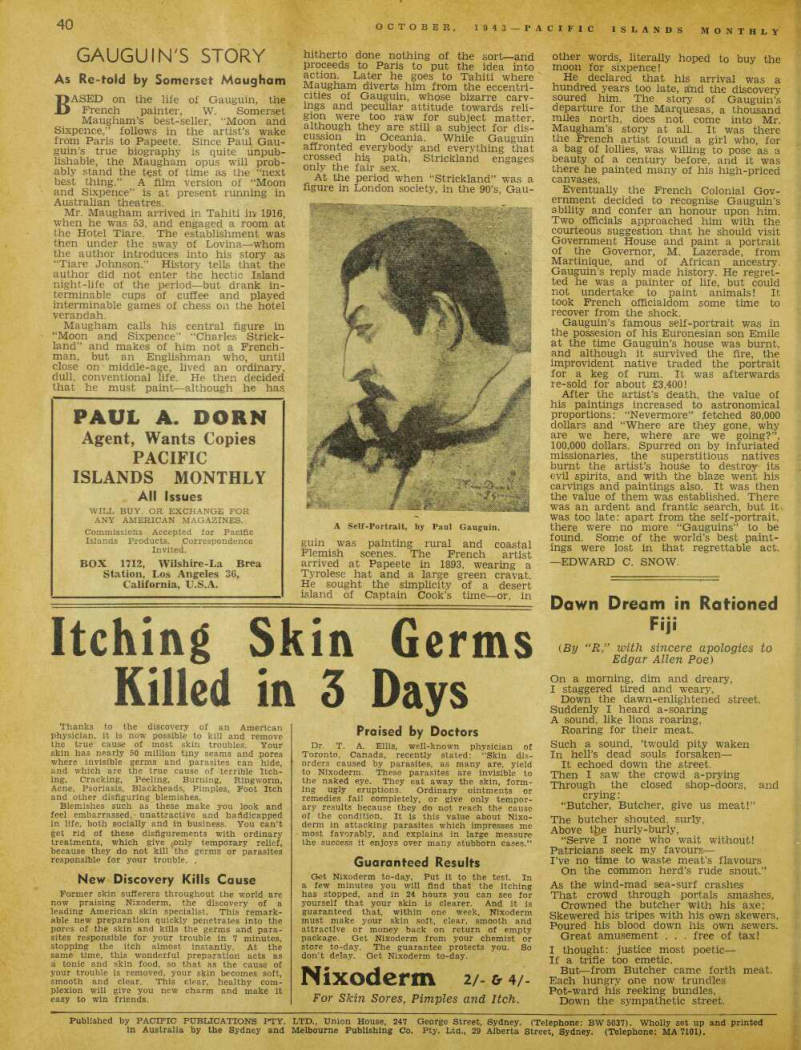
Gauguin’s famous self-portrait was in the possesion of his Euronesian son Emile at the time Gauguin’s house was burnt, and although it survived the fire, the improvident native traded the portrait for a keg of rum. It was afterwards re-sold for about £3,400!
After the artist’s death, the value of his paintings increased to astronomical proportions: “Nevermore” fetched 80,000 dollars and “Where are they gone, why are we here, where are we going?”, 100,000 dollars. Spurred on by infuriated missionaries, the superstitious natives burnt the artist’s house to destroy its evil spirits, and with the blaze went his carvings and paintings also. It was then the value of them was established. There was an ardent and frantic search, but it was too late: apart from the self-portrait, there were no more “Gauguins” to be found. Some of the world’s best paint ings were lost in that regrettable act.
Edward C. Snow.
A Self-Portrait, by Paul Gauguin.