Bishop Who "Lived Like A Rabbit"
p. 40 · Read in the full issue
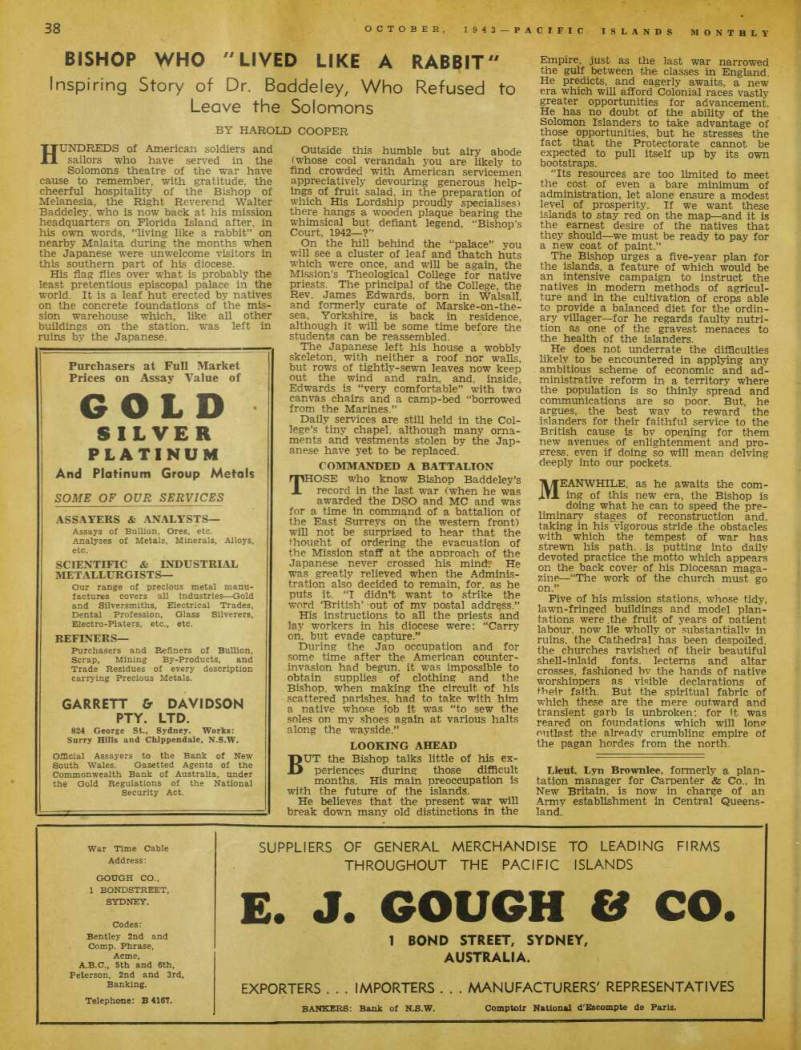
Inspiring Story of Dr. Boddeley, Who Refused to Leave the Solomons
By Harold Cooper
Outside this humble but airy abode (whose cool verandah you are likely to find crowded with American servicemen appreciatively devouring generous help ings of fruit salad, in the preparation of which His Lordship proudly specialises) there hangs a wooden plaque bearing the whimsical but defiant legend, “Bishop’s Court, 1942—?”
On the hill behind the “palace” you will see a cluster of leaf and thatch huts which were once, and will be again, the Mission’s Theological College for native priests. The principal of the College, the Rev. James Edwards, born in Walsall, and formerly curate of Marske-on-the sea, Yorkshire, is back in residence, although it will be some time before the students can be reassembled.
The Japanese left his house a wobbly skeleton, with neither a roof nor walls, but rows of tightly-sewn leaves now keep out the wind and rain, and, inside, Edwards is “very comfortable” with two canvas chairs and a camp-bed “borrowed from the Marines.”
Daily services are still held in the Col lege’s tiny chapel, although many orna ments and vestments stolen by the Jap anese have yet to be replaced.
Commanded A Battalion
rOSE who know Bishop Baddeley’s record in the last war (when he was awarded the DSO and MC and was for a time in command of a battalion of the East Surreys on the western front) will not be surprised to hear that the thought of ordering the evacuation of the Mission staff at the approach of the Japanese never crossed his mind: He was greatly relieved when the Adminis tration also decided to remain, for. as he puts it. “I didn’t want to strike the word ‘British’ out of my postal address.”
His instructions to all the priests and lay workers in his diocese were: “Carry on. but evade capture.”
During the Jap occupation and for some time after the American counter invasion had begun, it was impossible to obtain supplies of clothing and the Bishop, when making the circuit of his scattered parishes, had to take with him a native whose job it was “to sew the soles on my shoes again at various halts along the wayside.”
Looking Ahead
BUT the Bishop talks little of his ex periences during those difficult months. His main preoccupation is with the future of the islands.
He believes that the present war will break down many old distinctions in the
Empire, just as the last war narrowed the gulf between the classes in England.
He predicts, and eagerly awaits, a new era which will afford Colonial races vastly greater opportunities for advancement.
He has no doubt of the ability of the Solomon Islanders to take advantage of those opportunities, but he stresses the fact that the Protectorate cannot be expected to pull itself up by its own bootstraps.
“Its resources are too limited to meet the cost of even a bare minimum of administration, let alone ensure a modest level of prosperity. If we want these islands to stay red on the map—and it is the earnest desire of the natives that they should—we must be ready to pay for a new coat of paint.”
The Bishop urges a five-year plan for the islands, a feature of which would be an intensive campaign to instruct the natives in modern methods of agricul ture and in the cultivation of crops able to provide a balanced diet for the ordin ary villager—for he regards faulty nutri tion as one of the gravest menaces to the health of the islanders.
He does not underrate the difficulties likely to be encountered in applying any ambitious scheme of economic and ad ministrative reform in a territory where the population is so thinly spread and communications are so poor. But, he argues, the best way to reward the islanders for their faithful service to the British cause is by opening for them new avenues of enlightenment and pro gress. even if doing so will mean delving deeply into our pockets.
MEANWHILE, as he awaits the com ing of this new era, the Bishop is doing what he can to speed the pre liminary stages of reconstruction and, taking in his vigorous stride the obstacles with which the tempest of war has strewn his path, is putting into daily devoted practice the motto which appears on the back cover of his Diocesan maga zine—“ The work of the church must go on.”
Five of his mission stations, whose tidy, lawn-fringed buildings and model plan tations were the fruit of years of natient labour, now lie wholly or substantially in ruins, the Cathedral has been despoiled, the churches ravished of their beautiful shell-inlaid fonts, lecterns and altar crosses, fashioned bv the hands of native worshinpers as visible declarations of their faith. But the spiritual fabric of which these are the mere outward and transient garb is unbroken: for it was reared on foundations which will lone outlast the already crumbling empire of the pagan hordes from the north.
Lieut. Lyn Brownlee, formerly a plan tation manager for Carpenter & Co., in New Britain, is now in charge of an Army establishment in Central Queens land.
HUNDREDS of American soldiers and sailors who have served in the Solomons theatre of the war have cause to remember, with gratitude, the cheerful hospitality of the Bishop of Melanesia, the Right Reverend Walter Baddeley, who is now back at his mission headquarters on Florida Island after, in his own words, "living like a rabbit” on nearby Malaita during the months when the Japanese were unwelcome visitors in this southern part of his diocese.
His flag flies over what is probably the least pretentious episcopal palace in the world. It is a leaf hut erected by natives on the concrete foundations of the mission warehouse which, like all other buildings on the station, was left in ruins by the Japanese.