The Rising Of The
p. 21 · Read in the full issue
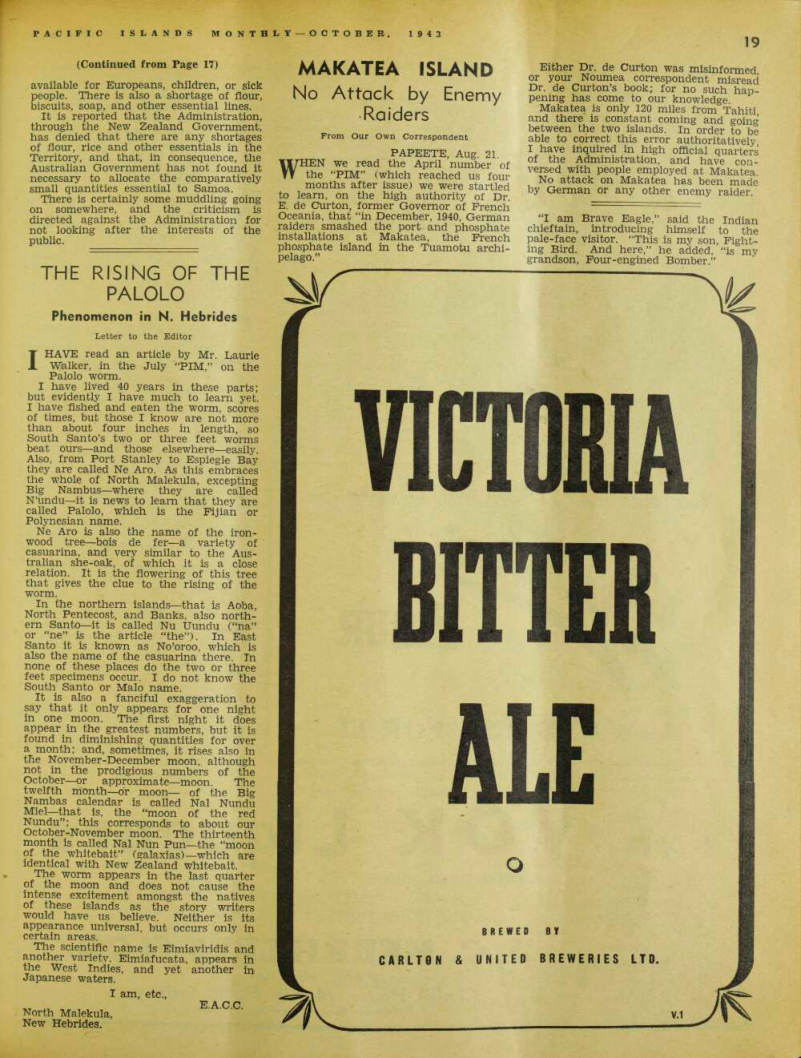
Palolo
Phenomenon in N. Hebrides
Letter to the Editor IHAVE read an article by Mr. Laurie Walker, in the July “PIM,” on the Palolo worm.
I have lived 40 years in these parts; but evidently I have much to learn yet.
I have fished and eaten the worm, scores of times, but those I know are not more than about four inches in length, so South Santo’s two or three feet worms beat ours—and those elsewhere—easily.
Also, from Port Stanley to Espiegle Bay they are called Ne Aro. As this embraces the whole of North Malekula, excepting Big Nambus—where they are called N’undu—it is news to leam that they are called Palolo, which is the Fijian or Polynesian name.
Ne Aro is also the name of the iron wood tree—bois de fer—a variety of casuarina, and very similar to the Aus tralian she-oak, of which it is a close relation. It is the flowering of this tree that gives the clue to the rising of the worm.
In the northern islands—that is Aoba, North Pentecost, and Banks, also north ern Santo—it is called Nu Uundu (“na” or “ne” is the article “the”). In East Santo it is known as No’oroo, which is also the name of the casuarina there. In none of these places do the two or three feet specimens occur. I do not know the South Santo or Malo name.
It is also a fanciful exaggeration to say that it only appears for one night in one moon. The first night it does appear in the greatest numbers, but it is found in diminishing quantities for over a month; and, sometimes, it rises also in the November-December moon, although not in the prodigious numbers of the October—or approximate—moon. The twelfth month—dr moon— of the Big Nambas calendar is called Nal Nundu Miel—that is, the “moon of the red Nundu”; this corresponds to about our October-November moon. The thirteenth month is called Nal Nun Pun—the “moon of the whitebait” (galaxias)—which are identical with New Zealand whitebait.
The worm appears in the last quarter of the moon and does not cause the intense excitement amongst the natives of these islands as the story writers would have us believe. Neither is its appearance universal, but occurs only in certain areas.
The scientific name is Eimiaviridis and another variety, Eimiafucata, appears in the West Indies, and yet another in Japanese waters.
I am, etc.,
E.A.C.C.
North Malekula, New Hebrides.