Mau'u Passes
pp. 33-34 · Read in the full issue
Link With Old Romantic Tahiti
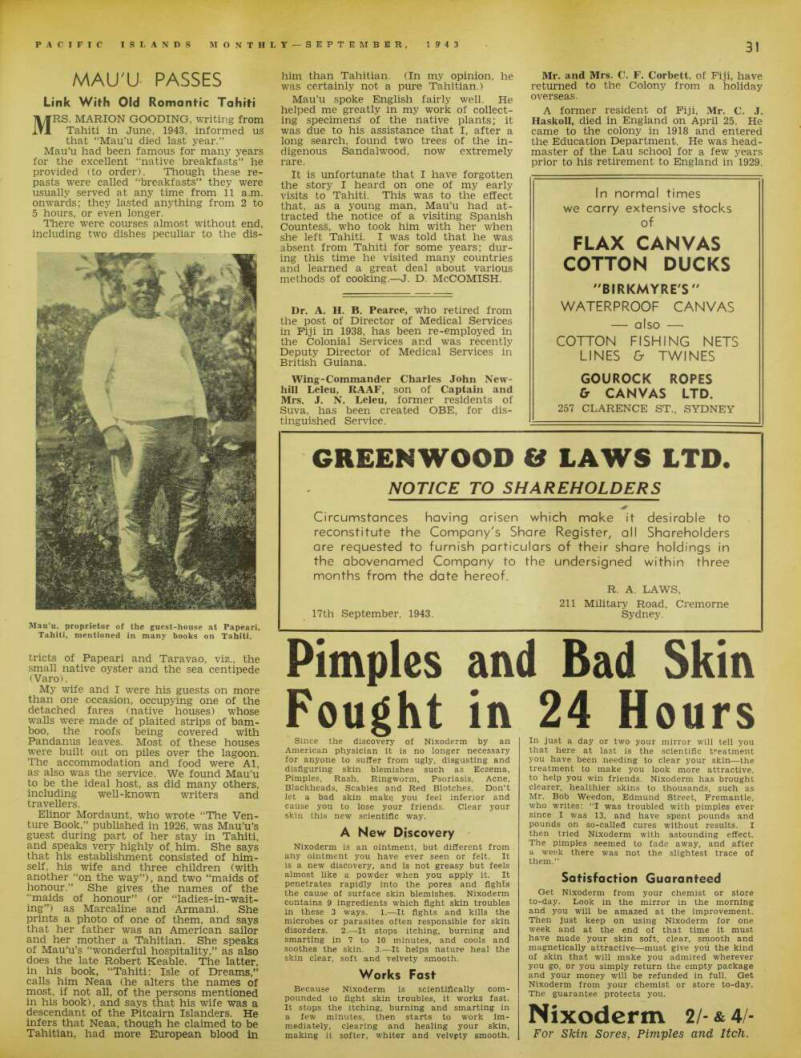
MRS. MARION GOODING, writing from Tahiti in June, 1943, informed us that “Mau’u died last year.”
Mau’u had been famous for many years for the excellent “native breakfasts” he provided (to order). Though these re pasts were called “breakfasts” they were usually served at any time from 11 a.m. onwards; they lasted anything from 2 to 5 hours, or even longer.
There were courses almost without end, including two dishes peculiar to the dis-
tricts of Papeari and Taravao, viz., the small native oyster and the sea centipede (Varo).
My wife and I were his guests on more than one occasion, occupying one of the detached fares (native houses) whose walls were made of plaited strips of bam boo, the roofs being covered with Pandanus leaves. Most of these houses were built out on piles over the lagoon.
The accommodation and food were Al, as also was the service. We found Mau’u to be the ideal host, as did many others, including well-known writers and travellers.
Elinor Mordaunt, who wrote “The Ven ture Book,” published in 1926, was Mau’u’s guest during part of her stay in Tahiti, and speaks very highly of him. She says that his establishment consisted of him self, his wife and three children (with another “on the way”), and two “maids of honour.” She gives the names of the “maids of honour” (or “ladies-in-wait ing”) as Marcaline and Armani. She prints a photo of one of them, and says that her father was an American sailor and her mother a Tahitian. She speaks of Mau’u’s “wonderful hospitality,” as also does the late Robert Keable. The latter, in his book, “Tahiti: Isle of Dreams,” calls him Neaa (he alters the names of most, if not all, of the persons mentioned in his book), and says that his wife was a descendant of the Pitcairn Islanders, He infers that Neaa, though he claimed to be Tahitian, had more European blood in
him than Tahitian. (In my opinion, he was certainly not a pure Tahitian.) Mau’u spoke English fairly well. He helped me greatly in my work of collect ing of the native plants; it was due to his assistance that I, after a long search, found two trees of the in digenous Sandalwood, now extremely rare.
It is unfortunate that I have forgotten the story I heard on one of my early visits to Tahiti. This was to the effect that, as a young man, Mau’u had at tracted the notice of a visiting Spanish Countess, who took him with her when she left Tahiti. I was told that he was absent from Tahiti for some years; dur ing this time he visited many countries and learned a great deal about various methods of cooking.—J. D. McCOMISH.
Dr. A. H. B. Pearce, who retired from the post of Director of Medical Services in Fiji in 1938, has been re-employed in the Colonial Services and was recently Deputy Director of Medical Services in British Guiana.
Wing-Commander Charles John New hill Leleu, RAAF, son of Captain and Mrs. J. N. Leleu, former residents of Suva, has been created OBE, for dis
tinguished Service.
Mr. and Mrs. C. F. Corbett, of Fiji, have returned to the Colony from a holiday overseas.
A former resident of Fiji, Mr. C. J.
Haskoll, died in England on April 25. He came to the colony in 1918 and entered the Education Department. He was head master of the Lau school for a few years prior to his retirement to England in 1929.
Mau’u, proprietor of the guest-house at Papeari, Tahiti, mentioned in many books on Tahiti.
Corporal Ron Farquhar, NZEF. son of Mr, and Mrs. R. C. Farquhar, of Suva, Fiji, is at present visiting his parents on leave. Corporal Farquhar served through Greece, Crete, Libya and Tunisia with the New Zealand forces, and was among those who returned to New Zealand recently from the Middle East.