Oyer The Owen Stanley Mountains
pp. 23-26 · Read in the full issue
What Happened Before the Japs Were Defeated in Papua
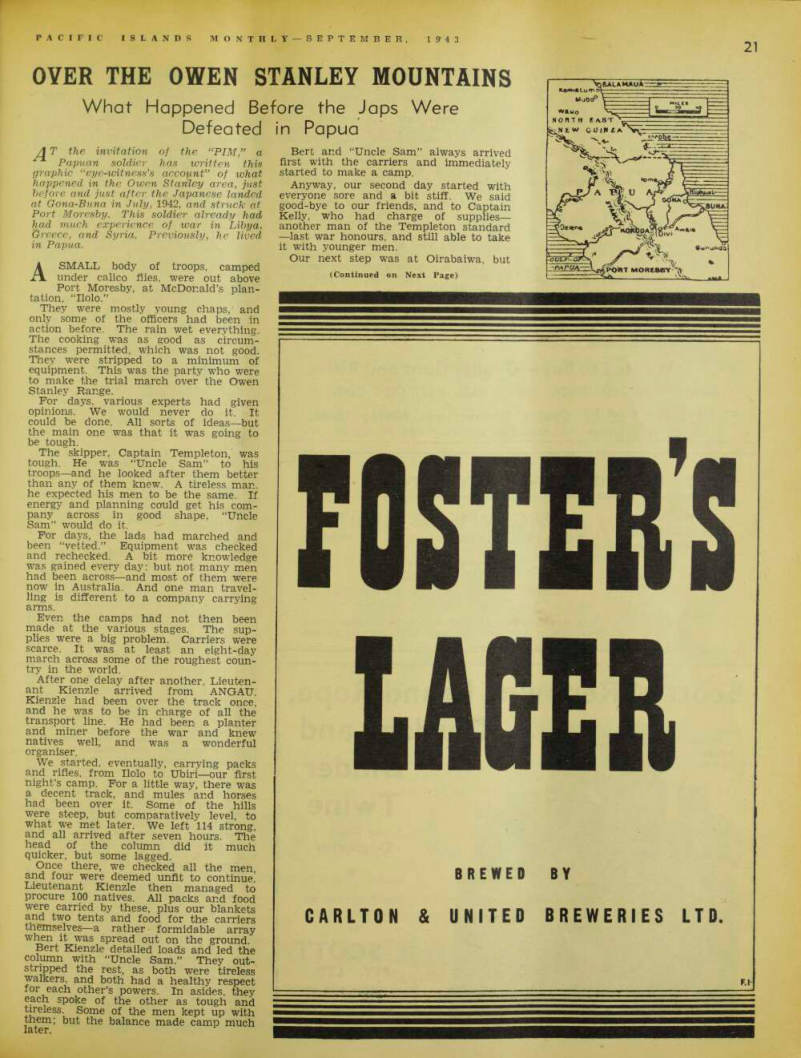
/X T the invitation of the “PIM,” a Papuan soldier has written this graphic “eye-witness’s account” of what happened in the Owen Stanley area, just before and just after the Japanese landed at Gona-Buna in July, 1942, and struck at Port Moresby. This soldier already had had much experience of war in Libya, 'Greece, and Syria. Previously, he lived in Papua.
A SMALL body of troops, camped under calico flies, were out above Port Moresby, at McDonald’s plan tation, “Ilolo.”
They were mostly young chaps,' and only some of the officers had been in action before. The rain wet everything.
The cooking was as good as circum stances permitted, which was not good.
They were stripped to a minimum of equipment. This was the party who were to make the trial march over the Owen Stanley Range.
For days, various experts had given opinions. We would never do it. It could be done. All sorts of ideas—but the main one was that it was going to be tough.
The skipper, Captain Templeton, was tough. He was “Uncle Sam” to his troops—and he looked after them better than any of them knew. A tireless man. he expected his men to be the same. If energy and planning could get his com pany across in good shape, “Uncle Sam” would do it.
For days, the lads had marched and been “vetted.” Equipment was checked and rechecked. A bit more knowledge was gained every day: but not many men had been across—and most of them were now in Australia. And one man travel ling is different to a company carrying arms.
Even the camps had not then been made at the various stages. The sup plies were a big problem. Carriers were scarce. It was at least an eight-day march across some of the roughest coun try in the world.
After one delay after another, Lieuten ant Kienzle arrived from ANGAU.
Kienzle had been over the track once, and he was to be in charge of all the transport line. He had been a planter and miner before the war and knew natives well, and was a wonderful organiser.
We started, eventually, carrying packs and rifles, from 11010 to Übiri—our first night’s camp. For a little way, there was a decent track, and mules and horses had been over it. Some of the hills were steep, but comparatively level, to what we met later. We left 114 strong, and all arrived after seven hours. The head of the column did it much quicker, but some lagged.
Once there, we checked all the men, and four were deemed unfit to continue.
Lieutenant Kienzle then managed to procure 100 natives. All packs and food were carried by these, plus our blankets and two tents and food for the carriers themselves—a rather formidable array when it was spread out on the ground.
Bert Kienzle detailed loads and led the column with “Uncle Sam.” They out stripped the rest, as both were tireless walkers, and both had a healthy respect for each other’s powers. In asides, they each spoke of the other as tough and tireless. Some of the men kept up with them; but the balance made camp much later.
Bert and “Uncle Sam” always arrived first with the carriers and immediately started to make a camp.
Anyway, our second day started with everyone sore and a bit stiff. We said good-bye to our friends, and to Captain Kelly, who had charge of supplies— another man of the Templeton standard —last war honours, and still able to take it with younger men.
Our next step was at Oirabaiwa, but (Continued on Next Page)
all that was there was one tent. However, after struggling up the longest hill I had seen to date, we came to the top.
It took hours to go up, and there were so many false tops. At some places one had to use hands and dig toe-holds to scramble up. We learned to appreciate a long staff that day.
Rifles began to weigh tons and ammunition wore ribs raw. Webbing and haversacks got heavier as we sweated and swore. Later, steps were put m on all those hills.
By the time the last of the column arrived, the natives, under the driving power of Bert Kienzle, had enough huts erected to house us all. Rain started at 5 p.m. and continued steadily all night: but a reasonably dry night was had by * ' THE air was chilly, and bones and muscles ached; but every man was on deck in the morning. Several cases of diarrhoea had developed, due to
the terrific strain. But we all left early, scrambling and sliding down a precipi tous mountain-side to a rushing stream.
Again we climbed and climbed until, it seemed, hours later, we looked back and there in plain view, only a mile or so away, was our camp of last night. How close it was, and yet how many hours we had spent getting here from it.
Then came a dreary trudge for hours, W e ate and went on. Water bottles became empty and there was none to refill with. We were right on the top of a huge ridge. Several men had to be relieved of their loads, and one had to be carried, owing to leg cramps, 0 , .. c J s h e wouM tave the would have been over ri g ht away as soon as one stopped, a small native bee swarmed all over pne, sucking up the salt from the perspiration.
Then we started down, and slid, and scrambled. Knees, which had stood up
to the climbing, now let men down unexpectedly. Some natives came back and helped the sick along.
And then back came “Uncle Sam,” looking fresh and cheerful, and he car ried some of his men’s stuff along.
We reached Nauro, and it looked swell, nestling under a hill on the banks of a large creek. There was a man in charge here. Sergeant Osborne, and he had a good supply of native fruits and foods, so “Uncle Sam” decided to have a day’s spell. We really enjoyed it; and the lads showed the benefit of it.
WE left the next morning, leaving one man to follow later. A stop was made at Menari for lunch—another very pretty little spot. The morning’s walk was not too bad, but it was only a saunter to the afternoon, when we made Efogi.
Sergeant Jarret was here, and cover for troops was available. The camp was on the end of a spur between two creeks.
Later, much later (when we had come back over that track and the Japs had followed us), some of us saw our planes do the best bit of strafing and bombing here I had ever seen, blowing the houses up and flying up and down mountain sides and up creeks. One almost flew through the doorway of one house. It was a marvellous exhibition.
But back to our trek. From Efogi we could see Kagi. It looked close, but we were now used to the hills, and sus picious.
However, we made it by 11 a.m. the next day, and spelled up for the assault on the Gap itself, on the morrow. Kagi was on a spur and overlooked as far back as Moresby. In fact, one could see the searchlights at Moresby. But in daylight the haze made objects at that distance indicipherable.
LIEUTENANT Brewer, from Kokoda, was at Kagi, to guide us over. It was one of the coldest nights we had so far experienced, and “Uncle Sam” gave the lads some rum. Captain Ste venson (second in command) was bar man, and “Stevenson’s Mountain Brew” was reasonably popular. A mixture of limes, hot water, sugar and rum, it helped the lads to sleep.
On the morrow we tackled the much talked-of Gap. We climbed again for a few hours, and crossed over amid moss and rain. Vines and moss were every where. At times, one’s feet sank into it for several inches. The air was chilly and damp. Water dripped continuously, and the track was the worst to date.
We scrambled over moss covered rocks and swung from tree to tree, down into icy-cold streams; and scrambled round precipitous shoulders of the mountain, until at last the rushing of a large volume of water could be heard. Still sliding, we went down for, it seemed, hours: but we reached, at 1 p.m., Erora Creek, at what was later called Templeton’s Cross ing (after our commander), and lunched.
From here we went on for a further three hours, to another crossing on the same creek, and then we had to start in and make shelter for the troops. Materials were scarce, and ram and fog added to our discomfort; but we had crossed the Owen Stanley Range. The first troops over, but far from the last.
It was here that we heard the 6 o’clock bird for the first time. This bird whistles right on dusk every evening, and the effect is weird, with hundreds whistling away for five minutes or so.
The next day we left early, and had hoped to stop at Isurava; but shelters were no good, so we pushed on to a spot a few miles from Kokoda, below Deniki.
The whole Yodda Valley opened up before us at Deniki. Little did we dream, (Continued on Next Page)
as we gazed in almost awe at the miles of fertile country, that for most of us our next view from there would be under such different circumstances.
The following morning saw us at Kokoda, camped among the rubber trees, and “Uncle Sam” already was away reconnoitring the country. What a man! (Some time later, somewhere on the Owen Stanley trail, Captain Templeton (our “Uncle Sam”) went out alone along a jungle track, revolver ready, stalking a Jap. He never came back. Officially, he is “missing”; but we hope that he is a prisoner, somewhere. He fought in three wars, including the Spanish show.) WE. had not many supplies: but a boat was to go from Moresby to Buna with them. Away to Buna went “Uncle Sam,” again, with a corporal and a few natives; and five days later our automatic weapons and supplies began to dribble in.
Then, two days later, the Japs arrived at Buna. But that is another story.
Kokoda suited us, while we were there.
There was plenty of native fruit and vegetables and the men were in good shape. The climate was good. Mosqui toes were few. Housing was good. We had radio communication with the out side world. Life looked sweet—for a full week.
Rubber production was still going on and, apart from an occasional plane seen from afar, the war was far away. It was just as in piece-time, except for the khaki hats everyone wore. The native prisoners went out every morning from Kokoda calaboose, and were carefully locked up every night.
Lieutenant Brewer, as magistrate, had cases every day. Captain Grahamshaw, in charge of the area, arrived for two days and left again for Awala. Another tireless walker. Lieutenant Kienzle went back to organise the carrier-line. We recuperated.
SUDDENLY, the word came of the landing by Japanese at Buna and Gona.
At Kokoda, we sat and looked at the weary, unshaven man who brought the story. Behind him were the last 15 men who had arrived by plane, too late to get to Givi, where our troops had been fighting and had been surrounded. We knew some would get away; but the situation looked grim, indeed.
Well, all we could do now was to burn and destroy as much stuff as possible, and go back to a safer spot in the hills.
We were only few. Several miles away were some more men, covering the track—but so few. The natives had almost all left us. Some of the police
had also left, silently, for home, duty forgotten. The few left were real men.
Some of the Papuan Infantry Battalion natives and officers were here also—the best of the lot.
We almost 4 cried, as we consigned to the fire goods which we had been cry ing out for for months. They would only have fallen into Jap hands, if left.
Every man carried as much as he could.
Natives were loaded to capacity, and sent off in charge of a European.
At last, on the tick of 11 a.m., Colonel Owen said, “Let her go!’’ We set fire to the kerosene-soaked bundles and houses, and made our way regret fully through the 20-years-old rubber trees. Flames leaped, and explosions shook the air.
It was a sin—but what could we do?
Some stuff we buried, but time pressed.
ONE of our native police—a real old timer—was called Toi. He had been a policeman all his life and had grown old in the service. His skin was begining to look a trifle too large for him now as his flesh shrank.
Never before had Toi seen such waste, such a lot of stuff he had always wanted, just lying about waiting to be taken. Opportunity knocks but once.
Toi gathered up his spoils into four large bundles, which weighed about 2 cwt., and carefully swung them on sticks.
To our stopping-place was about four miles.
Toi started. His ancient knees wobbled
and his eyeballs protruded, but he advanced—slowly—a hundred yards, half a mile—and a spell. He took his jacket off and hung it on a stick. On again another half-mile, and Toi realised that he had to unload something. With tears in his eyes, he went through one bundle, (Continued on Next Page)
and finally he threw away a torn mos quito net into the bush!
Toi struggled on, for another spell; but the spells grew longer and the advance slower until at last the magistrate had to order him to leave two bundles. Toi cried, but he obeyed, and we reached Deniki. Once there, after a short spell, Toi disappeared and one hour later arrived with his two other bundles. He had been determined not to lose his goods. He was absolutely exhausted, and dropped like a log.
A number of our troops from Oivi had reached Deniki, and their clothing, after days of fighting, was in rags. I thought of Toi, and told him of the predicament the troops were in.
His bundles were a godsend—shorts, shirts, a few blankets, some hats and boots. We managed to get all the chaps reasonably well clothed from what we ourselves carried and" also, mainly, from Toi’s lot. A lot of troops owed a lot to Toi. and Toi was happy that he had again been of service to his white friends.
He smiled and slept content. * * * rpHE rest is history, well known to you.
X Our few units, vastly out-numbered, kept falling back, as the Japs came up the track from Buna to Kokoda, and then struggled on and reached the notorious Gap.
They were grim days, out there on the bleak, rain-sodden Owen Stanleys, with the over-confident little Japs pressing hard upon us, and trying to sneak around our flanks.
Deeds of heroism, without number, were performed, and we lost some fine officers and brave men. Our Colonel Owen was killed when directing a rear guard action. No one appears to have told how Papua’s one and only “Doc”
Vernon, ignoring Jap snipers, crawled forward to where the officer lay. “Doc” and a couple of men brought back his body.
The Japs came right across the moun tain tops, to loribava, in sight of Central Papua and Port Moresby, before the Australians struck back. That was in September, 1942. By the end of the year they had been driven into the sea, at Buna and Sanananda.