SsfOffices to R^bau^forusel^lSks 7
p. 16 · Read in the full issue
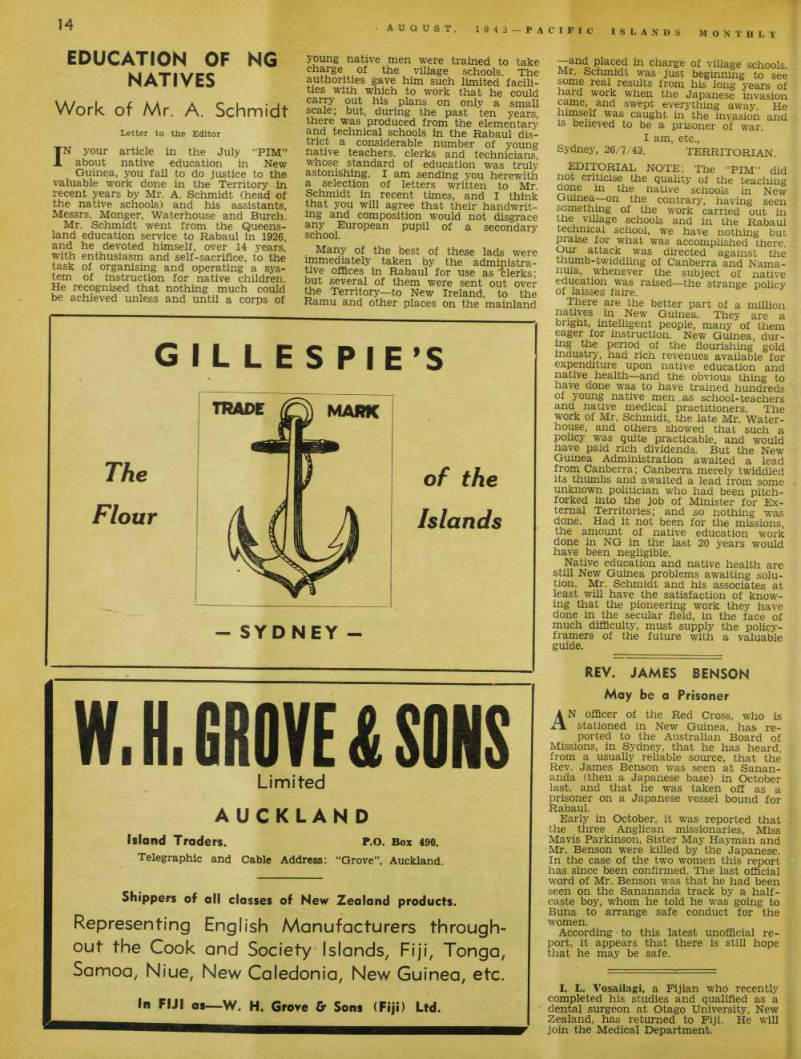
Education Of Ng
Natives
Work of Mr. A. Schmidt
Letter to the Editor I N your article in the July “PIM” about native education in New Guinea, you fail to do justice to the valuable work done in the Territory in recent years by Mr. A. Schmidt (head of the native schools) and his assistants, Messrs. Monger, Waterhouse and Burch.
Mr. Schmidt went from the Queens land education service to Rabaul in 1926, and he devoted himself, over 14 years, with enthusiasm and self-sacrifice, to the task of organising and operating’ a sys tern of instruction for native children.
He recipgmsed that nothing much could be achieved unless and until a corps of
young native men were trained to take charge of the village schools. The authorities gave him such limited facili ties with which to work that he could carry out his plans on only a small s £ ale ; but, during the past ten years, there was produced from the elementary and technical schools in the Rabaul dis trict a considerable number of young native teachers, clerks and technicians whose standard of education was truly astonishing. I am sending you herewith a selection of letters written to Mr.
Schmidt in recent times, and I think that you will agree that their handwrit in § and composition would not disgrace any European pupil of a secondary school, Manv of thp hp<?t nf immediately taken bv* thp
SsfOffices to R^bau^forusel^lSks 7
but several of themwere sSt out ovw the Territory—to New Ireland to the Ramu and other places on the ’mainland
—and placed in charge of village schools.
Mr. Schmidt was just beginning to see some real results from his long years of hard work when the Japanese invasion came, and swept everything away. He himself was caught in the invasion and is believed to be a prisoner of war.
I am, etc.,
Sydney, 26/7/43.
Territorial.
Editorial Note; The “Plm’’ Did
not criticise the quality of the teaching done in the native schools in New Gumea—on the contrary, having seen something of the work carried out in the village schools and in the Rabaul technical school, we have nothing but praise for what was accomplished there.
Our attack was directed against the thumb-twiddling of Canberra and Nama nula, whenever the subject of native education was raised—the strange policy of laissez faire. J There are the better part of a million natives in New Guinea. They are a bright, intelligent people, many of them eager for instruction. New Guinea dur ing the period of the flourishing gold industry, had rich revenues available for expenditure upon native education and native health—and the obvious thing to have done was to have trained hundreds of young native men as school-teachers and native medical practitioners. The work of Mr. Schmidt, the late Mr. Water house, and others showed that such a policy was quite practicable, and would have paid rich dividends. But the New Guinea Administration awaited a lead from Canberra; Canberra merely twiddled its thumbs and awaited a lead from some unknown politician who had been pitch forked into the job of Minister for Ex ternal Territories; and so nothing was done. Had it not been for the missions, the amount of native education work done in NG in the last 20 years would have been negligible.
Native education and native health are still New Guinea problems awaiting solu tion. Mr. Schmidt and his associates at least will have the satisfaction of know ing that the pioneering work they have done in the secular field, in the face of much difficulty, must supply the policy framers of the future with a valuable guide.