Guinea Evacuation
p. 11 · Read in the full issue
THE BRAVERY OF FATHER GLOVER IN NEW
FROM DATA KINDLY SUPPLIED BY MR. E. V. O’BRIEN, OF MADANG f TNG
AMONG all the courageous things done by soldiers and civilians during the evacuation of New Guinea, in the Japanese invasion of early 1942, few are more worthy of praise than the achievement of Father John Glover, missionary priest, of the Morobe district. Yet, while praises and decorations—all well deserved —have been scattered around, the name of Father Glover has been rarely mentioned. Here, told for the first time, is the story of what he did.
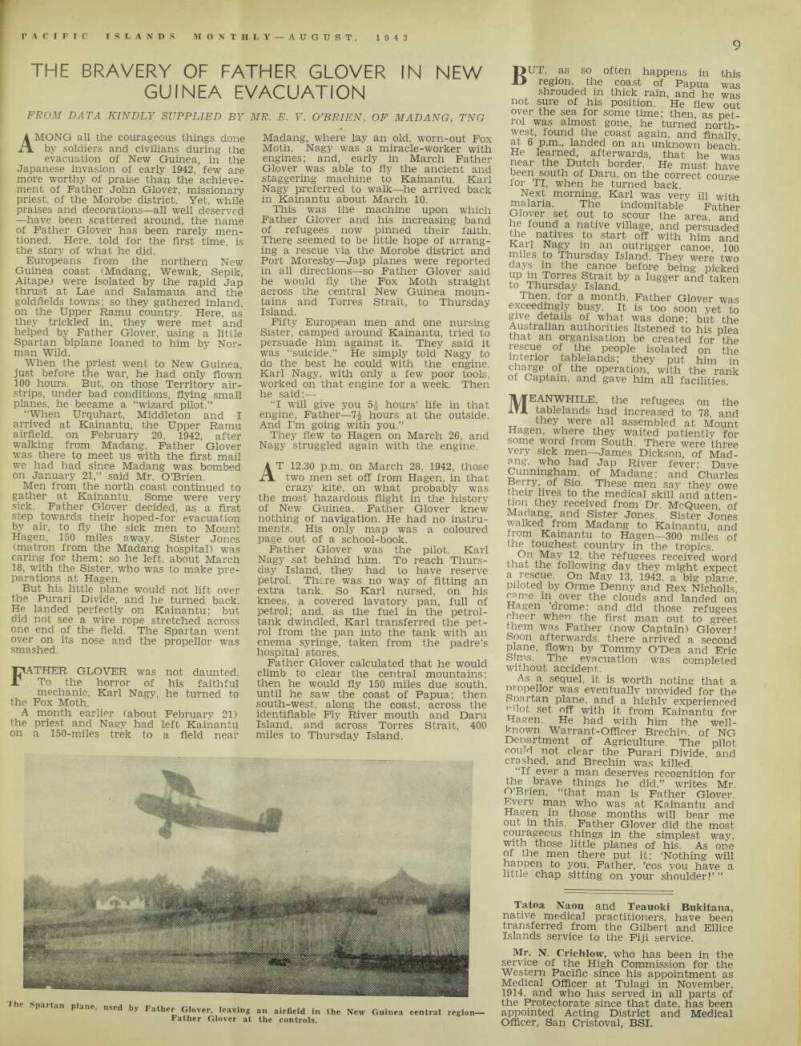
Europeans from the northern New Guinea coast (Madang, Wewak, Sepik, Aitape) were isolated by the rapid Jap thrust at Lae and Salamaua and the goldfields towns; so they gathered inland, on the Upper Ramu country. Here, as they trickled in, they were met and helped by Father Glover, using a little Spartan biplane loaned to him by Norman Wild.
When the priest went to New Guinea, just before the war, he had only flown 100 hours. But, on those Territory airstrips, under bad conditions, flying small planes, he became a “wizard pilot.”
“When Urquhart, Middleton and I arrived at Kainantu, the Upper Ramu airfield, on February 20, 1942, after walking from Madang, Father Glover was there to meet us with the first mail we had had since Madang was bombed on January 21,” said Mr. O’Brien.
Men from the north coast continued to gather at Kainantu, Some were very sick. Father Glover decided, as a first step towards their hoped-for evacuation by air, to fly the sick men to Mount Hagen. 150 miles away. Sister Jones (matron from the Madang hospital) was caring for them; so he left, about March 18, with the Sister, who was to make preparations at Hagen.
But his little plane would not lift over the Purari Divide, and he turned back.
He landed perfectly on Kainantu; but did not see a wire rope stretched across one end of the field. The Spartan went over on its nose and the propeller was smashed.
F Amtttn „
ATHER GLOVER was not daunted.
To the horror of his faithful mechanic, Karl Nagy, he turned to the Fox Moth.
A month earlipr (about February 21) the priest and Nagy had left Kainantu on a 150-miles trek to a field near
Madang, where lay an old, worn-out Fox Moth. Nagy was a miracle-worker with engines; and, early in March Father Glover was able to fly the ancient and staggering machine to Kainantu. Karl Nagy preferred to walk—he arrived back i n Kainantu about March 10.
This was the machine upon which Father Glover and his increasing band of refugees now pinned their faith, There seemed to be little hope of arrang ing a rescue via the Morobe district and Port Moresby—Jap planes were reported in all directions—so Father Glover said he would fly the Fox Moth straight across the central New Guinea moun tains and Torres Strait, to Thursday Island.
Fifty European men and one nursing Sister, camped around Kainantu, tried to persuade him against it. They said it was “suicide.” He simply told Nagy to do the best he could with the engine, Karl Nagy, with only a few poor tools. worked on that engine for a week. Then he said: — “I will give you 5£ hours’ life in that engine, Father—7i hours at the outside, And I’m going with you.”
They flew to Hagen on March 26, and Nagy struggled again with the engine, 4 T 12.30 p.m. on March 28, 1942, those two men set off from Hagen, in that crazy kite, on what probably was the most hazardous flight in the history of New Guinea. Father Glover knew nothing of navigation. He had no instru ments. His only map was a coloured page out of a school-book.
Father Glover was the pilot. Karl Nagy sat behind him. To reach Thurs day Island, they had to have reserve petrol. There was no way of fitting an extra tank. So Karl nursed, on his knees, a covered lavatory pan, full of petrol; and, as the fuel in the petrol tank dwindled, Karl transferred the pet rol from the pan into the tank with an enema syringe, taken from the padre’s hospital stores.
Father Glover calculated that he would climb to clear the central mountains; then he would fly 150 miles due south, until he saw the coast of Papua; then south-west, along the coast, across the Identifiable Fly River mouth and Daru Island, and across Torres Strait, 400 miles to Thursday Island.
BUT, as so often happens in this region, the coast of Papua was shrouded in thick rain, and he was not sure of his position. He flew out over the sea for some time; then, as pet rol was almost gone, he turned north west, found the coast again, and finally at 6 p.m., landed on an unknown beach’
He learned, afterwards, that he was near the Dutch border. He must have been south of Daru, on the correct course for TI, when he turned back.
Next morning, Karl was very ill with malaria. The indomitable Father Glover set out to scour the area and he found a native village, and persuaded the natives to start off with him and Karl Nagy in an outrigger canoe, 100 miles to Thursday Island. They were two days in the canoe before being picked b, 1 1 Torres strait by a lugger and taken to Thursday Island.
Then, for a month, Father Glover was exceedingly busy. It is too soon yet to give details of what was done; but the Australian authorities listened to his plea that an organisation be created for the rescue of the people isolated on the interior tablelands; they put him in charge of the operation, with the rank of Captain, and gave him all facilities.
MEANWHILE, the refugees on the tablelands had increased to 78 and they were all assembled at Mount Hagen, where they waited patiently for some word from South. There were three very sick men—James Dickson, of Madwho had Jap River fever; Dave Cunningham, of Madang; and Charles Berry, of Sio. These men say they owe their lives to the medical skill and atten tion they received from Dr. McQueen, of Madang, and Sister Jones. Sister Jones walked from Madang to Kainantu, and from Kainantu to Hagen—3oo miles of the toughest country in the tropics.
On May 12, the refugees received word that the following day they might expect a rescue. On May 13, 1942, a big plane piloted by Orme Denny and Rex Nicholls came m over the clouds and landed on Hagen ’drome: and did those refugees cheer when the first man out to greet them was Father (now Captain) Glover' Soon afterwards, there arrived a second plane, flown by Tommy O’Dea and Eric Sims. The evacuation was completed without accident.
As a sequel, it is worth noting that a nropellor was eventually nrovided for the Snartan plane, and a highly experienced ’nlot set off with it from Kainantu for Hagen. He had with him the well known Warrant-Officer Brechin of NG Denartment of Agriculture. The pilot could not clear the Purari Divide, and crashed, and Brechin was killed.
“If ever a man deserves recognition for the brave things he did.” writes Mr O’Brien, “that man is Father Glover.
Every man who was at Kainantu and Hagen in those months will bear me out in this. Father Glover did the most courageous things in the simplest way, with those little planes of his. As one of the men there put it: ‘Nothing will happen to you. Father, ’cos you have a little chap sitting on your shoulder!”’
Tatoa Naou and Teauoki Bukitana, native medical practitioners, have been transferred from the Gilbert and Ellice Islands service to the Fiji service.
Mr. N. Crichlow, who has been in the service of the High Commission for the Western Pacific since his appointment as Medical Officer at Tulagi in November, 1914, and who has served in all parts of the Protectorate since that date, has been appointed Acting District and Medical Officer, San Cristoval, BSI.
The spartan plane, used by Father Glover, leaving an airfield in the New Guinea central region— Father Glover at the controls.