Future Of Pacific
p. 30 · Read in the full issue
Missions
Present and Post-war Problems
WHEN - the National Missionary Coun cil of Australia met in Sydney at the end of April, missionary prob lems of the post-war period, as well as those pertaining to the present time, were discussed.
The welfare of orphaned missions, cut off from their homelands, has been affected by the outbreak of war in the Pacific. It is impossible for the Council to send funds to help the Netherlands Indies now. but the Council has arranged for the immediate relief of missionaries as the United Nations forces win back
these territories. In this regard, it will be acting for the International Mission ary Council (headquarters in New York), whose appeal for ‘orphaned missions” has raised £700,000 in the last three years.
Military operations in Papua and New Guinea have affected missionary work.
Missionaries of the Anglican, Lutheran and Methodist churches are known to be in Japanese hands; five others are dead.
The future educational policy of these territories is being watched closely in the interests of all the missionary societies who, in the past, have been almost entirely responsible for education of native peoples there. Some time ago, the Commonwealth Government was asked to set up a Commission to consider the control of the natives' language, educa tion and labour conditions. Since then it has been noted with satisfaction that the Minister for External Affairs has stated that the Commonwealth Govern ment intends to include these natives specifically in its plan for a “new order.”
The Council was not in agreement with the proposal that only missionaries of British nationality should be permitted to work in New Guinea in future. Such a step would involve the repatriation of American missionaries, as well as others, and this in turn would nrobably have unfortunate repercussions in other fields where British missionaries are at work.
FINALLY, the Council believes, its chief function at present is to look ahead and survey the missionary tasks that claim—or soon will claim —the attention of all churches in Australia.
One of the most pressing problems is the urgent need for co-operation in the provision of food relief for stricken countries. Other problems which will concern them are the principles of reli gious liberty, which are now threatened in some countries; the study of the larger
issues affecting Pacific nations; and the promotion of international understand ing and goodwill.
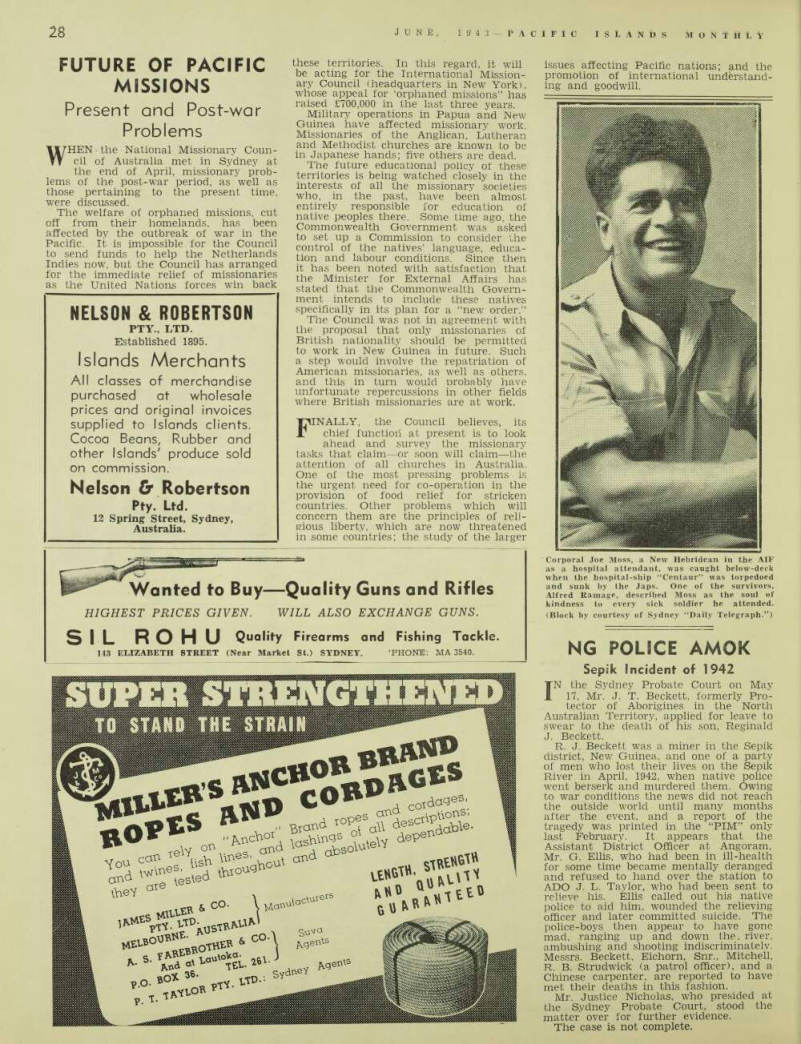
Corporal Joe Moss, a New Hebridean in the AIF as a hospital attendant, was caught below-deck when the hospital-ship “Centaur” was torpedoed and sunk by the Japs. One of the survivors, Alfred Ramage, described Moss as the soul of kindness to every sick soldier he attended. (Block by courtesy of Sydney “Daily Telegraph.”)