Axis Shadow Over Tahiti
pp. 17-19 · Read in the full issue
The Dork Days of June-September, 1940
ITERE is the story, told by Edward C. Snow, for the first time, of what happened in Tahiti in those black days after France surrendered and before the French Colonies rallied to de Gaulle—June to September, 1940.
IWAS in Tahiti in 1939; and from there I saw the opening of the European war and the calamity which, in June, 1940, fell upon the colonies of the French Empire.
During the first six months, the Americans used the term “Phoney War,” while the French used their familiar expression for “nothing to report” (“rien signaler”). And except for an ominous warning: “Do not ask about ships,” “rien signaler” was all the French censor dis played on colonial post office notice boards.
The brief three weeks’ fight, and the overthrow of French in 1940, came like a violent thunderstorm. It was all over before the colonies could follow the speedy events; though the aftermath is with them yet, and may be with them for a long time.
“The enemy may reach the Loire before they are held,” said the British Consul at Papeete, after the break through at Sedan. He moved a wavy line of flags across the map of Europe, according to the latest radio news. But, in the meantime, Marshal Petain, who had scant intention of holding anywhere, decided the issue by surrendering. (In doing so, he carried out his original 1917 intention, as anticipated by General Edmund Ironsides and forestalled by Foch.) General de Gaulle was at Leopoldville (Belgian Congo) while the 1940 Armistice was made. Colonial France drifted and disintegrated as though it were a fleet of rudderless ships.
Mysterious Drama
WHAT human experience could be more bitter than the sudden loss of property, power and wealth? In trying to save something from the wreck, like drowning men grasping at straws, French admirals, generals, governors and officials only fell deeper and more heavily into German power. It came about with the greatest of ease, though it was obscure and mystifying to the rest of the world, who expected an “honourable surrender.”
Many of France’s highest officials were super-individualists, not patriots, and in their blind, fundamental efforts to re trieve anything at all of their former power and wealth, they merely played the poisonous and infamous game of Vichy.
Almost every influential family in the French colonies had relatives in and around Paris. After the surrender, many of the French in Tahiti sent cablegrams of inquiry.
The German High Command, in con trol at the Paris Post Office, was fully prepared for them (and had the same system in readiness for the disruption of the British Commonwealth, had London fallen!). Every name and address was tabulated before delivery, replies were intercepted and altered, and a fake answer preceded the relative’s name.
The answer to twenty separate cables read exactly the same;— “We are alright; we are fine. Please obey orders.”
One doubting French colonist, with more money than wisdom, cabled a second time in the Tahitian language,
. . . „ , J asking for confirmation of the first cable’s veracity. It brought no reply.
A temporarily stranded British doctor in Papeete was derisive and contemptu ous. “Obeying German orders will save nothing,” he declared, with emphasis.
“It will only delay the inevitable Ger man double-cross. The cables are just a waste of good money. Right down through the history of conquered coun tries, once the psychological shock of invasion and defeat wear off, the major
ity of people left alive settle down to conditions as they found them.”
French colonial officials could not see it and, in their semi-delirious efforts to save face before their African and Poly nesian subjects, commenced to carry out “Vichy” orders. The first result was at Oran, when Admiral Gensoul put per sonal interests before his country and his fleet—and saved nothing. That was followed by a succession of peculiar inci dents at Dakar, Syria, Martinique, and Madagascar, as the German Gestapo system operated through its liaison offi cers at Vichy.
AT Tahiti, the situation vacillated from obscure to “sticky” (as an old English resident expressed it).
“We’re on the spot; the only thing to do is to lay low and keep quiet till it blows over,” he added.
An American, named James Quinlan, a resident of some twelve years’ duration, did not keep quiet, and was given a
month in gaol, with scant ceremony.
The US Consul, Mr. Cobb, to whom he appealed, regretted he could not help him. “They’d have done the same to an alien in the States, Jimmy,” he pointed out; “probably given him far worse for the act you put on. You got off very light.”
A Senegalese from Dakar told a French sailor exactly what he thought of the “European situation” and the out come was the closure of Quinn’s Cabaret for a week as an act of “discipline.” (During the week it underwent a thor ough spring-cleaning.) Another cabaret was closed for three months.
On July 13, 1940, five hundred of the finest pro-British natives in Tahiti visited the British Consulate and volun teered for fighting service with the Aus tralian armed forces.
On July 21, on a direct order from Vichy, the British Consulate was closed, the first time since it opened in 1835.
The Governor banished the Consul to a district twenty miles away, and placed him under house arrest, to avoid native demonstrations.
The Consul’s feelings can be better imagined than described; and his brow — like that of his famous Roman predeces sor —was very low. A Rarotongan who witnessed the sorry procedure remarked in quiet confidence; — “The Tahitian boys will get to the war.
You see! The Consul took their names.
They’ll build their own boat. You don’t know these fellows; they’ll make the Germans run!”
Due to the distant influence of the conqueror’s heel, the entertainment side of the island life quickly came to a standstill. As the result of the officials’ mania to “obey orders,” the whole cos mopolitan populace had to suffer un necessary hardship.
Chinese stores closed at 5 p.m., instead
of 9 p.m., and they shuttered their win dows to prevent looting. Bars and caba rets closed at 8 p.m. instead of 11 p.m. or 1.30 a.m. (The Tahitian police announced that the missionaries—to whom the cabarets had always been a severe thorn in the side —were responsible for that particular piece of legislation.) Under conditions thus imposed the famous South Sea island had no more resemblance to the Tahiti of song and fiction than the bare, white-washed stage-walls have to the finest scenes from “Aida” or “Chu Chin Chow.” But this
condition was not to last; it could not last.
Fashions In Mourning
THE waterfronts throughout the French possessions became the national wailing places. The Governors of Tahiti and Noumea set the fashion; and distinguished French families resident in the colonies followed their example.
Just as Germany in 1942 declared four days of mourning for “Stalingrad”; France in 1940 declared five days for her “total defeat.” On five days at Tahiti
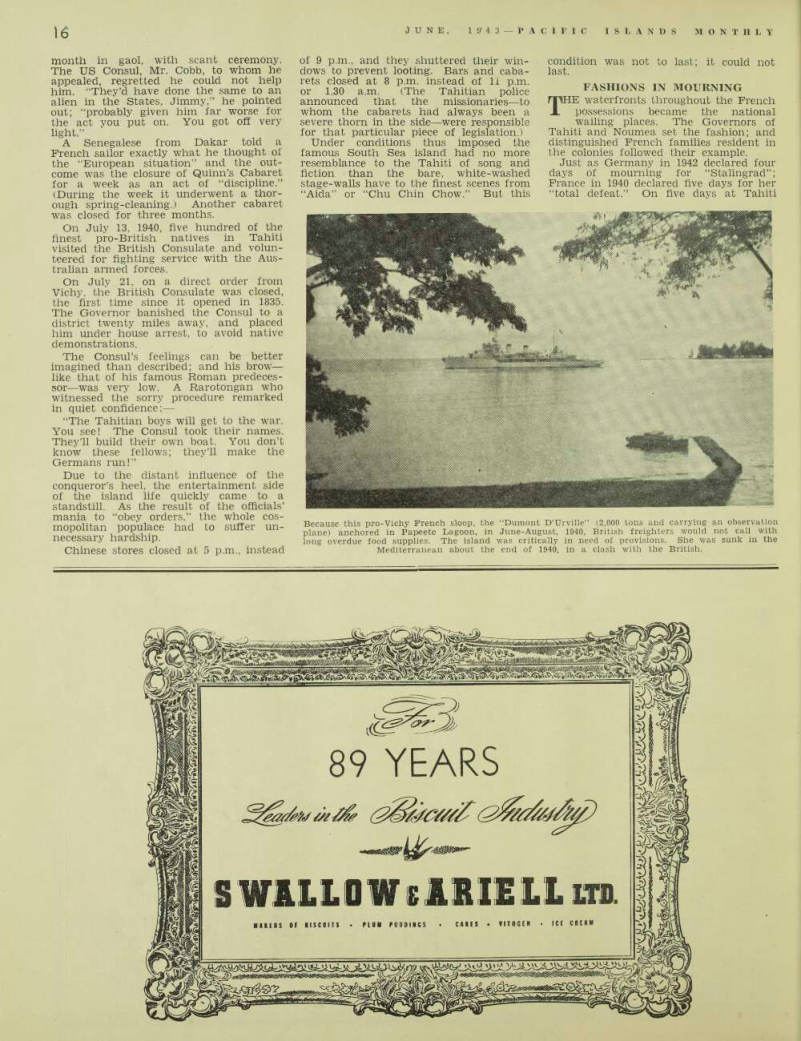
Because this pro-Vichy French sloop, the “Dumont D’Urville" (2,000 tons and carrying an observation plane) anchored in Papeete Lagoon, in June-August, 1940, British freighters would not call with long overdue food supplies. The island was critically in need of provisions. She was sunk in the Mediterranean about the end of 1940, in a clash with the British.
flags were flown at half-mast and there was copious weeping.
A nonplussed American asked a British resident what he thought of it all. The latter shrugged and said he didn’t understand such Continental behaviour.
“The word that I do understand begins with ‘V’,” he said.
“That’s the way I like to hear a man talk,” said the American.
The French defeat seemed to be a double affair. There was not merely the loss of France. There was the loss of face in Colonial France. Before the derision and contempt of their coloured subjects, many high-strutting fonction naires, men who naturally adhered to Vichy, found life almost unendurable.
Fortunately, these super-individualists were a small minority. The majority of Frenchmen were made of better stuff and they became the patriots of Fighting France.
The “Dumont D’Urville”
INCIDENTS involving the French sloop, “Dumont D’Urville” precipitated the crisis and brought matters to a head.
The pro-Vichy commander of the sloop, Toussaint Quievrecourt, quarrelled with the Tahiti Governor, Monsieur Chastenet de Gery, as to who should govern the island. The Governor refused to step down, so the commandant, unable to obtain satisfaction, put to sea for 19 days, for an unknown destination.
Speculation immediately became rife as to the sloop’s mission. As the coconut radio got to work, flights of fancy reached unpublishable proportions.
Public opinion decided that it would return, flying the Allied colours, and, if not exactly over-flowing with milk and honey, at least bringing some flour, of which the island had had none for at least ten weeks.
When the sloop duly returned it did not fly another flag, to which the Gov ernor might surrender in homage. It brought some Sydney flour, but unloaded it at night, into the Naval Stores. For the public it brought nothing—nothing except a virulent brand of Prussic acid from Berlin, via Vichy.
The return of the sloop did little to help the island’s difficult position, but a lot to hinder it. Its continued presence in Papeete, and its dubious attitude, caused the diversion of a British freighter, with some 4,000 tons of essen tial foodstuffs for the Society Group.
Though badly in need of it, the islands lost the lot; and. worse than that, owing to the obscure situation, the trans-Pacific cargo service was suspended, so far as Tahiti was concerned.
Feeling ran high when the news became known. One Canadian offered 1,000 dollars for a passage to anywhere.
The port captain at Papeete was requested to send the French sloop to sea, and on August 15 it went out, and away to Noumea. Its unwelcome arrival there was blamed on Governor Pelicier, and that precipitated the “September Revolution” described by the “Pacific Islands Monthly” in 1940-41.
Meanwhile, General de Gaulle had reached London and had there estab lished the headquarters of “Libre Fran cais,” at Carlton Terrace.
The end of the Vichy regime came quickly in Tahiti. In the plebiscite taken in French Oceania, soon after the sloop departed, only 18 voted for Vichy: thou sands were for de Gaulle and Free France. Governor de Gery departed for the United States; de Gaulle officials took charge; and there began a long, slow, painful weeding-out of Vichy sympathisers.
As for the 500 native zealots, they renewed their offers as volunteers with
the Australian forces, and 300 single and fit were accepted. It wasn’t necessary for them to build their own boat, however.
Ships were found, and carried contingents from Noumea and Tahiti. One man, Peter Cowan, whose father was a Cook Islander, passed as eligible for the AIF. After training at Liverpool, NSW they joined the Allies in the Middle East and, wherever they went, they maintained their reputation as being among the world’s best singers, dancers—and warriors.