Inspiring Story of Elizabeth Mahony, Papuan
pp. 28-29 · Read in the full issue
"QUEEN OF SUDEST" IS DEAD AT 88 Inspiring Story of Elizabeth Mahony, Papuan Pioneer
WITH the death of Mrs. Elizabeth Mahony at her home in Waverley, Sydney, on March 30, there passed one of the finest pioneers of the Southwest Pacific—an almost legendary figure who lived for 30 years on the island of Sudest (South-east Papua) and who became virtual ruler of 20,000 natives.
The "Queen of Sudest,” as she was known throughout the South-west Pacific, has a place in the early history of Papua which none can challenge and she was, personally, one of the best types of pioneering womanhood.
Born in Camden. NSW, 88 years ago, she lived in Port Douglas and Port
Curtis before she went to Sudest Island in 1889 with her husband and two of her children. Gold had just been discovered in Sudest; life was raw and rough, and 200 miners were camped about what later became “Griffin Point” homestead.
Communication with the outside world began and ended with the old sailing ships. When they departed from the island the little community was entirely isolated, until they sailed back again, in anything from four to eight months, Malaria was rife, and dysentry—that almost inevitable accompaniment to a new goldfield—soon appeared. Mrs.
Mahony nursed all she could, unselfishly.
and ill-equipped though she was to fight a major epidemic. With the small faci lities at her disposal, she saved the lives of many men, although she could not hope to save all. She was sometimes helped by her husband, but often, when his duties took him away, she fought her battle against death alone.
Finally her health broke, and she suf fered recurring bouts of malaria, and became gravely ill. The "Wanganui” took her to Cooktown, where she recovered her strength and immediately chartered a vessel to take her back to the island.
With her this time she took her four children, a governess and a piano—the first piano in Papua.
By now, fresh goldfields had been dis covered n Papua, and some of the
Sudest miners had followed them; others had moved off, farther inland, seeking better prospects.
Mr. Mahony began to acquire trading and planting interests, as well as gold mines, and in all of these he had the active support and interest of his wife.
The Sudest natives were a kindly, un aggressive people, and glad to have the protection of the Mahony family against their hereditary enemies, the Bruka Islanders, who frequently made raids upon Sudest.
Mrs. Mahony had phenomenal success with these natives. She was their pro tector and their friend—and, when necessary, their stern teacher. She had a happy knack of getting the best out of them: and their reputation as hon est, well-trained, courteous servants made them greatly sought after by em ployers of native labour from other dis
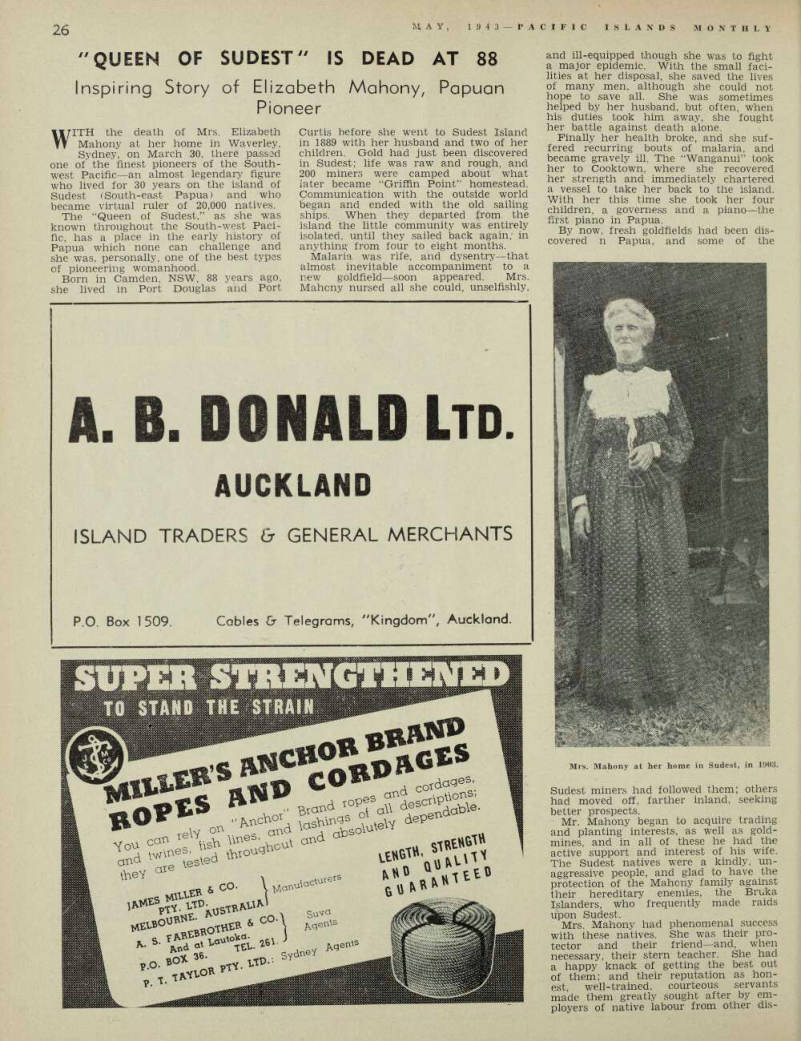
Mrs. Mahony at her home in Sudest, in 1903.
tricts. The parties she gave her natives at Easter and Christmas are remembered yet in Sudest.
ALL this time, the various Mahony interests were growing, and Mrs.
Mahony daily had to rise early and walk miles inland to her various native storekeepers, to weigh their gold and check the goods in their stores, return ing to her family late in the afternoon.
She also undertook long trips up and down the coast in her 14 ft. dinghy, rowed or sailed against tide and wind by her own boys. On one of these occa sions, while negotiating one of Sudest’s worst passages, the dinghy capsized in a guest of wind. She could not swim; but the boys got her to a reef about three miles from shore, where she waited till they righted the boat.
When her husband died, early in life, she left the hotel she owned in Samarai and returned to Sudest. She bought out her husband’s partner, Mr. Patrick Gar vey, and carried on in her husband’s place as planter, trader, mariner, engi neer and gold-miner. She bought one of the first marine engines seen in Papua and, with this installed in her six-ton launch, the “Nil Desperandum,” she became a familiar figure in Papuan waters.
Travelling mostly at night, to escape the hot sun, to which she never became accustomed, she let neither storm nor seas dismay her.
On one occasion, during the north west season, she was within three miles of Samarai but the seas were so big that the launch could not make it. Going on deck with the captain and spare boy, she gave orders to “ready about”—a seem ingly impossible feat—but “about” she went and then, under jib, ran for the first opening about 10 miles back. The opening, even in the calmest weather, presents a pretty problem in seaman ship—in a storm it is practically impos sible —but the “Nil Desperandum” some how went through and rode out the storm, and a week later returned to Samarai by another route.
IN the 1920’5, she handed over her interests to younger folk and came to live in Sydney with an unmarried daughter. She and her daughter toured England and the Continent and she made frequent trips to Papua—her last trip to the Territory being in 1929. For some years she lived with her daughter in Bathurst, NSW, but recently the inland climate became too trying and she made her home in Waverley, Sydney.
In 1935 she received a Jubilee Medal from King George V, in recognition of her fine pioneering work in Papua.
In spite of many years of pioneering and hardships, she remained a gentle? woman, with a charming personality, ever ready to help those less fortunate than herself.
She is survived by three daughters (two of whom normally live, in Milne Bay, Papua), nine grandchildren and 14 great-grandchildren.
The Governor of Fiji, Sir Philip Mit chell, K.C.M.G., M.C., has returned to Suva after a short holiday in New Zealand.
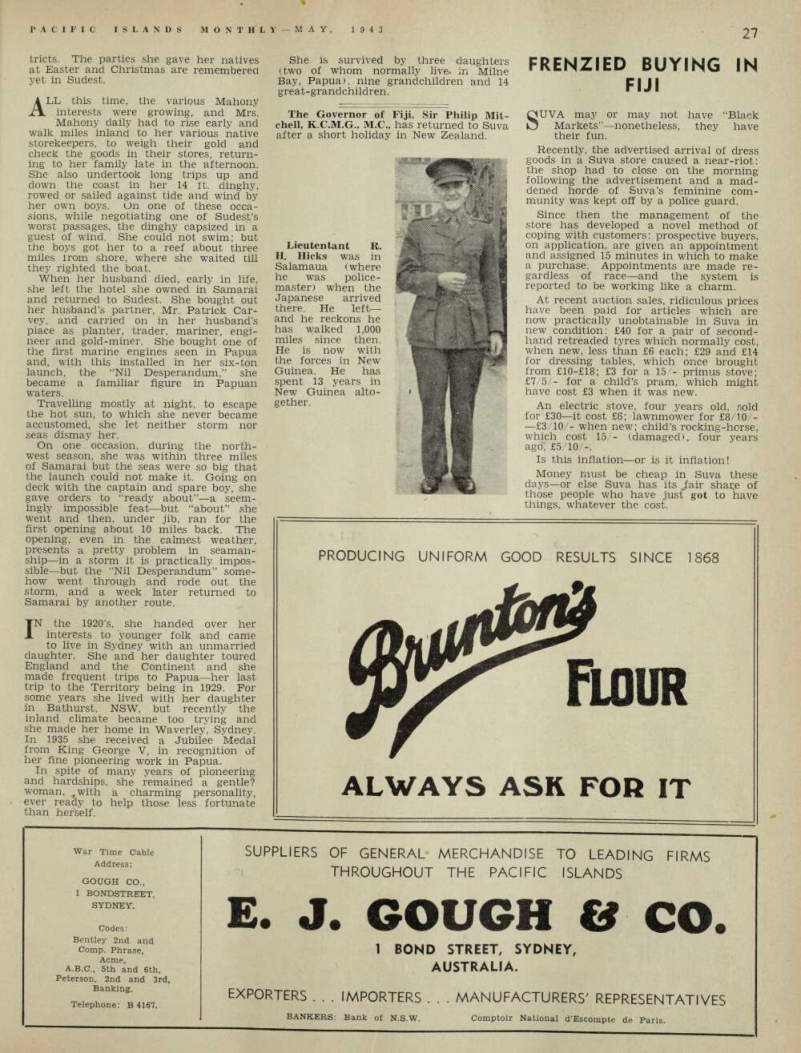
Lieutentant R.
H. Hicks was in Salamaua (where he was police master) when the Japanese arrived there. He left— and he reckons he has walked 1,000 miles since then.
He is now with the forces in New Guinea. He has spent 13 years in New Guinea alto gether.