Future Of Bulolo
p. 35 · Read in the full issue
Gold
Interesting Questions Raised by
BGD Annual Report
THE annual report of Bulolo Gold Dredging, Ltd., for the year ended May 31, 1942, states that the eight dredges which the company had success fully established in the Bulolo Valley, New Guinea, operated profitably from June 1, 1941, to January 21, 1942, when dredging ceased owing to air attacks be ing made upon the area by the Japanese, who then were in process of occupying the Mandated Territory of New Guinea.
It is stated by the directors that a preliminary claim, amounting to £538,426A has been filed with the Australian War Damage Commission in respect of stores, supplies, and fixed assets, destroyed or damaged as the result of war operations.
It is reported that the net working profit of the company for the period, be fore allowances were made for amorti sation, and for an appropriation of 2 million dollars towards contingencies reserve was 2,354,644 dollars. It is thus indicated that it is proposed, very wisely, to put practically the whole of this profit into a war-contingencies reserve.
All New Guinea mining operations are entirely suspended, of course, and the condition of the company’s large plant in the Bulolo Valley is unknown.
The BGD company has had very bad luck. It was one of the best planned and most successfully operated enter prises in the Pacific, and it had just reached its maximum production, with eight dredges, when Japan struck.
The company has a rich gold-bearing property and great financial strength; but its future now necessarily depends upon the place that will be taken by gold in the post-war economic structure. Gold was maintained at about £IOA per ounce, for some years, because of the United States policy of buying gold; but, so far, there is no guarantee that that policy will continue. The future of gold is bound up with discussions of post-war economic plans which now are proceed ing between the United Nations.
Best-informed opinion is that gold must remain as the fundamental backing of national currencies; but the future of a large section of the gold-mining industry depends upon the price at which gold eventually is stabilised.
Position of Cuthbert's Misimo
Goldmine
DIRECTORS of Cuthbert’s Misima Goldmine, Ltd., Papua, expect that income from investments will meet all expenditure until operations can be Net profit of £2,090 shown for 1942 covers operations for less than one month cuate was received. The profit, struck after writing-off £lOO flotation expenses, compares with £35,557 for 1941. After adding £750 to contingencies reserve, the carry-forward is increased to £18,047 from St ?evera? C precedl^ r years had b66n At December 3? the had Government bonds £21,104, and cash £2,228.
Recent regulations will exempt the company from payment of lease rents for almost 12 months from the date permission is received to resume operations.—
“S.M. Herald”
report.
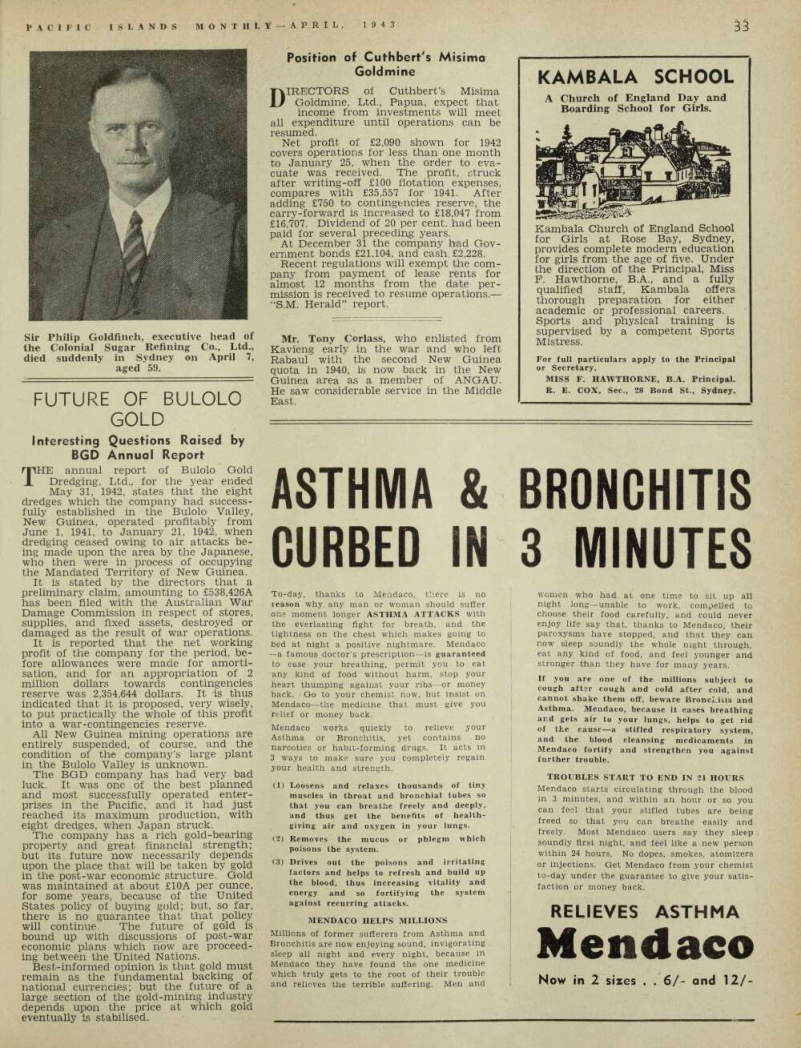
_■. . , Mr. Tony Corlass, who enlisted from Kavieng early in the war and who left Rabaul with the second New Guinea quota in 1940, is now back in the New Guinea area as a member of ANGAU.
He saw considerable service in the Middle East.