Solomons
p. 31 · Read in the full issue
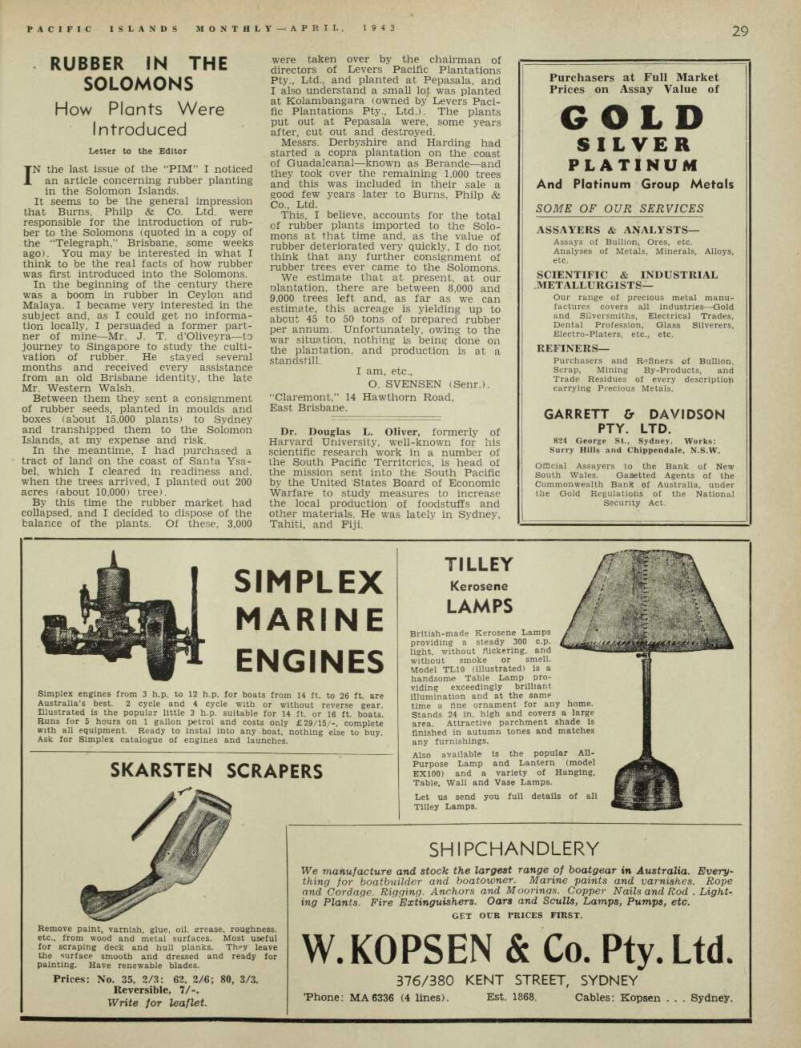
Rubber In The
How Plants Were Introduced
Letter to the Editor IN the last issue of the “PIM” I noticed an article concerning rubber planting in the Solomon Islands.
It seems to be the general impression that Burns, Philp & Co. Ltd. were responsible for the introduction of rub ber to the Solomons (quoted in a copy of the “Telegraph,” Brisbane, some weeks ago). You may be interested in what I think to be the real facts of how rubber was first introduced into the Solomons.
In the beginning of the century there was a boom in rubber in Ceylon and Malaya. I became very interested in the subject and, as I could get no informa tion locally, I persuaded a former part ner of mine—Mr. J. T. d’Oliveyra—to journey to Singapore to study the culti vation of rubber. He stayed several months and received every assistance from an old Brisbane identity, the late Mr. Western Walsh.
Between them they sent a consignment of rubber seeds, planted in moulds and boxes (about 15,000 plants) to Sydney and transhipped them to the Solomon Islands, at my expense and risk.
In the meantime, I had purchased a tract of land on the coast of Santa Ysa bel, which I cleared in readiness and, when the trees arrived, I planted out 200 acres (about 10,000) tree).
By this time the rubber market had collapsed, and I decided to dispose of the balance of the plants. Of these, 3,000
were taken over by the chairman of directors of Levers Pacific Plantations Pty., Ltd., and planted at Pepasala, and I also understand a small lot was planted at Kolambangara (owned by Levers Paci fic Plantations Pty., Ltd.). The plants put out at Pepasala were, some years after, cut out and destroyed.
Messrs. Derbyshire and Harding had started a copra plantation on the coast of Guadalcanal —known as Berande—and they took over the remaining 1,000 trees and this was included in their sale a good few years later to Burns, Philp & Co., Ltd.
This, I believe, accounts for the total of rubber plants imported to the Solo mons at that time and, as the value of rubber deteriorated very quickly, I do not think that any further consignment of rubber trees ever came to the Solomons.
We estimate that at present, at our nlantation, there are between 8,000 and 9,000 trees left and, as far as we can estimate, this acreage is yielding up to about 45 to 50 tons of prepared rubber per annum. Unfortunately, owing to the war situation, nothing is being done on the plantation, and production is at a standstill.
I am, etc.,
O. Svensen (Senr.).
“Claremont,” 14 Hawthorn Road, East Brisbane.
Dr. Douglas L. Oliver, formerly of Harvard University, well-known for his scientific research work in a number of the South Pacific Territories, is head of the mission sent into the South Pacific by the United States Board of Economic Warfare to study measures to increase the local production of foodstuffs and other materials. He was lately in Sydney, Tahiti, and Fiji.