Latitude, Longitude
p. 18 · Read in the full issue
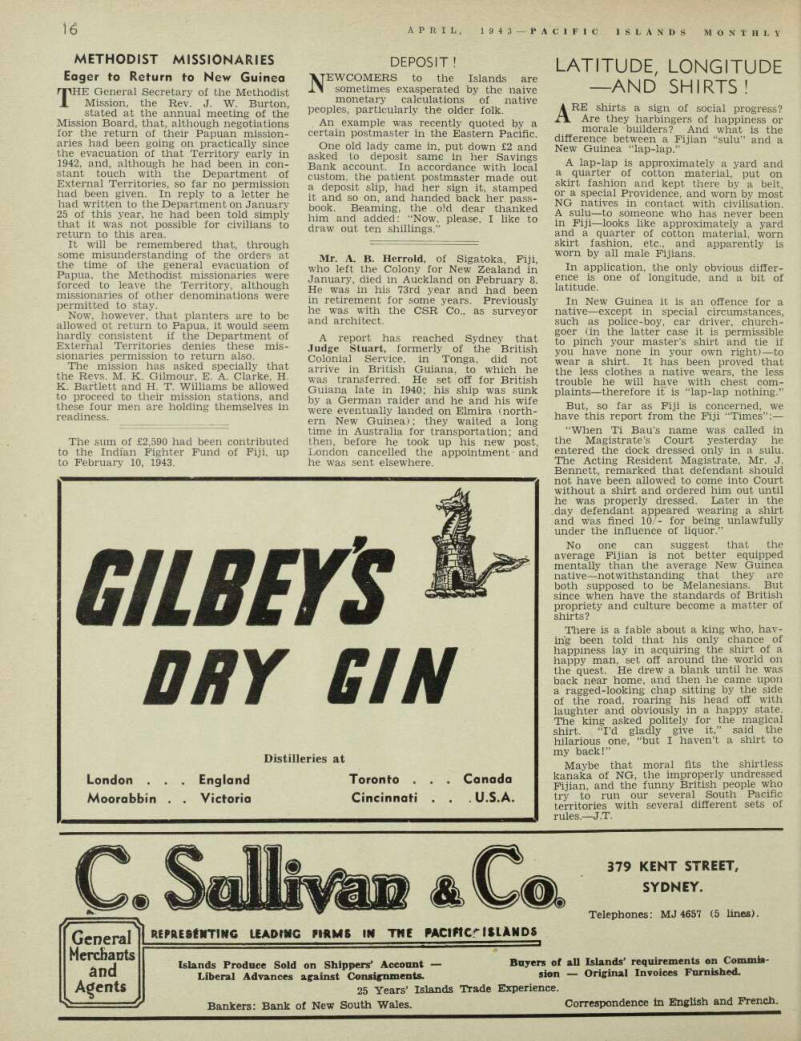
—And Shirts !
ARE shirts a sign of social progress?
Are they harbingers of happiness or morale builders? And what is the difference between a Fijian “sulu” and a New Guinea “lap-lap.”
A lap-lap is approximately a yard and a quarter of cotton material, put on skirt fashion and kept there by a belt, or a special Providence, and worn by most NG natives in contact with civilisation.
A sulu—to someone who has never been in Fiji—looks like approximately a yard and a quarter of cotton material, worn skirt fashion, etc., and apparently is worn by all male Fijians.
In application, the only obvious differ ence is one of longitude, and a bit of latitude.
In New Guinea it is an offence for a native—except in special circumstances, such as police-boy, car driver, church goer (in the latter case it is permissible to pinch your master’s shirt and tie if you have none in your own right)—to wear a shirt. It has been proved that the less clothes a native wears, the less trouble he will have with chest com plaints—therefore it is “lap-lap nothing.”
But, so far as Fiji is concerned, we have this report from the Fiji “Times”: — “When Ti Bau’s name was called in the Magistrate’s Court yesterday he entered the dock dressed only in a sulu.
The Acting Resident Magistrate, Mr. J.
Bennett, remarked that defendant should not have been allowed to come into Court without a shirt and ordered him out until he was properly dressed. Later in the day defendant appeared wearing a shirt and was fined 10/- for being unlawfully under the influence of liquor,”
No one can suggest that the average Fijian is not better equipped mentally than the average New Guinea native—notwithstanding that they are both supposed to be Melanesians. But since when have the standards of British propriety and culture become a matter of shirts?
There is a fable about a king who, hav ing been told that his only chance of happiness lay in acquiring the shirt of a happy man, set off around the world on the quest. He drew a blank until he was back near home, and then he came upon a ragged-looking chap sitting by the side of the road, roaring his head off with laughter and obviously in a happy state.
The king asked politely for the magical shirt. “I’d gladly give it,” said the hilarious one, “but I haven’t a shirt to my back!”
Maybe that moral fits the shirtless kanaka of NG, the improperly undressed Fijian, and the funny British people who try to run our several South Pacific territories with several different sets of
rules.
J.T.