L. J, Stokie
p. 14 · Read in the full issue
Daring Escape From N. Britain, With Three Americans
ANOTHER New Guinea man figures in what the newspapers are describing as one of the “most dramatic rescues of the Pacific War.”
This is Leslie John Stokie, well-known planta tion manager, of the Bainings district, New
Britain, and a mem ber of the NGVR.
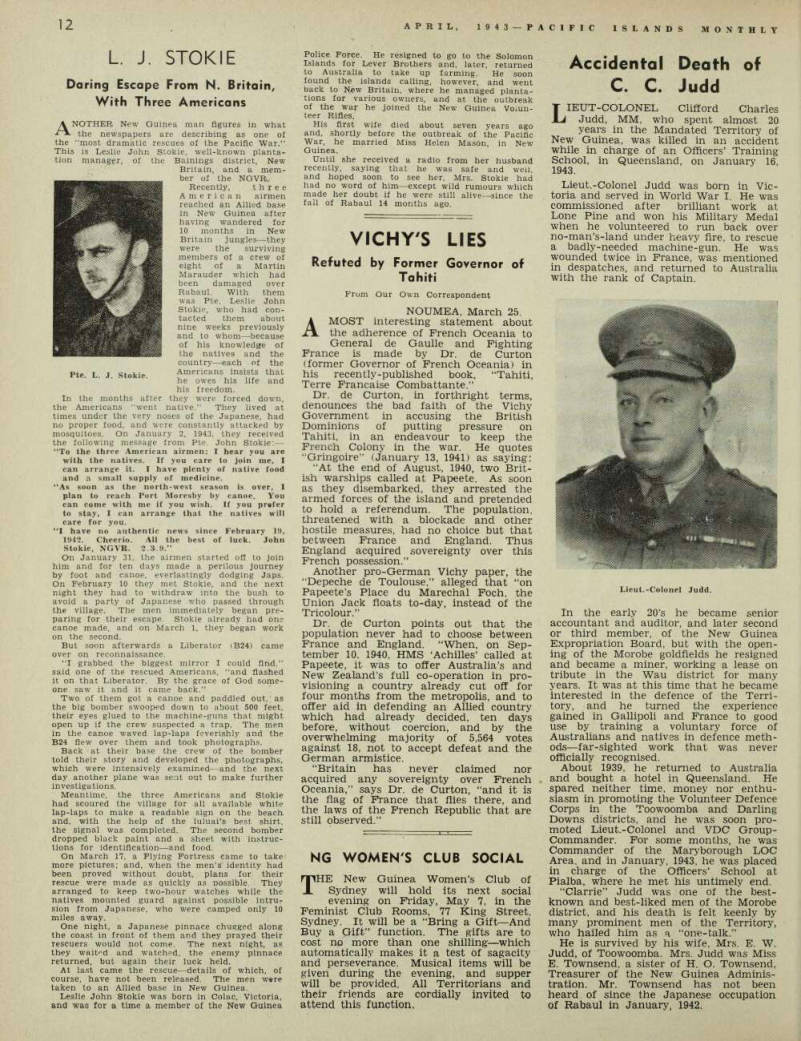
Recently, three American airmen reached an Allied base in New Guinea after having wandered for 10 months in New Britain jungles—they were the surviving members of a crew of eight of a Martin Marauder which had been damaged over Rabaul. With them was Pte. Leslie John Stokie, who had con tacted them about nine weeks previously and to whom —because of his knowledge of the natives and the country—each of the Americans insists that he owes his life and his freedom.
In the months after they were forced down, the Americans “went native.” They lived at times under the very noses of the Japanese, had no proper food, and were constantly attacked by mosquitoes. On January 2, 1943, they received the following message from Pte. John Stokie;— “To the three American airmen: I hear you are with the natives. If you care to join me, I can arrange it. I have plenty of native food and a small supply of medicine.
“As soon as the north-west season is over, I plan to reach Port Moresby by canoe. You can come with me if you wish. If you prefer to stay, I can arrange that the natives will care for you.
“I have no authentic news since February 19, 194?. Cheerio. All the best of luck. John Stokie, NGVR. 2.3.9.”
On January 31, the airmen started off to join him and for ten days made a perilous journey by foot and canoe, everlastingly dodging Japs.
On February 10 they met Stokie, and the next night they had to withdraw into the bush to avoid a party of Japanese who passed through the village. The men immediately began pre paring for their escape. Stokie already had one canoe made, and on March 1, they began work on the second.
But soon afterwards a Liberator < 824) came over on reconnaissance.
“I grabbed the biggest mirror I could find,” said one of the rescued Americans, “and flashed it on that Liberator. By the grace of God some one saw it and it came back.”
Two of them got a canoe and paddled out, as the big bomber swooped down to about 500 feet, their eyes glued to the machine-guns that might open up if the crew suspected a trap. The men in the canoe waved lap-laps feverishly and the 824 flew over them and took photographs.
Back at their base the crew of the bomber told their story and developed the photographs, which were intensively examined—and the next day another plane was sent out to make further investigations.
Meantime, the three Americans and Stokie had scoured the village for all available white lap-laps to make a readable sign on the beach and, with the help of the luluai’s best shirt, the signal was completed. The second bomber dropped black paint and a sheet with instruc tions for identification —and food.
On March 17, a Flying Fortress came to take more pictures: and, when the men’s identity had been proved without doubt, plans for their rescue were made as quickly as possible. They arranged to keep two-hour watches while the natives mounted guard against possible intru sion from Japanese, who were camped only 10 miles away.
One night, a Japanese pinnace chugged along the coast in front of them and they prayed their rescuers would not come. The next night, as they waited and watched, the enemy pinnace returned, but again their luck held.
At last came the rescue—details of which, of course, have not been released. The men were taken to an Allied base in New Guinea.
Leslie John Stokie was born in Colac, Victoria, and was for a time a member of the New Guinea
Police Force. He resigned to go to the Solomon Islands for Lever Brothers and, later, returned to Australia to take up farming. He soon found the islands calling, however, and went back to New Britain, where he managed planta tions for various owners, and at the outbreak of the war he joined the New Guinea Volun teer Rifles.
His first wife died about seven years ago and, shortly before the outbreak of the Pacific War, he married Miss Helen Mason, in New Guinea.
Until she received a radio from her husband recently, saying that he was safe and well, and hoped soon to see her, Mrs. Stokie had had no word of him —except wild rumours which made her doubt if he were still alive—since the fall of Rabaul 14 months ago.
Pte. L. J. Stokie.