Queen Pomare's
p. 22 · Read in the full issue
Diary
LITTLE by little, scholars are piecing together the early history of Tahiti —and especially the turbulent period prior to 1840, and the “golden age” (1840-1880). Here is an extract from a letter from Mr. W. W. Bolton. MA, who takes a keen interest in Tahiti’s history and in Pacific affairs generally:—
“For years I have been making inquiries as to the existence or not of a diary, kept by Queen Pomare IV. At last I have run it to its lair.
“The Queen was evidently not a sys tematic person. She made her entries when the spirit moved her. It was dire stress alone which led to the use of her
pen. She was no scribbler; her penman ship is clear and good.
“Up to 1843 —just a century ago—no diary for her. There is not a word of her early life, not a word of what led to the crisis in her affairs. No mention appears of the coming of the RC priests nor of Du Petit Thours’s two visits, nor of his threats, and her forced petition for a Protectorate.
“She starts off with her troubles in the year 1843 and stops abruptly ere she fled to Raiatea (from the French). There is no entry about her many years’ self exile, nor of her appeals from there to Queen Victoria and others.
“Without a word of explanation, the diary ends with the entry which appears in the article in your November, 1942, issue, when she returned to her home.
“The book she used is a large, unnum bered, unlined volume which she used as a sort of day-book; many a blank page, and then an entry, sometimes a list of names, sometimes a note by or for her self. It may, in a measure, be called a diary, but it is but a tiny fragment of a life which ran to nigh on three score years and ten. To preserve the binding she used some variegated cloth which time —and ants! —have sadly ravaged: but the pages are as clean as when she wrote thereon.”
After Mr. Bolton wrote, the diary was carefully translated, with a view to pub lication. But Mr. Bolton, after con sideration, evidently decided that the diary’s contents were of a too revealing or intimate character. The translation was stopped, and publication will not be preceded with.
News of Mr. G. Winfred was received in Fiji in mid-January. He was form erly an entomologist attached to the CSR Co. Ltd., at Lautoka, but was in Bangkok when the Japanese occupied Thailand and at the time of writing (November) he had been in a prisoner of war camp there for 7 h months. Origin ally there were 350 Dutch, British and American men, women and children in the camp, but the Americans were eva cuated in June and 45 Britishers and 10 Dutch in August. The rest of them remained hopeful that they too would be permitted to leave soon.
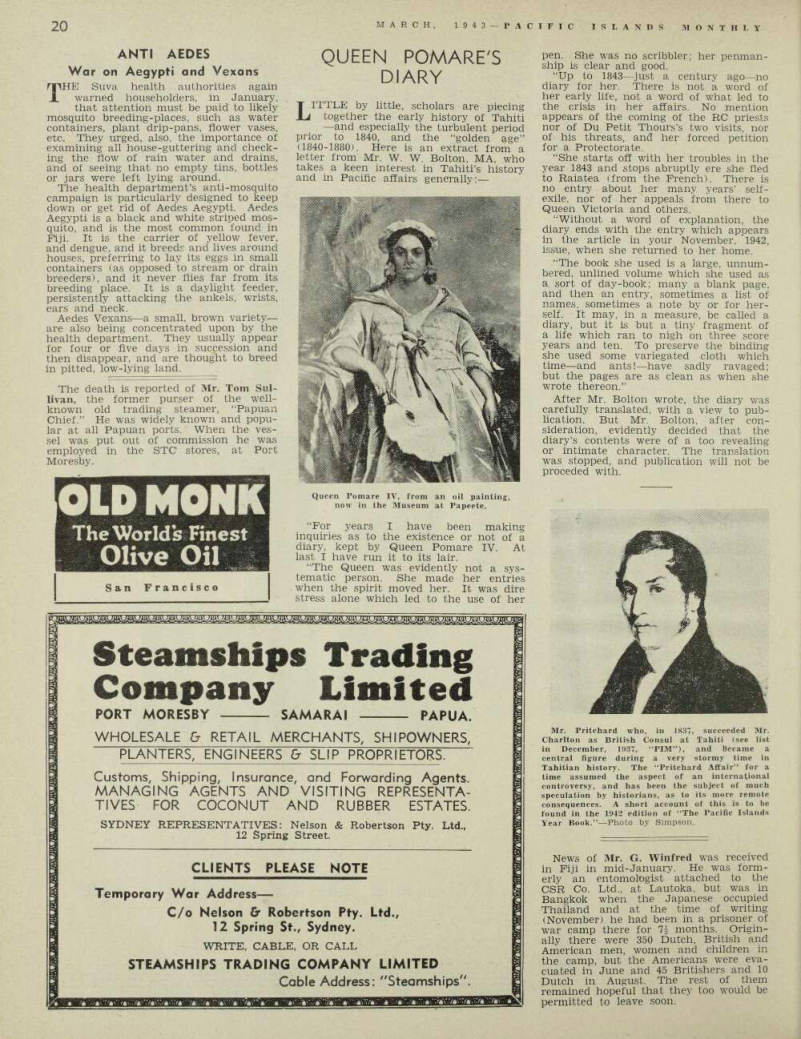
Queen Pomare IV, from an oil painting, now in the Museum at Papeete.
Mr. Pritchard who, in 1837, succeeded Mr.
Charlton as British Consul at Tahiti (see list in December, 1937, “PIM”), and became a central figure during a very stormy time in Tahitian history. The “Pritchard Affair” for a time assumed the aspect of an international controversy, and has been the subject of much speculation by historians, as to its more remote consequences. A short account of this is to be found in the 1942 edition of “The Pacific Islands Year Book.”Photo by Simpson.