After the War
p. 19 · Read in the full issue
Tourism for Tahiti After the War
THE war has destroyed our tourist trade. Wars do not, however, last forever, and it is the part of wis dom to plan for a happier future.
Accordingly, we have carefully studied the tourist literature of our rival archi pelagoes in order to prepare ourselves against any surprises our competitors may be contriving, and, at the same time, to discover and eliminate our own shortcomings.
Here is a paragraph which gives us a bright new idea: — “Papalangi is the seat of Government and headquarters for the Salmation Islands. Here there are many places of interest—the hospital subsidised fully from public funds; the prison, which seems to be well filled with offenders varying from petty thieves to murderers.
“Hanging is still in force here and often carried out.”
Recalling that public hangings were the chief occasions of festival and merri ment for our ancestors, we can compre hend why, in the past, the Salmatian Islands attracted the tourist away from our far less joyous community. Our Tahi tian islands are so law-abiding that there has been but one murderer (a China man) executed during a period of 70 years.
Nevertheless, our Tourist Bureau may solve this problem by asking the United Nations to send out a squad of Nazi Gestapo. They could be kept on Mehe tia, whence they could be brought over one at a time and hanged, whenever a tourist steamer is in port.
We are sternly reminded that we must not fall into the error of our neighbour ing Haramora Islands. Here is the tragic story:— “The Commissioner said: Tn regard to prohibition, we have decided in this matter to make the white as the native, and the native as the white. We have all suffered and sacrificed in the great war. The white people of Haramora must also make some sacrifice for the benefit of the natives . . . ’
“The result of imposing prohibition on the Europeans is just as it was predicted at the time. It closed the hotels in Haramora and did away with the tourist traffic, always a source of revenue.” , This was terrible! The Tourist Bureau rose in revolt. “What are natives for,” they said, “if not to amuse tourists?” Did the Commissioner not know that natives dance with more abandon when well charged with rum? Even though they do sicken and die from liquor, we can do what has been done in another archi pelago under such circumstances—import sun-tanned blondes from Hollywood to dance the hula. Tourists prefer blondes, anyway!
Now, as to our own deficiencies. We must arrange some changes in our Bas tile Day celebrations. Tourists appear bored when listening to our native music. One of them confided to us that £^ sem bled too much the “high-brow stuff” they broadcast once a week over the radio. We are convinced that if our district singing companies would learn some “swing” and “boogie woogie,” and the committee provide a first-class jazz band at the assembly ground, Tarahoi, in Papeete, to enliven the dancing, tourists would feel well repaid for their long voy age to our island.
Finally, we must have bigger and bet ter night clubs, in which artificial palms are installed to give that ineffable atmo sphere of the tropics which tourists travel so far to experience.
Coconut groves, out-of-doors, are all very well to look at from a distance; but they are not places in which to have cocktail-parties. The ground is usually untidy and coconuts are always dropping down. One might fall on somebody’s head or, worse, on the table, and splash the cocktails all about.
And so, by careful navigation and avoidance of mine-fields, we hope to bring our tourist-ship safely to port— when the war is over., —A. C. Rowland.
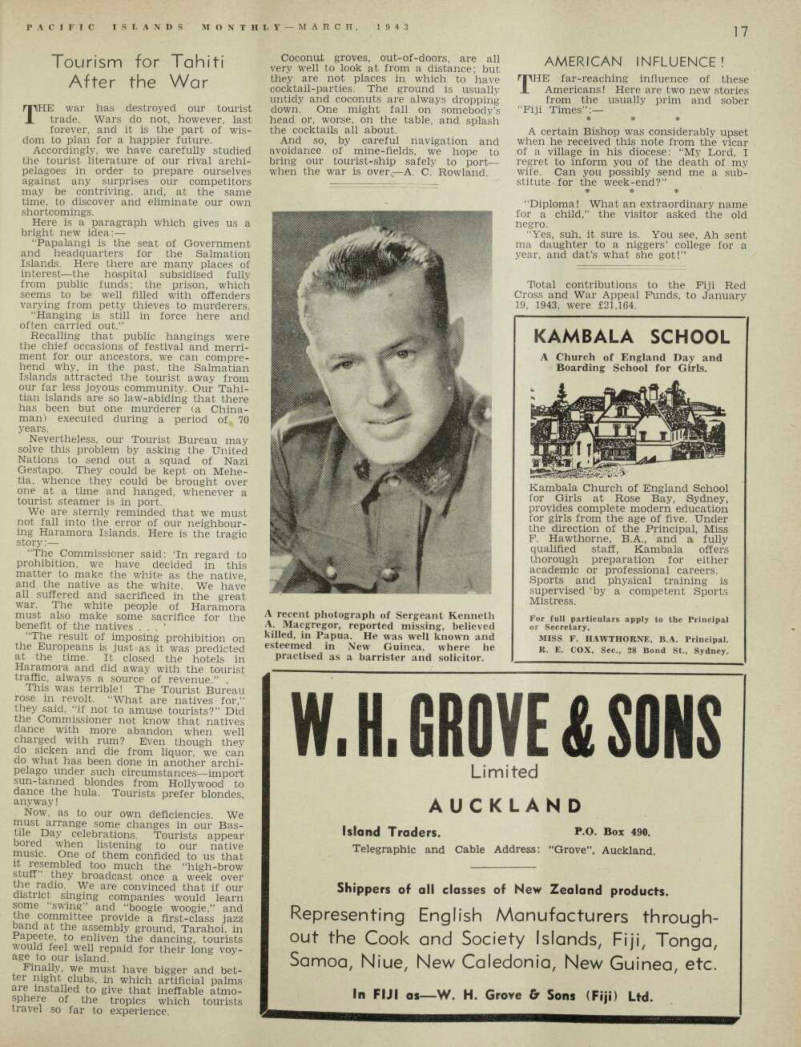
A recent photograph of Sergeant Kenneth A. Macgregor, reported missing, believed killed, in Papua, He was well known and esteemed in New Guinea, where he practised as a barrister and solicitor.