A. P. Lyons
p. 13 · Read in the full issue
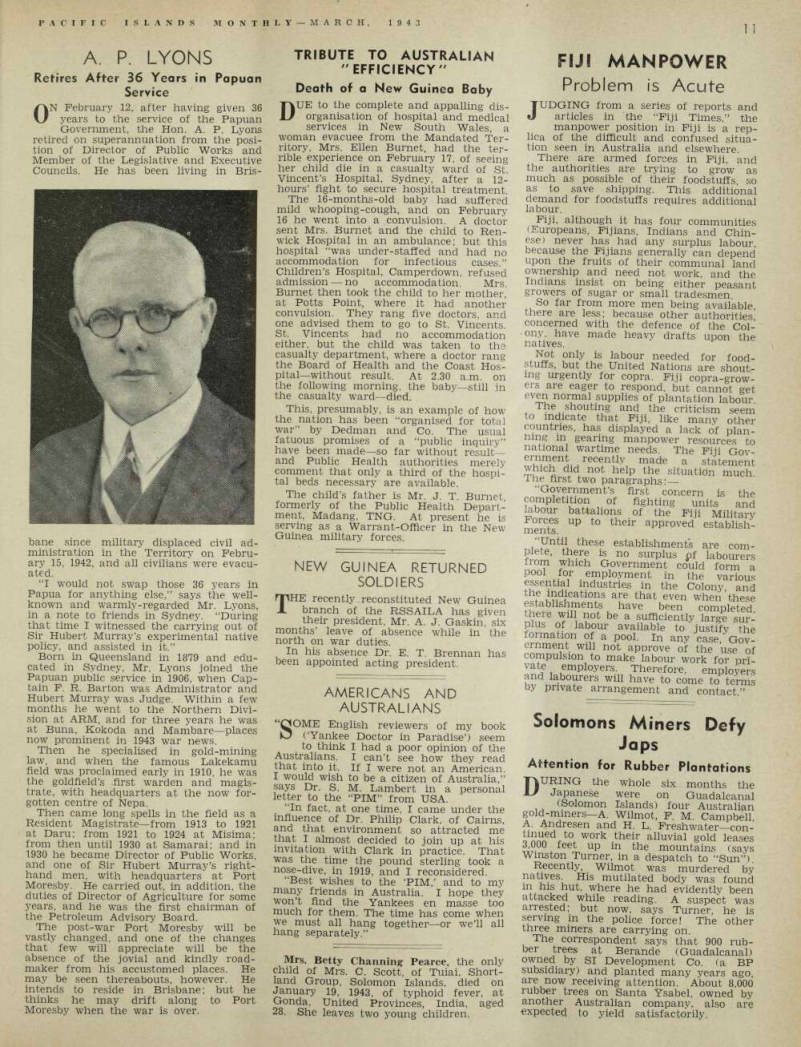
Retires After 36 Years in Papuan Service
ON February 12, after having given 36 years to the service of the Papuan Government, the Hon. A. P. Lyons retired on superannuation from the posi tion of Director of Public Works and Member of the Legislative and Executive Councils. He has been living in Bris-
“I would not swap those 36 years in Papua for anything else,” says the well known and warmly-regarded Mr. Lyons, in a note to friends in Sydney. “During that time I witnessed the carrying out of Sir Hubert Murray’s experimental native policy, and assisted in it.”
Born in Queensland in 1879 and edu cated in Sydney, Mr. Lyons joined the Papuan public service in 1906, when Cap tain F. R. Barton was Administrator and Hubert Murray was Judge. Within a few months he went to the Northern Divi sion at ARM, and for three years he was at Buna, Kokoda and Mambare—places now prominent in 1943 war news.
Then he specialised in gold-mining law, and when the famous Lakekamu field was proclaimed early in 1910, he was the goldfield’s .first warden and magis trate, with headquarters at the now for gotten centre of Nepa.
Then came long spells in the field as a Resident Magistrate—from 1913 to 1921 at Daru; from 1921 to 1924 at Misima; from then until 1930 at Samarai; and in 1930 he became Director of Public Works, and one of Sir Hubert Murray’s right hand men, with headquarters at Port Moresby. He carried out, in addition, the duties of Director of Agriculture for some years, and he was the first chairman of the Petroleum Advisory Board.
The post-war Port Moresby will be vastly changed, and one of the changes that few will appreciate will be the absence of the jovial and kindly road maker from his accustomed places. He may be seen thereabouts, however. He intends to reside in Brisbane; but he thinks he may drift along to Port Moresby when the war is over.
bane since military displaced civil ad ministration in the Territory on Febru ary 15, 1942, and all civilians were evacu ated.