Daily Dogfights Over
Mission Remarkable Experiences of Papuan Padre
RECENTLY arrived in Australia, after a strenuous year under war-condi tions in Papua, are two members of the Anglican Mission: The Rt. Rev. P. N.
W. Strong, Bishop of New Guinea, and Archdeacon S. R. M. Gill, of All Saints’
Mission, Mamba (at the mouth of the Mambare River, Papua).
Bishop Strong has been an inspiration to his staff, who insisted upon remain ing behind in Papua, and in whose mis sion area most of the Papuan fighting took place. He has spent much of the past year in active work in the field.
Since reaching Australia, he has preached at St. Andrew’s Cathedral, Sydney, on the part played by the natives in the Papuan campaign, and he was a speaker at the Australian Board of Missions rally in the Sydney Town Hall on March 8, which was held for the purpose of plan ning missionary work in the Pacific after the war.
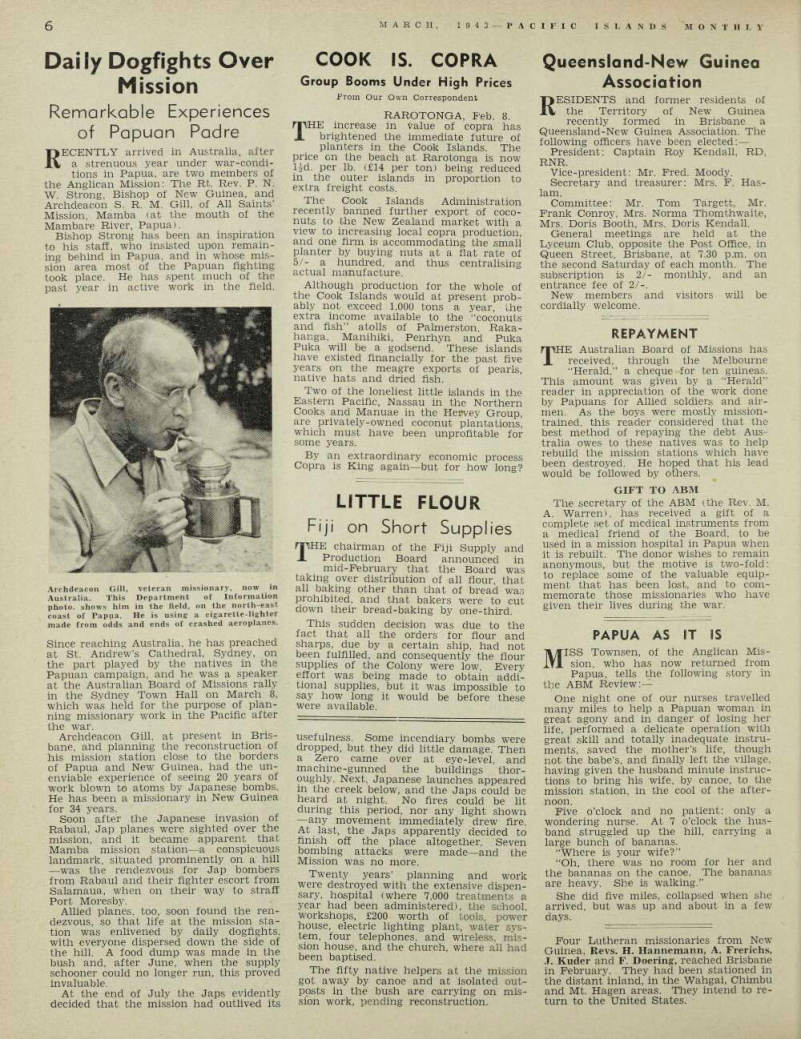
Archdeacon Gill, at present in Bris bane, and planning the reconstruction of his mission station close to the borders of Papua and New Guinea, had the un enviable experience of seeing 20 years of work blown to atoms by Japanese bombs.
He has been a missionary in New Guinea for 34 years.
Soon after the Japanese invasion of Rabaul, Jap planes were sighted over the mission, and it became apparent that Mamba mission station —a conspicuous landmark, situated prominently on a hill —was the rendezvous for Jap bombers from Rabaul and their fighter escort from Salamaua, when on their way to straff Port Moresby.
Allied planes, too, soon found the ren dezvous, so that life at the mission sta tion was enlivened by daily dogfights, with everyone dispersed down the side of the hill. A food dump was made in the bush and, after June, when the supply schooner could no longer run, this proved invaluable.
At the end of July the Japs evidently decided that the mission had outlived its
usefulness. Some incendiary bombs were dropped, but they did little damage. Then a Zero came over at eye-level, and machine-gunned the buildings thor oughly. Next, Japanese launches appeared in the creek below, and the Japs could be heard at night. No fires could be lit during this period, nor any light shown —any movement immediately drew fire.
At last, the Japs apparently decided to finish off the place altogether. Seven bombing attacks were made —and the Mission was no more.
Twenty years’ planning and work were destroyed with the extensive dispen sary, hospital (where 7,000 treatments a year had been administered), the school, workshops, £2OO worth of tools, power house, electric lighting plant, water sys tem, four telephones, and wireless, mis sion house, and the church, where all had been baptised.
The fifty native helpers at the mission got away by canoe and at isolated out posts in the bush are carrying on mis sion work, pending reconstruction.
Archdeacon Gill, veteran missionary, now in Australia. This Department of Information photo, shows him in the field, on the north-east coast of Papua. He is using a cigarette-lighter made from odds and ends of crashed aeroplanes.