Overlanding Cattle in N
p. 14 · Read in the full issue
N. Guinea Useful Wartime Work by Harry Lumb and Dan Leahy
THE value of the work being done by residents of Papua and New Guinea, now attached to the Australian Army, cannot be over-emphasised.
Elsewhere in this issue are reports of the activities of the NGVR, both on the mainland and in New Britain: and now details have been released of how two well-known Morobe men overlanded 500 Zebu cattle, from Madang to Wau, in order that Australian troops stationed in Wau might have fresh meat.
The men are Corporal Harry Lumb and
Rifleman Danny Leahy, both formerly members of the NGVR.
Danny Leahy is one of the famous Leahy Brothers, who have done much valuable exploration work in New Guinea and who hold the only mining leases in the remote Mt. Hagen district.
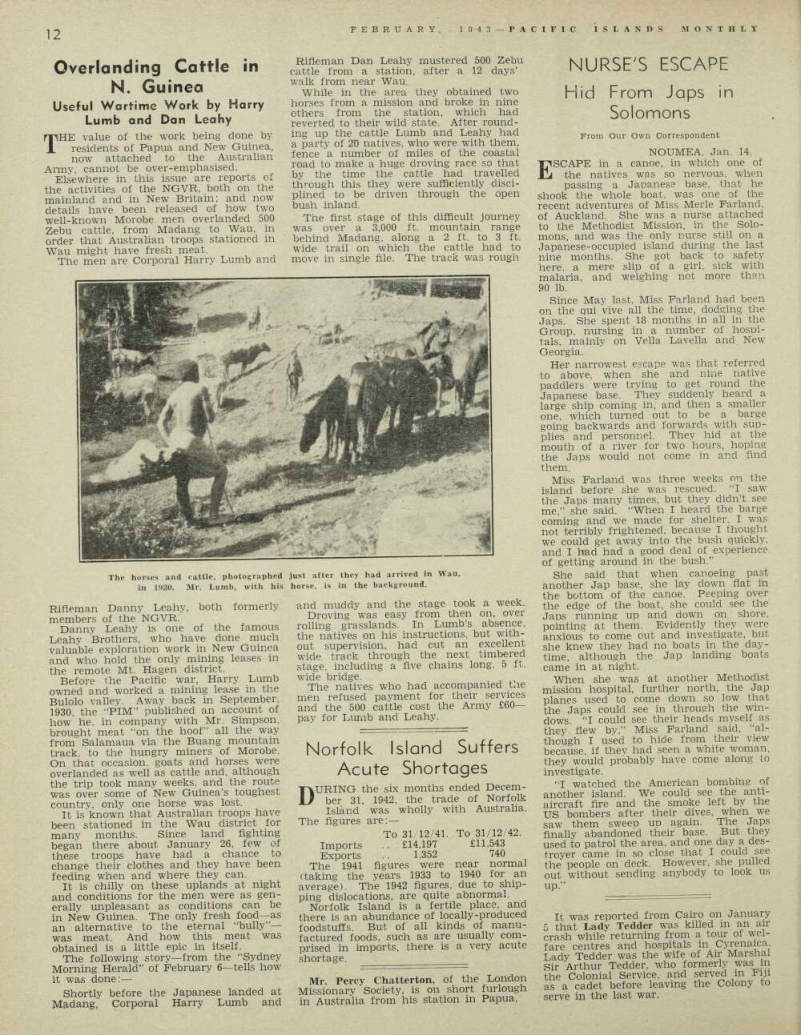
Before the Pacific war, Harry Lumb owned and worked a mining lease in the Bulolo valley. Away back in September, 1930, the “PIM” published an account of how he, in company with Mr. Simpson, brought meat “on the hoof” all the way from Salamaua via the Buang mountain track, to the hungry miners of Morobe.
On that occasion, goats and horses were overlanded as well as cattle and, although the trip took many weeks, and the routs was over some of New Guinea’s toughest country, only one horse was lost.
It is known that Australian troops have been stationed in the Wau district for many months. Since land fighting began there about January 26, few of these troops have had a chance to change their clothes and they have been feeding when and where they can.
It is chilly on these uplands at night and conditions for the men were as gen erally unpleasant as conditions can be in New Guinea. The only fresh food—as an alternative to the eternal “bully”— was meat. And how this meat was obtained is a little epic in itself.
The following story—from the “Sydney Morning Herald” of February 6—tells how it was done: — Shortly before the Japanese landed at Madang, Corporal Harry Lumb and
Rifleman Dan Leahy mustered 500 Zebu cattle from a station, after a 12 days’ walk from near Wau.
While in the area they obtained two horses from a mission and broke in nine others from the station, which had reverted to their wild state. After round ing up the cattle Lumb and Leahy had a party of 2b natives, who were with them, fence a number of miles of the coastal road to make a huge droving race so that by the time the cattle had travelled through this they were sufficiently disci plined to be driven through the open bush inland.
The first stage of this difficult journey was over a 3,000 ft. mountain range behind Madang, along a 2 ft. to 3 ft. wide trail on which the cattle had to move in single file. The track was rough
and muddy and the stage took a week.
Droving was easy from then on, over rolling grasslands. In Lumb’s absence, the natives on his instructions, but with out supervision, had cut an excellent wide track through the next timbered stage, including a five chains long, 5 ft. wide bridge.
The natives who had accompanied txie men refused payment for their services and the 500 cattle cost the Army £6o— for Lumb and Leahy.
The horses and cattle, photographed just after they had arrived in Wau, in 1930. Mr. Lumb, with his horse, is in the background.