How War Blasted The Solomons
Munda is on Roviana Lagoon
WHEN Mr. H. A. Markham, looking young and walking sprightly, in spite of three-score-years-and-five, and several recent operations, came into the “PIM” office in February, we were able to clear up some uncertainty about the location of Munda. Munda is the first airfield established by the Japs in the New Georgia cluster of the Solomons, and it has been blasted many times by American air fleets lately. The Japs went to New Georgia when the Americans threw them out of Guadalcanal.
Some people had placed Munda on the island of Kolombangara, directly opposite Gizo; but that place is named Hunda, not Munda.
Munda is much better known to Solomon Islands people as Lambeti, the famous plantation established by the late Mr. Norman Wheatley, at the western end of the beautiful Roviana Lagoon, on the southern shore of the large island of New Georgia. There is an islet called Munda, and the Munda Bar, near the western end of Roviana, is wellknown to navigators.
When Mr. Wheatley died, Lambeti was bought by Mr. Leslie F. Gill, and he lived there until the evacuation. There has been nothing to indicate the part of the New Georgia cluster being used by the Japanese as a naval base. Some suppose that they are using the little port of Gizo, some 30 miles north-west of the
Roviana Lagoon; but if their chief air field is at Munda, it is probable that their principal centre for shipping will be in the vicinity of the Roviana Lagoon.
It has been announced that the Japanese have recently completed a second airfield in this cluster, on the island of Kolombangara, and that the Americans have bombarded it, with both aircraft and with naval vessels. It is not known exactly where this second airfield is situated —probably in a position handy to Gizo, from which Kolombangara is separated by only a narrow strait. Simi larly, on the south, there is only a narrow strait between Kolombangara and New Georgia.
Mr. Gill, who now is holding a Govern ment position in Melbourne, has had singularly bad luck. Until the Japanese came he was the owner of several plan tations. He lived on Lambeti Plantation (now the much-blasted Munda airfield); he owned property on Gizo Island, which was blitzed early in 1942, and which is now in Japanese occupation; and he had other properties on Vella Lavella, facing Kolombangara—and both Vella Lavella and Kolombangara have been mentioned recently as actual battle areas.
A similar loss has been suffered by Mr.
Markham, whose plantation, on the Marovo Lagoon, between the islands of New Georgia and Vangunu, was one of the show places of the Solomons. Few, if any, of the famous people who visited
the Solomons during the past 30 years failed to spend a few days with Mr. Mark ham in this delightful spot.
Mr. Markham was ill when he came away from his home in 1941; and now, between the Japanese and looting natives, most of his property has disappeared, including diaries extending over nearly 40 years.
It is presumed that some kind of war damage com pensation plan will operate for the assistance of Solo mons planters like Mr. Mark ham and Mr. Gill, who have lost their all; but there is no indication of its character and scope. It necessarily will be controlled by London, through the British Colonial Office; and the amount of compensation probably can not be determined until the war is ended and some survey of total damage can be made.
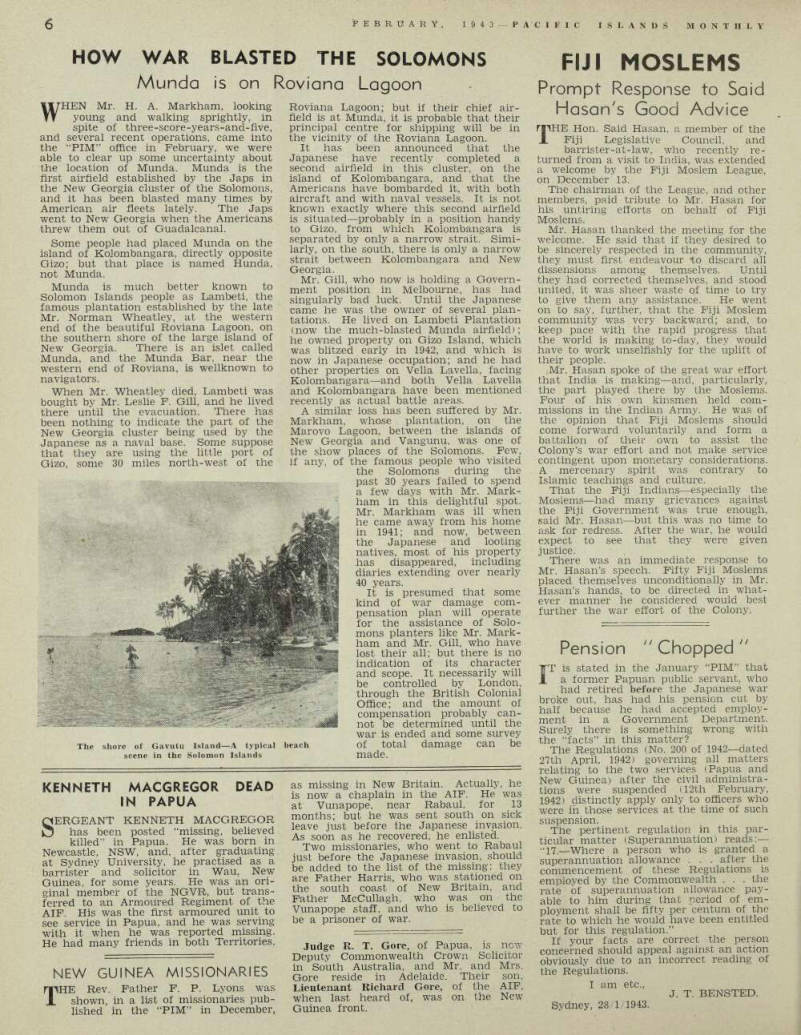
The shore of Gavutu Island —A typical beach scene in the Solomon Islands