How Judge Robinson Died
pp. 26-29 · Read in the full issue
Tragic Sequel to Murder of Missionary Chalmers
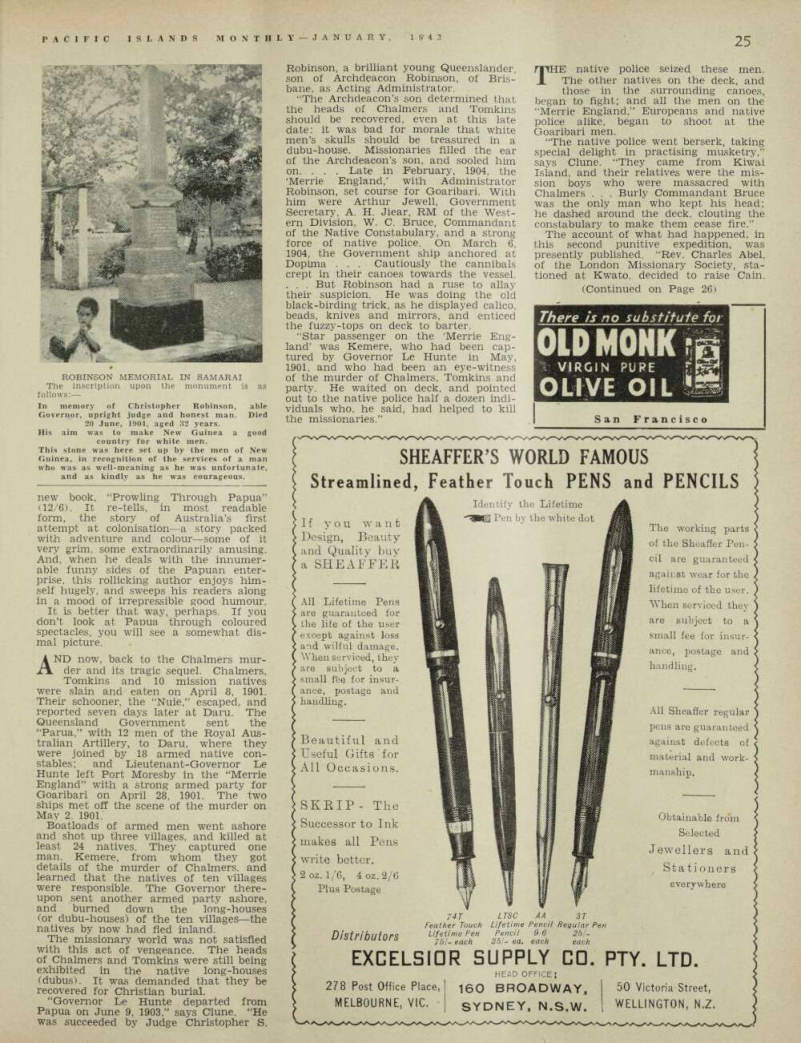
TF. you wandered through Samarai in JL the days before bombs blasted that beautiful little tropical town, you may have noticed a beautiful monu ment; and, pausing to read, you may have been intrigued—as I was—by the curious wording of the inscription on the monument. (See photograph on the op posite page.) So. because I knew nothing of what had happened in 1904. I inquired con
cerning Governor Robinson; and, imme diately, I came upon a very definite “hush-hush policy.”
I was told that this had been a great tragedy; that many people believed that a very able young Administrator had been hounded to his death by missionaries— but that everyone, including the mission aries, now were sincerely sorry for what had occurred. “Better let the whole thing be forgotten,” they said.
So I put my photograph away in a file, and duly forgot it.
BUT now come two reminders —the foregoing article by Mr. Hunter and, coincidentally, a new book by that northwards-roving Australian writer, Frank Clune.
Clune cannot stay away long from the Australian tropics. Every so often, he hops a ship or a plane, and goes wander ing in Australia’s Far North, or in the colourful territories north of Australia’s Far North: and, every time, his expedi tion is followed by a book, hot off the presses of Angus and Robertson, and richly bedight with quaint phrases and shrewd observation. There may be those who do not like the Clune style, and the impish Clune faculty for making jokes out of things which must not be joked about; but we take off our hats to the tireless energy of this disrespectful fel low, and his ingenuity in producing a merry story where seemingly no story had existed.
And, for once sober and restrained, he exhumes and re-tells the tragic story of Governor Robinson. I see no reason why I should not make use of his account here. It is as well that this generation should know the circumstances: they will serve as a warning.
The story also gives some idea of the character and scope of Frank Clune’s
new book, “Prowling Through Papua” (12/6). It re-tells, in most readable form, the story of Australia’s first attempt at colonisation—a story packed with adventure and colour —some of it very grim, some extraordinarily amusing.
And, when he deals with the innumer able funny sides of the Papuan enter prise. this rollicking author enjoys him self hugely, and sweeps his readers along in a mood of irrepressible good humour.
It is better that way, perhaps. If you don’t look at Papua through coloured spectacles, you will see a somewhat dis mal picture.
AND now, back to the Chalmers mur der and its tragic sequel. Chalmers, Tomkins and 10 mission natives were slain and eaten on April 8. 1901.
Their schooner, the “Nuie,” escaped, and reported seven days later at Daru. The Queensland Government sent the “Parua,” with 12 men of the Royal Aus tralian Artillery, to Daru, where they were joined by 18 armed native con stables; and Lieutenant-Governor Le Hunte left Port Moresby in the “Merrie England” with a strong armed party for Goaribari on April 28, 1901. The two ships met off the scene of the murder on May 2. 1901.
Boatloads of armed men went ashore and shot up three villages, and killed at least 24 natives. They captured one man, Kemere, from whom they got details of the murder of Chalmers, and learned that the natives of ten villages were responsible. The Governor there upon sent another armed party ashore, and burned down the long-houses (or dubu-houses) of the ten villages—the natives by now had fled inland.
The missionary world was not satisfied with this act of vengeance. The heads of Chalmers and Tomkins were still being exhibited in the native long-houses (dubus). It was demanded that they be recovered for Christian burial.
“Governor Le Hunte departed from Papua on June 9. 1903.” says Clune. “He was succeeded by Judge Christopher S.
Robinson, a brilliant young Queenslander, son of Archdeacon Robinson, of Bris bane, as Acting Administrator.
“The Archdeacon’s son determined that the heads of Chalmers and Tomkins should be recovered, even at this late date: it was bad for morale that white men’s skulls should be treasured in a dubu-house. Missionaries filled the ear of the Archdeacon’s son, and sooled him on. . . . Late in February, 1904, the ‘Merrie England,’ with Administrator Robinson, set course for Goaribari. With him were Arthur Jewell, Government Secretary, A. H. Jiear, RM of the West ern Division, W. C. Bruce, Commandant of the Native Constabulary, and a strong force of native police. On March 6, 1904, the Government ship anchored at Dopima . . . Cautiously the cannibals crept in their canoes towards the vessel. . . . But Robinson had a ruse to allay their suspicion. He was doing the old black-birding trick, as he displayed calico, beads, knives and mirrors, and enticed the fuzzy-tops on deck to barter.
“Star passenger on the ‘Merrie Eng land’ was Kemere, who had been cap tured by Governor Le Hunte in May, 1901, and who had been an eye-witness of the murder of Chalmers, Tomkins and party. He waited on deck, and pointed out to the native police half a dozen indi viduals who, he said, had helped to kill the missionaries.”
THE native police seized these men.
The other natives on the deck, and those in the surrounding canoes, began to fight; and all the men on the “Merrie England,” Europeans and native police alike, began to shoot at the Goaribari men.
“The native police went berserk, taking special delight in practising musketry,” says Clune. “They came from Kiwai Island, and their relatives were the mis sion boys who were massacred with Chalmers . . . Burly Commandant Bruce was the only man who kept his head; he dashed around the deck, clouting the constabulary to make them cease fire.”
The account of what had happened, in this second punitive expedition, was presently published. “Rev. Charles Abel, of the London Missionary Society, sta tioned at Kwato. decided to raise Cain. (Continued on Page 26)
Robinson Memorial In Samarai
The Inscription upon the monument is as follow:- In memory of Christopher Robinson, able Governor, upright judge and honest man. Died 20 June, 1904, aged 32 years.
His aim was to make New Guinea a good country for white men.
This stone was here set up by the men of New Guinea, in recognition of the services of a man who was as well-meaning as he was unfortunate, and as kindly as he was courageous.
Although the Government party had been avenging the death of Missionary Chalmers, the procedure did not appeal to Missionary Abel.” He went south to take up the matter with the Common wealth Government, and he told reporters “that nothing less than a Royal Com mission will satisfy the European popu lation of Port Moresby—omitting to mention that Port's European population at that time consisted of 38 males and 18 females, including children.”
Mr. Clune bitterly attacks the activities of Mr. Abel. He says that the Australian newspapers—as usual, knowing nothing of local conditions and eager only for a sensational story—revelled in the gory accounts of Goaribari. as supplied by Mr.
Abel, “who achieved his ambition of becoming headline news.” The news papers clamoured for more blood, and demanded the recall of the Administrator.
“Yielding to the clamour of the press hounds, the Commonwealth Government decided to recall Administrator Robinson to Sydney for an inquiry, and appointed Captain F. R. Barton, RM of the Cen tral Division, as Administrator in his stead. Events moved quickly to a tragic climax.”
ON June 16, 1904, in accordance with his instructions, Captain Barton went to Government House. Port Moresby, and officially informed Judge Robinson of what had occurred, and of the decision to inquire into “the affray at Goaribari Island.”
“For three days, Robinson brooded over this blow to his ambitions and the dis grace of being sacked, and superseded by a junior magistrate. Then, in the early morning of June 20, a shot was fired.
Government House staff rushed into the garden. Captain Barton said: T got up and saw something white on the grass
near the flagstaff. It was Robinson, revolver in hand, still breathing, but unconscious.’ The coroner returned a verdict that the ex-Administrator had committed suicide, while temporarily insane.
"Thus,” concludes Clune, “the first Australian-born Administrator of Papua died, a victim to the newspaper hunger for sensation, fed by the mumbles of a maundering missionary; Christopher Robinson preferred death to dishonour and went out like an officer and a gentleman.”
The Royal Commission was duly held.
It found that, in the Goaribari affair, about 260 shots were fired in about seven minutes, and that at least eight natives were killed on the spot. Judge Robinson was blamed for “treacherously” seizing the prisoners after inveigling them on deck; but the Commission said that his suicide could not be regarded as the result of a feeling of guilt. “His errors were the result of over-zeal.”
On March 18, 1905. Captain Barton arrived at Goaribari with two of the six prisoners taken by Robinson, and sent them ashore to inform the natives that the Government wanted the skulls of the murdered missionaries, now believed to be displayed in the re-built dubu-house.
The villagers, after some “persuasion,” reluctantly handed over a skull, “affirmed to be that of one of the murdered mis sionaries”: and that skull was accepted as the skull of Chalmers, and reverently buried in the grave of Mrs. Chalmers, at Daru Island.
THAT is the end of Mr. dune’s story.
He says nothing of the bitter feel ing held against Charles Abel for many long years by a section of the Europeans in Papua, who believed that Mr. Robinson had been hounded to his
death.
Mr. Abel was a perfectly sincere man, but typical of the somewhat one-eyed churchmen of his time. He was one of that class who insisted on wearing top hats and frock-coats in the tropics, and wrapping the healthily-naked bodies of the natives in unhealthy clothes, because things were done that way in England.
The Goaribari affair, to him, was a cruel slaughter of trusting and semi defenceless natives. To the people who knew the country, it was a punishment of cruel, brutal and treacherous savages, thoroughly merited by the circumstances which attended the death of Chalmers.
Those natives, said the Europeans, had been worked upon for years and trusted by Chalmers, and yet they turned upon him and murdered him most foully: they never would be tamed until they under stood that, behind any treacherous abuse of the trust placed in them by the mis sionaries, there lay the implacable ven geance of the white man. Governor Robinson, they declared, did his duty properly, as he saw it; and. in to-day’s wider tolerance and vastly extended knowledge of the natives, there will be found few to combat that view.
Charles Abel remained in the London Missionary Society for many years, but eventually he broke away and established the famous mission of Kwato, near Samarai, which still is carried on by members of the Abel family. The monu ment erected to Judge Robinson on Samarai Island, close to Kwato, is the answer of the non-mission Europeans of that time to the activities of Abel in the Robinson affair.
There, the story should end. Robinson has been vindicated, and his memory is honoured. So, also, is the memory of Abel—Kwato Mission is a monument to his life-work on behalf of the natives of
Papua. It can be said of both of them that their “errors were the result of over
zeal/'—: