All Non-Official Motions Defeated
p. 12 · Read in the full issue
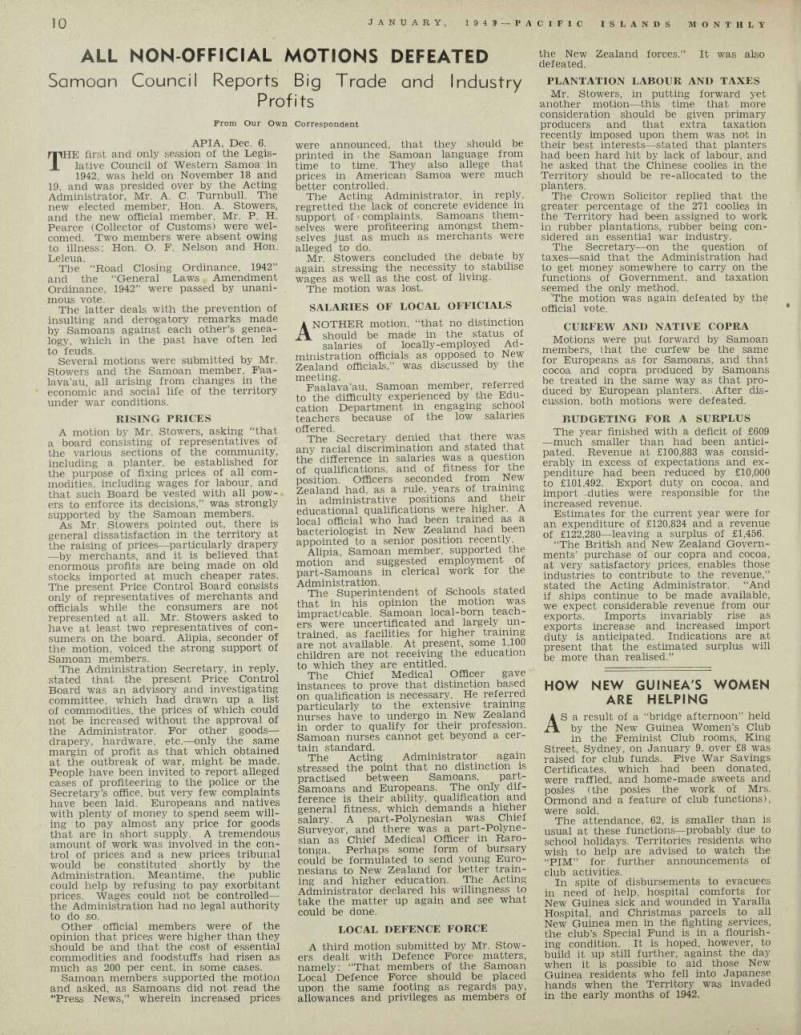
Samoan Council Reports Big Trade and Industry Profits
From Our Own Correspondent
Apia, Dec. 6.
THE first and only session of the Legis lative Council of Western Samoa in 1942, was held on November 18 and 19, and was presided over by the Acting Administrator, Mr. A. C. Turnbull. The new elected member, Hon. A. Stowers, and the new official member. Mr. P. H.
Pearce (Collector of Customs) were wel comed. Two members were absent owing to illness: Hon. O. F. Nelson and Hon.
Leleua.
The “Road Closing Ordinance. 1942” and the “General Laws Amendment Ordinance, 1942” were passed by unani mous vote.
The latter deals with the prevention of insulting and derogatory remarks made by Samoans against each other’s genea logy, which in the past have often led to feuds.
Several motions were submitted by Mr.
Stowers and the Samoan member. Faa lava'au, all arising from changes in the economic and social life of the territory under war conditions.
Rising Prices
A motion by Mr. Stowers, asking “that a board consisting of representatives of the various sections of the community, including a planter, be established for the purpose of fixing prices of all com modities, including wages for labour, and that such Board be vested with all pow ers to enforce its decisions,” was strongly supported by the Samoan members.
As Mr, Stowers pointed out, there is general dissatisfaction in the territory at the raising of prices—particularly drapery —by merchants, and it is believed that enormous profits are being made on old stocks imported at much cheaper rates.
The present Price Control Board consists only of representatives of merchants and officials while the consumers are not represented at all. Mr. Stowers asked to have at least two representatives of con sumers on the board. Alipia, seconder of the motion, voiced the strong support of Samoan members.
The Administration Secretary, in reply, stated that the present Price Control Board was an advisory and investigating committee, which had drawn up a list of commodities, the prices of which could not be increased without the approval of the Administrator. For other goods— drapery, hardware, etc. —only the same margin of profit as that which obtained at the outbreak of war, might be made.
People have been invited to report alleged cases of profiteering to the police or the Secretary’s office, but very few complaints have been laid. Europeans and natives with plenty of money to spend seem will ing to pay almost any price for goods that are in short supply. A tremendous amount of work was involved in the con trol of prices and a new prices tribunal would be constituted shortly by the Administration. Meantime, the public could help by refusing to pay exorbitant prices. Wages could not be controlled — the Administration had no legal authority to do so.
Other official members were of the opinion that prices were higher than they should be and that the cost of essential commodities and foodstuffs had risen as much as 200 per cent, in some cases.
Samoan members supported the motion and asked, as Samoans did not read the “Press News,” wherein increased prices
were announced, that they should be printed in the Samoan language from time to time. They also allege that prices in American Samoa were much better controlled.
The Acting Administrator, in reply, regretted the lack of concrete evidence in support of ■ complaints. Samoans them selves were profiteering amongst them selves just as much as merchants were alleged to do.
Mr. Stowers concluded the debate by again stressing the necessity to stabilise wages as well as the cost of living.
The motion was lost.
Salaries Of Local Officials
ANOTHER motion, “that no distinction should be made in the status of salaries of locally-employed Ad ministration officials as opposed to New Zealand officials,” was discussed by the meeting.
Faalava’au, Samoan member, referred to the difficulty experienced by the Edu cation Department in engaging school teachers because of the low salaries offered.
The Secretary denied that there was any racial discrimination and stated that the difference in salaries was a question of qualifications, and of fitness for the position. Officers seconded from New Zealand had, as a rule, years of training in administrative positions and their educational qualifications were higher. A local official who had been trained as a bacteriologist in New Zealand had been appointed to a senior position recently.
Alipia, Samoan member, supported the motion and suggested employment of part-Samoans in clerical work for the Administration. . , The Superintendent of Schools stated that in his opinion the motion was impracticable. Samoan local-born teach ers were uncertificated and largely un trained. as facilities for higher training are not available. At present, some 1,100 children are not receiving the education to which they are entitled.
The Chief Medical Officer gave instances to prove that distinction based on qualification is necessary. He referred particularly to the extensive training nurses have to undergo in New Zealand in order to qualify for their profession.
Samoan nurses cannot get beyond a cer tain standard.
The Acting Administrator again stressed the point that no distinction is practised between Samoans, part- Samoans and Europeans. The only dif ference is their ability, qualification and general fitness, which demands a higher salary. A part-Polynesian was Chief Surveyor, and there was a part-Polyne sian as Chief Medical Officer in Raro tonga. Perhaps some form of bursary could be formulated to send young Euro nesians to New Zealand for better train ing and higher education. The Acting Administrator declared his willingness to take the matter up again and see what could be done.
Local Defence Force
A third motion submitted by Mr. Stow ers dealt with Defence Force matters, namely: “That members of the Samoan Local Defence Force should be placed upon the same footing as regards pay, allowances and privileges as members of
the New Zealand forces.” It was also defeated.
Plantation Labour And Taxes
Mr. Stowers, in putting forward yet another motion —this time that more consideration should be given primary producers and that extra taxation recently imposed upon them was not in their best interests—stated that planters had been hard hit by lack of labour, and he asked that the Chinese coolies in the Territory should be re-allocated to the planters.
The Crown Solicitor replied that the greater percentage of the 271 coolies in the Territory had been assigned to work in rubber plantations, rubber being con sidered an essential war industry.
The Secretary—on the question of taxes —said that the Administration had to get money somewhere to carry on the functions of Government, and taxation seemed the only method.
The motion was again defeated by the official vote.
Curfew And Native Copra
Motions were put forward by Samoan members, that the curfew be the same for Europeans as for Samoans, and that cocoa and copra produced by Samoans be treated in the same way as that pro duced by European planters. After dis cussion. both motions were defeated.
Budgeting For A Surplus
The year finished with a deficit of £609 —much smaller than had been antici pated. Revenue at £100,883 was consid erably in excess of expectations and ex penditure had been reduced by £lO,OOO to £101,492. Export duty on cocoa, and import duties were responsible for the increased revenue.
Estimates for the current year were for an expenditure of £120,824 and a revenue of £122,280 —leaving a surplus of £1,456.
“The British and New Zealand Govern ments’ purchase of our copra and cocoa, at very satisfactory prices, enables those industries to contribute to the revenue,” stated the Acting Administrator. “And if ships continue to be made available, we expect considerable revenue from our exports. Imports invariably rise as exports increase and increased import duty is anticipated. Indications are at present that the estimated surplus will be more than realised.”