Copra Values
America Buys all South Pacific,
While Australia Imports From
Ceylon.
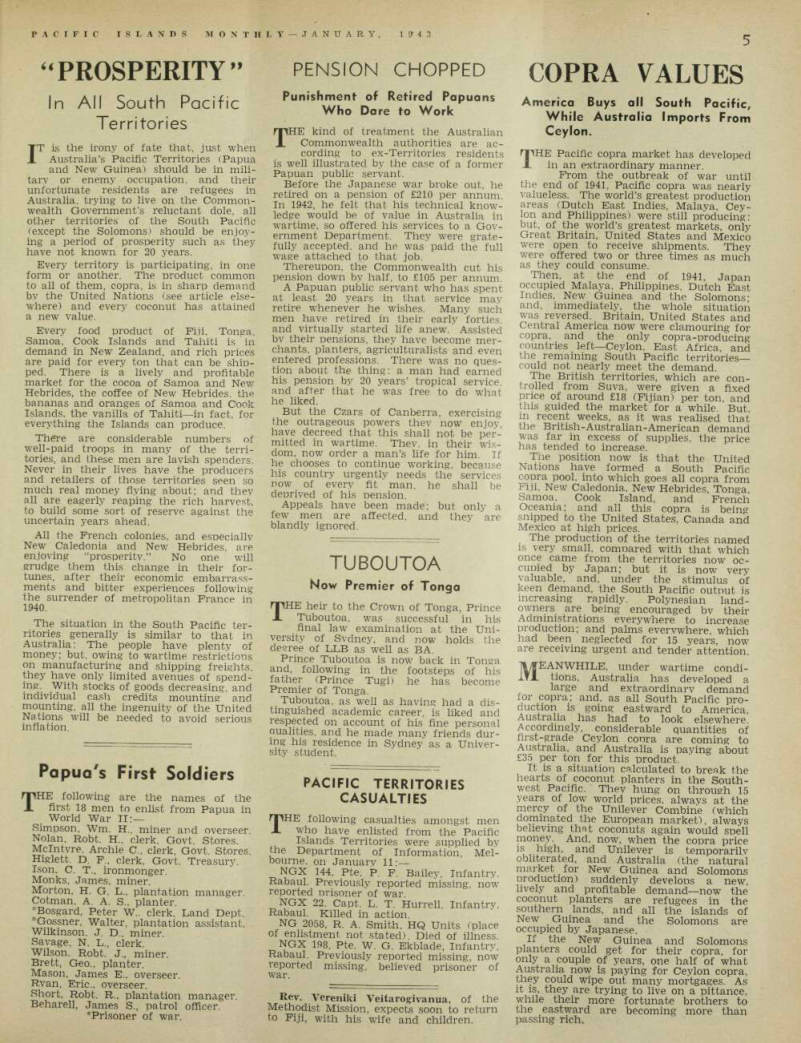
THE Pacific copra market has developed in an extraordinary manner.
From the outbreak of war until the end of 1941, Pacific copra was nearly valueless. The world’s greatest production areas (Dutch East Indies, Malaya, Cey lon and Philippines) were still producing: but, of the world’s greatest markets, only Great Britain, United States and Mexico were open to receive shipments. They were offered two or three times as much as they could consume.
Then, at the end of 1941, Japan occupied Malaya, Philippines, Dutch East Indies, New Guinea and the Solomons and, immediately, the whole situation was reversed. Britain, United States and Central America now were clamouring for copra, and the only copra-producing countries left—Ceylon, East Africa, and the remaining South Pacific territories— could not nearly meet the demand.
The British territories, which are con trolled from Suva, were given a fixed price of around £lB (Fijian) per ton, and this guided the market for a while. But in recent weeks, as it was realised that the British-Australian-American demand was far in excess of supplies, the price has tended to increase.
The position now is that the United Nations have formed a South Pacific copra pool, into which goes all copra from Fiji, New Caledonia, New Hebrides, Tonga.
Samoa, Cook Island, and French Oceania; and all this copra is being snipped to the United States, Canada and Mexico at high prices.
The production of the territories named is very small, comnared with that which once came from the territories now oc cunied by Japan; but it is now very valuable, and, under the stimulus of keen demand, the South Pacific outnut is increasing rapidly. Polynesian land owners are being encouraged bv their Administrations everywhere to increase production; and palms evervwhere, which had been neglected for 15 years, now are receiving urgent and tender attention.
MEANWHILE, under wartime condi tions, Australia has developed a large and extraordinarv demand for copra; and. as all South Pacific pro duction is going eastward to America, Australia has had to look elsewhere.
Accordingly, considerable quantities of first-grade Ceylon conra are coming to Australia, and Australia is paying about £35 per ton for this product.
It is a situation calculated to break the hearts of coconut planters in the South west Pacific. They hung on through 15 years of low world prices, always at the mercy of the Unilever Combine (which dominated the European market), always believing that coconuts again would spell money. And, now, when the copra price is high, and Unilever is temporarily obliterated, and Australia (the natural market for New Guinea and Solomons production) suddenly develops a new, lively and profitable demand—now the coconut planters are refugees in the southern lands, and all the islands of New Guinea and the Solomons are occupied by Japanese.
If the New Guinea and Solomons planters could get for their copra, for only a couple of years, one half of what Australia now is paying for Ceylon copra, they could wipe out many mortgages. As it is, they are trying to live on a pittance, while their more fortunate brothers to the eastward are becoming more than passing rich.