United NaUonfafter thewfr by
pp. 5-6 · Read in the full issue
When Should We Make Post-War Plans?
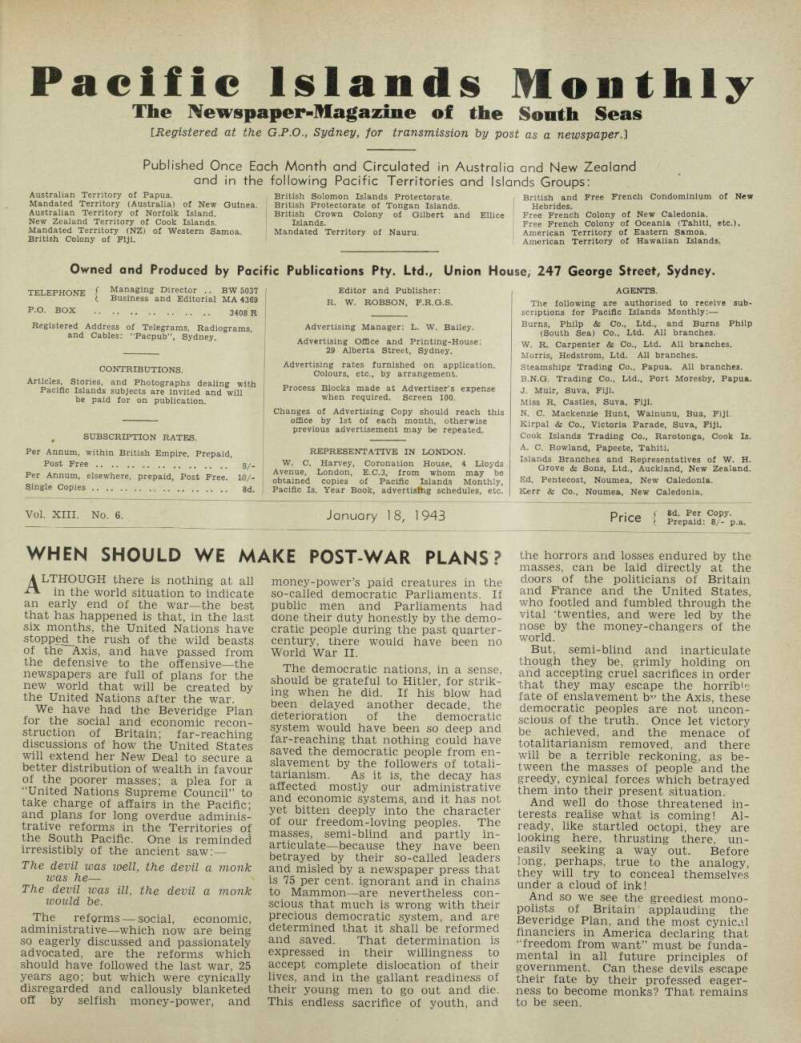
X LTHOUGH there is nothing at all in the world situation to indicate an early end of the war—the best that has happened is that, in the last six months, the United Nations have stopped the rush of the wild beasts of the Axis, and have passed from
neLpaperf
United NaUonfafter thewfr by
We have had the Plan for thrlocial and economic structinn nf Rritain- for Lonbinir discussions of how tho iirvitprffa
wfll extend her n!w 1 f
wealth°
Council*” to
take charge l of affairs in the PnHfip and plans f 0? long overdue admirds ’ to the Territories of the South Pacific One is remtoded irreslstibly of the ancient saw d6d irresisuDiy or tne ancient saw.— The devil was well, the devil a monk W 9 /S !} e — . , The devil was ill, the devil a monk would be.
The reforms social, economic, administrative—which now are being so eagerly discussed and passionately advocated, are the reforms which should have followed the last war, 25 years ago; but which were cynically disregarded and callously blanketed off by selfish money-power, and
money-power’s paid creatures in the so-called democratic Parliaments. If public men and Parliaments had done their duty honestly by the demo cratic people during the past quarter century, there would have been no World War 11.
The democratic nations, in a sense, should be grateful to Hitler, for strik ing when he did. If his blow had been delayed another decade, the deterioration of the democratic system would have been so deep and far-reaching that nothing could have saved the democratic people from en slavement by the followers of totali tarianism. As it is, the decay has affected mostly our administrative and economic systems, and it has not yet bitten deeply into the character of our freedom-loving peoples. The masses, semi-blind and partly in articulate —because they have been betrayed by their so-called leaders and misled by a newspaper press that is 75 per cent, ignorant and in chains to Mammon—are nevertheless con scious that much is wrong with their precious democratic system, and are determined that it shall be reformed and saved. That determination is expressed in their willingness to accept complete dislocation of their lives, and in the gallant readiness of their young men to go out and die.
This endless sacrifice of youth, and
the horrors and losses endured by the masses, can be laid directly at the doors of the politicians of Britain and France and the United States, who footled and fumbled through the vital ‘twenties, and were led by the nose by the money-changers of the world.
But, semi-blind and inarticulate though they be, grimly holding on and accepting cruel sacrifices in order that they may escape the horrib'e fate of enslavement b” the Axis, these democratic peoples are not uncon scious of the truth. Once let victory be achieved, and the menace of totalitarianism removed, and there will be a terrible reckoning, as be tween the masses of people and the greedy, cynical forces which betrayed them into their present situation.
And well do those threatened in terests realise what is coming! Al ready, like startled octopi, they are looking here, thrusting there, un easily seeking a way out. Before long, perhaps, true to the analogy, they will try to conceal themselves under a cloud of ink!
And so we see the greediest mono polists of Britain' applauding the Beveridge Plan, and the most cynical financiers in America declaring that “freedom from want” must be funda mental in all future principles of government. Can these devils escape their fate by their professed eager ness to become monks? That remains to be seen.
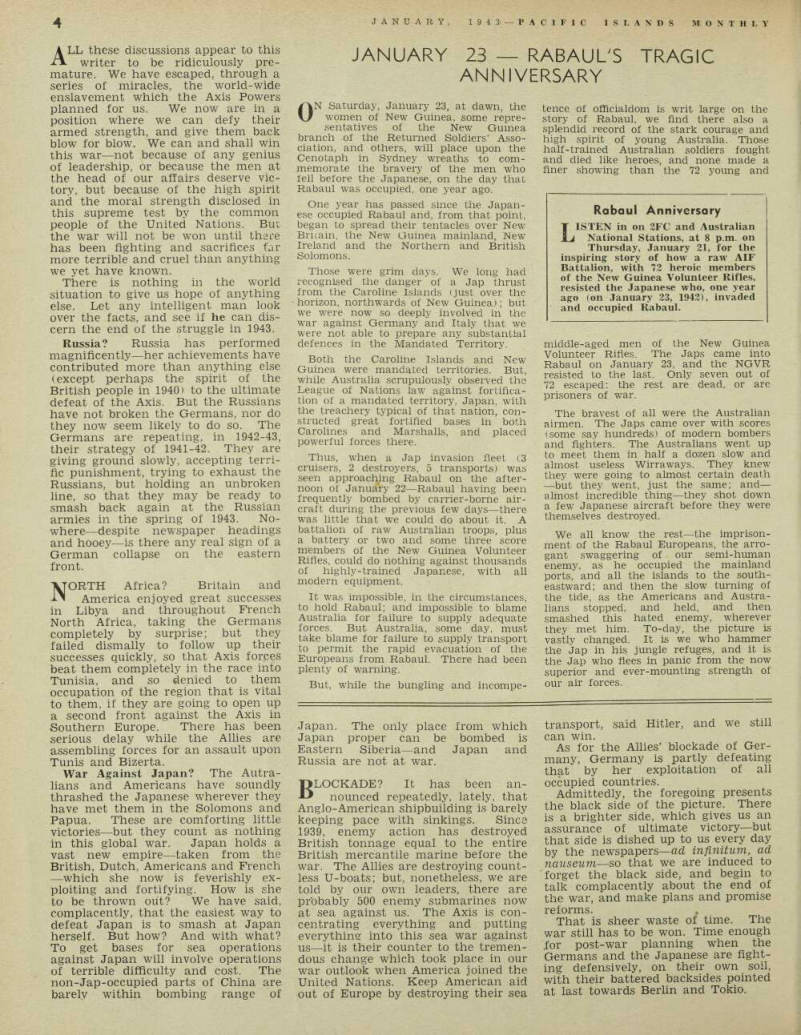
ALL these discussions appear to this writer to be ridiculously pre mature. We have escaped, through a series of miracles, the world-wide enslavement which the Axis Powers planned for us. We now are in a position where we can defy their armed strength, and give them back blow for blow. We can and shall win this war—not because of any genius of leadership, or because the men at the head of our affairs deserve vic tory, but because of the high spirit and the moral strength disclosed in this supreme test by the common people of the United Nations. But the war will not be won until there has been fighting and sacrifices far more terrible and cruel than anything we yet have known.
There is nothing in the world situation to give us hope of anything else. Let any intelligent man look over the facts, and see if he can dis cern the end of the struggle in 1943.
Russia? Russia has performed magnificently—her achievements have contributed more than anything else (except perhaps the spirit of the British people in 1940) to the ultimate defeat of the Axis. But the Russians have not broken the Germans, nor do they now seem likely to do so. The Germans are repeating, in 1942-43, their strategy of 1941-42. They are giving ground slowly, accepting terri fic punishment, trying to exhaust the Russians, but holding an unbroken line, so that they may be ready to smash back again at the Russian armies in the spring of 1943. No where—despite newspaper headings and hooey—is there any real sign of a German collapse on the eastern front.
NORTH Africa? Britain and America enjoyed great successes in Libya and throughout French North Africa, taking the Germans completely by surprise; but they failed dismally to follow up their successes quickly, so that Axis forces beat them completely in the race into Tunisia, and so denied to them occupation of the region that is vital to them, if they are going to open up a second front against the Axis in Southern Europe. There has been serious delay while the Allies are assembling forces for an assault upon Tunis and Bizerta.
War Against Japan? The Autra lians and Americans have soundly thrashed the Japanese wherever they have met them in the Solomons and Papua. These are comforting little victories—but they count as nothing in this global war. Japan holds a vast new empire—taken from the British, Dutch, Americans and French —which she now is feverishly ex ploiting and fortifying. How is she to be thrown out? We have said, complacently, that the easiest way to defeat Japan is to smash at Japan herself. But how? And with what?
To get bases for sea operations against Japan will involve operations of terrible difficulty and cost. The non-Jap-occupied parts of China are barely within bombing range of
Japan. The only place from which Japan proper can be bombed is Eastern Siberia—and Japan and Russia are not at war.
BLOCKADE? It has been an nounced repeatedly, lately, that Anglo-American shipbuilding is barely keeping pace with sinkings. Since 1939, enemy action has destroyed British tonnage equal to the entire British mercantile marine before the war. The Allies are destroying count less U-boats; but, nonetheless, we are told by our own leaders, there are pr'obably 500 enemy submarines now at sea against us. The Axis is con centrating everything and putting everything into this sea war against us—it is their counter to the tremen dous change which took place in our war outlook when America joined the United Nations. Keep American aid nut of Europe by destroying their sea
transport, said Hitler, and we still can win.
As for the Allies’ blockade of Ger many, Germany is partly defeating that by her exploitation of all occupied countries.
Admittedly, the foregoing presents the black side of the picture. There is a brighter side, which gives us an assurance of ultimate victory -but that side is dished up to us every day by the newspapers ad infinitum, ad nauseum —so that we are induced to forget the black side, and begin to talk complacently about the end of the war, and make plans and promise reforms. . .
That is sheer waste of time. The war still has to be won. Time enough for post-war planning when the Germans and the Japanese are fight ing defensively, on their own soil, with their battered backsides pointed at last towards Berlin and Tokio.