Loyalty
p. 21 · Read in the full issue
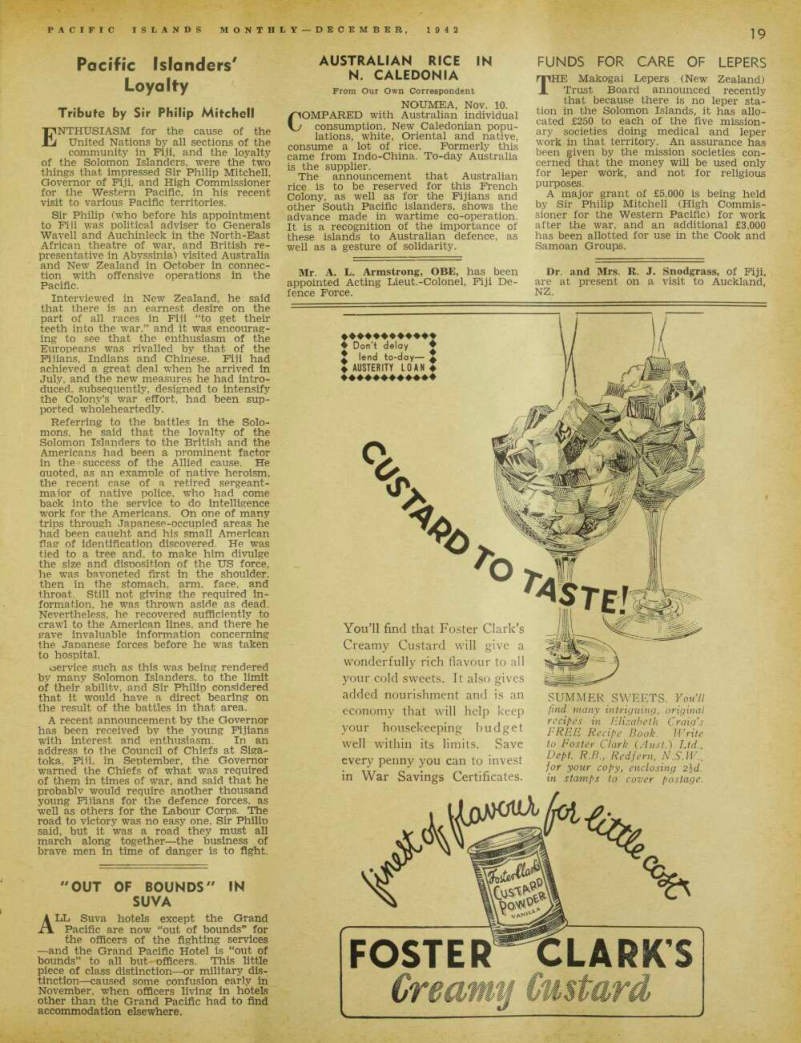
Pacific Islanders' Loyalty Tribute by Sir Philip Mitchell
Enthusiasm for the cause of the United Nations by all sections of the community in Fiji, and the loyalty of the Solomon Islanders, were the two things that impressed Sir Philip Mitchell, Governor of Fiji, and High Commissioner for the Western Pacific, in his recent visit to various Pacific territories.
Sir Philip (who before his appointment to Fiji was political adviser to Generals Wavell and Auchinleck in the North-East African theatre of war, and British re presentative in Abyssinia) visited Australia and New Zealand in October in connec tion with offensive operations in the Pacific.
Interviewed in New Zealand, he said that there is an earnest desire on the part of all races in Fiji “to get their teeth into the war,” and it was encourag ing to see that the enthusiasm of the Europeans was rivalled by that of the Fijians, Indians and Chinese. Fiji had achieved a great deal when he arrived in July, and the new measures he had intro duced. subsequently, designed to intensify the Colony’s war effort, had been sup ported wholeheartedly.
Referring to the battles in the Solo mons, he said that the loyalty of the Solomon Islanders to the British and the Americans had been a prominent factor in the success of the Allied cause. He Quoted, as an example of native heroism, the recent case of a retired sergeant maior of native police, who had come back into the service to do intelligence work for the Americans. On one of many trips through Japanese-occupied areas he had been caught and his small American flag of identification discovered. He was tied to a tree and, to make him divulge the size and disposition of the US force, he was bayoneted first in the shoulder, then in the stomach, arm, face, and throat. Still not giving the required in formation, he was thrown aside as dead.
Nevertheless, he recovered sufficiently to crawl to the American lines, and there he gave invaluable information concerning the Japanese forces before he was taken to hospital. oervice such as this was being rendered by many Solomon Islanders, to the limit of their ability, and Sir Philip considered that it would have a direct bearing on the result of the battles in that area.
A recent announcement by the Governor has been received by the young Fijians with interest and enthusiasm. In an address to the Council of Chiefs at Siga toka, Fiji, in September, the Governor warned the Chiefs of what was required of them in times of war, and said that he probablv would require another thousand young Fijians for the defence forces, as well as others for the Labour Corps. The road to victory was no easy one, Sir Philip said, but it was a road they must all march along together—the business of brave men in time of danger is to fight.